
Summary
Editor's rating
Value for money: strong training watch, but the price stings
Compact outdoor look without feeling like a brick
Battery life: good for training, a bit optimistic vs the marketing
Comfort and everyday wear: fine for 24/7, even on smaller wrists
Build quality and durability: feels solid, not indestructible
GPS, heart rate, and training tools: solid tracking with a few quirks
What the Polar Grit X2 actually offers in real life
Pros
- Compact and comfortable for an outdoor watch, suitable even for smaller wrists
- Dual-frequency GPS and offline maps work well for running and hiking
- Strong training and recovery tools (Running Power, Training Load Pro, HRV, Nightly Recharge, TrainingPeaks integration)
Cons
- Price feels high compared to competitors with similar core features
- Real-world battery life closer to 4–5 days than the advertised 7 with regular use
- Smartwatch features (notifications, apps, extras) are basic for the price

Specifications
View full product page →| Brand | Polar |
A serious training watch without the Garmin price tag (but not cheap either)
I’ve been wearing the Polar Grit X2 daily for a few weeks, mainly for running, hiking, and some strength sessions. Before this, I used a Garmin Forerunner and briefly tried a Fenix, so I’m not new to sports watches. I picked the Grit X2 because I wanted strong GPS, decent maps, and proper training/recovery data without going all-in on Garmin prices. On paper, this watch ticks most of those boxes: AMOLED, dual-frequency GPS, offline maps, wrist ECG, SpO2, HRV, TrainingPeaks, Strava, the whole package.
In practice, it behaves like a serious training tool first and a smartwatch second. If you’re expecting an Apple Watch level of smart features, this is not it. But if you mainly care about tracking runs, hikes, and sleep, and you like data, it’s much more interesting. The Polar Flow app and the whole training ecosystem are clearly built for people who actually train, not just count steps.
What surprised me most was how compact it feels. On paper 45 mm doesn’t sound tiny, but on the wrist it’s lighter and less bulky than most outdoor watches I’ve tried. That matters if you wear it 24/7 for sleep tracking and recovery. The AMOLED screen is bright, readable outdoors, and finally makes old Polar screens look dated.
It’s not perfect though. The price is high for what it does, battery life is good but not mind-blowing, and the general smart features are pretty basic. If you’re okay with that and you mainly care about training metrics and navigation, it’s a pretty solid option. If you want a flashy smartwatch, you’ll probably find it a bit boring and expensive.
Value for money: strong training watch, but the price stings
This is where things get a bit tricky. The Grit X2 is not a budget watch. You’re paying a serious amount for the Polar name, the AMOLED screen, the sensors, and the maps. One Amazon reviewer straight up said it feels a bit overpriced because it doesn’t offer much more than other brands, and I get that point. When you compare it to something like a Garmin Forerunner or even some cheaper outdoor watches, the price difference can be hard to justify if you’re just looking at basic GPS and heart rate.
Where the value makes more sense is if you actually use the training tools and recovery features regularly: Training Load Pro, Running Power, HRV, Nightly Recharge, TrainingPeaks syncing, Strava support, plus the dual-frequency GPS and offline maps. If you’re the kind of person who trains several times a week and likes data, this package starts to feel more reasonable. The fact that you also get sapphire glass and a more compact form factor compared to some bulkier outdoor watches helps too.
On the other hand, if you mainly want notifications, step counting, and the occasional run, this is probably overkill. Cheaper watches or even a mid-range Garmin or Fitbit will cover your needs for less money. Also, the battery life is good but not mind-blowing, and the smartwatch features are basic, so you’re clearly paying for the training and outdoor focus, not for a fully loaded smartwatch experience.
So in plain terms: good value if you’re an active user who will actually use the maps, dual-frequency GPS, and training ecosystem. Mediocre value if you just want a general-purpose smartwatch or casual fitness tracker. If you’re already deep into Polar Flow and TrainingPeaks, it makes more sense. If you’re new and price-sensitive, I’d at least compare it seriously to what Garmin and Coros offer around the same budget before deciding.
Compact outdoor look without feeling like a brick
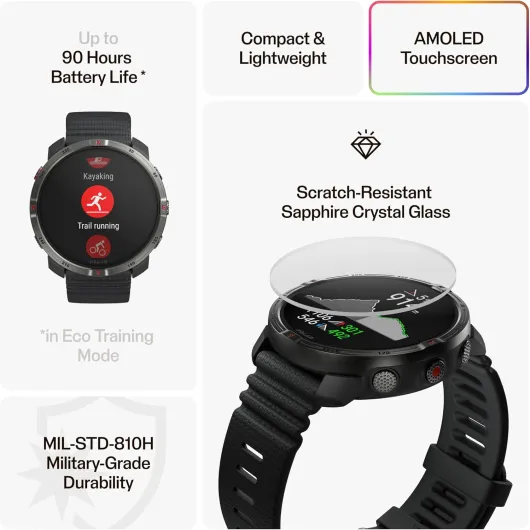
The first thing I noticed when I strapped the Grit X2 on was the size and weight. It’s 45 mm across and about 12 mm thick, and weighs 62 g. On paper that still sounds like a chunky watch, but on the wrist it feels lighter and less bulky than most outdoor models I’ve tried. Compared to a Garmin Fenix, it definitely feels less like wearing a manhole cover. If you have smaller wrists, this matters a lot; it doesn’t flop around or feel like it’s going to catch on every jacket sleeve.
The overall design is pretty straightforward: round case, stainless-steel bezel, sapphire glass, silicone band with a normal buckle. It looks more like a solid sports watch than a fashion accessory. I wore it at the office and it didn’t scream “hardcore ultra runner”, but it’s clearly more sporty than dressy. The black version is low key, which I like. No shiny chrome, no fake luxury vibe, just a practical outdoor style.
The AMOLED screen at 1.28 inches is bright and easy to read, even in direct sunlight with the brightness set to medium. The resolution listed (240 x 135) looks odd on paper, but in reality the screen is sharp enough that I never thought about pixels. Text and data fields are clear, and maps are perfectly readable. The always-on display option is handy for workouts, but it does hit the battery a bit more, so I left it on only during training days.
Button layout is standard Polar: three buttons on one side, two on the other, plus the touchscreen. I ended up using buttons more during workouts because they’re more reliable with sweat or rain, but the touchscreen is handy in menus and maps. Nothing on the design feels fancy, but it all feels thought-through and practical, which is what you want in an outdoor watch. If you’re into flashy bezels and crazy colors, this one will probably feel a bit too plain; if you like “just works and doesn’t shout”, it’s a good fit.
Battery life: good for training, a bit optimistic vs the marketing
Polar claims up to 7 days of battery life, which, like most brands, is under ideal conditions: limited always-on display, not too many notifications, moderate GPS use. In real life, with daily workouts and the AMOLED screen, I didn’t reach 7 days. I was more in the 4–5 day range, which actually lines up with one Amazon review saying about 4 days max. For me, that’s still totally acceptable for a watch with a bright AMOLED and dual-frequency GPS.
On days with a 1-hour GPS run and general daily use (notifications, occasional map check, always-on disabled), I saw around 15–20% battery drop. On a long hike with maps and GPS on for several hours, the battery drained faster but still comfortably got me through the day with plenty left. If you’re planning multi-day hikes without charging, you’ll need to be a bit more careful with settings (screen brightness, GPS mode, etc.), but for typical weekend adventures it’s fine.
Charging is done via the Polar Charge 2.0 USB-C cable. It clips on securely and doesn’t feel like it’s going to fall off if you move the watch a bit on the desk. From low battery to full, it took me roughly an hour and a bit, which is fast enough that I usually just topped it up when I showered or sat at the computer. One user mentioned charging while showering and that’s exactly how I ended up using it – small top-ups instead of running it completely flat.
If you’re coming from an older transflective-screen watch that easily did 10–14 days, the Grit X2 will feel like a small downgrade in battery life. If you’re coming from an Apple Watch or Wear OS watch that barely lasts 1–2 days, this will feel like a relief. So it sits in the middle: good battery for an AMOLED sports watch, not class-leading, but definitely good enough for regular training and 24/7 wear if you don’t mind charging twice a week.
Comfort and everyday wear: fine for 24/7, even on smaller wrists
Comfort-wise, the Grit X2 is better than I expected for an outdoor watch. At 62 g, it’s not ultra-light like a plastic Forerunner, but it’s light enough that I forgot it was there most of the time. The 22 mm silicone band is soft, flexible, and didn’t rub or cause hot spots, even on long sweaty runs. I wore it 24/7 for sleep tracking and only took it off for charging or showers when I felt like giving my skin a break.
I have fairly average wrists, and the watch sits flat without wobbling. The case back doesn’t dig in, and the sensor area is smooth. On smaller wrists, I think it still works because the lugs aren’t too long and the overall footprint is more compact than the Pro or big Garmin models. One Amazon reviewer mentioned it looking good on a smaller wrist, and I’d agree – it doesn’t look absurdly big.
For sleep tracking, comfort is always the real test. I usually hate sleeping with heavy watches, but this one was okay. I could feel it, but it didn’t bother me enough to consider taking it off. The band holes are close enough together that you can fine-tune the fit to keep the optical sensor stable without cutting off circulation. That’s important if you want decent heart rate and SpO2 data at night. I only had to adjust it once or twice if it slid a bit during the day.
The only minor comfort downside is that, like most larger watches, it can still knock into door frames or desk edges if you’re clumsy. One user mentioned knocking it a few times and the screen holding up, which matches my experience – a couple of knocks, no marks. But if you’re used to small slim watches, there’s a short adjustment period. Overall, for a rugged GPS watch, comfort is pretty solid and I had no real complaints wearing it all day and night.
Build quality and durability: feels solid, not indestructible
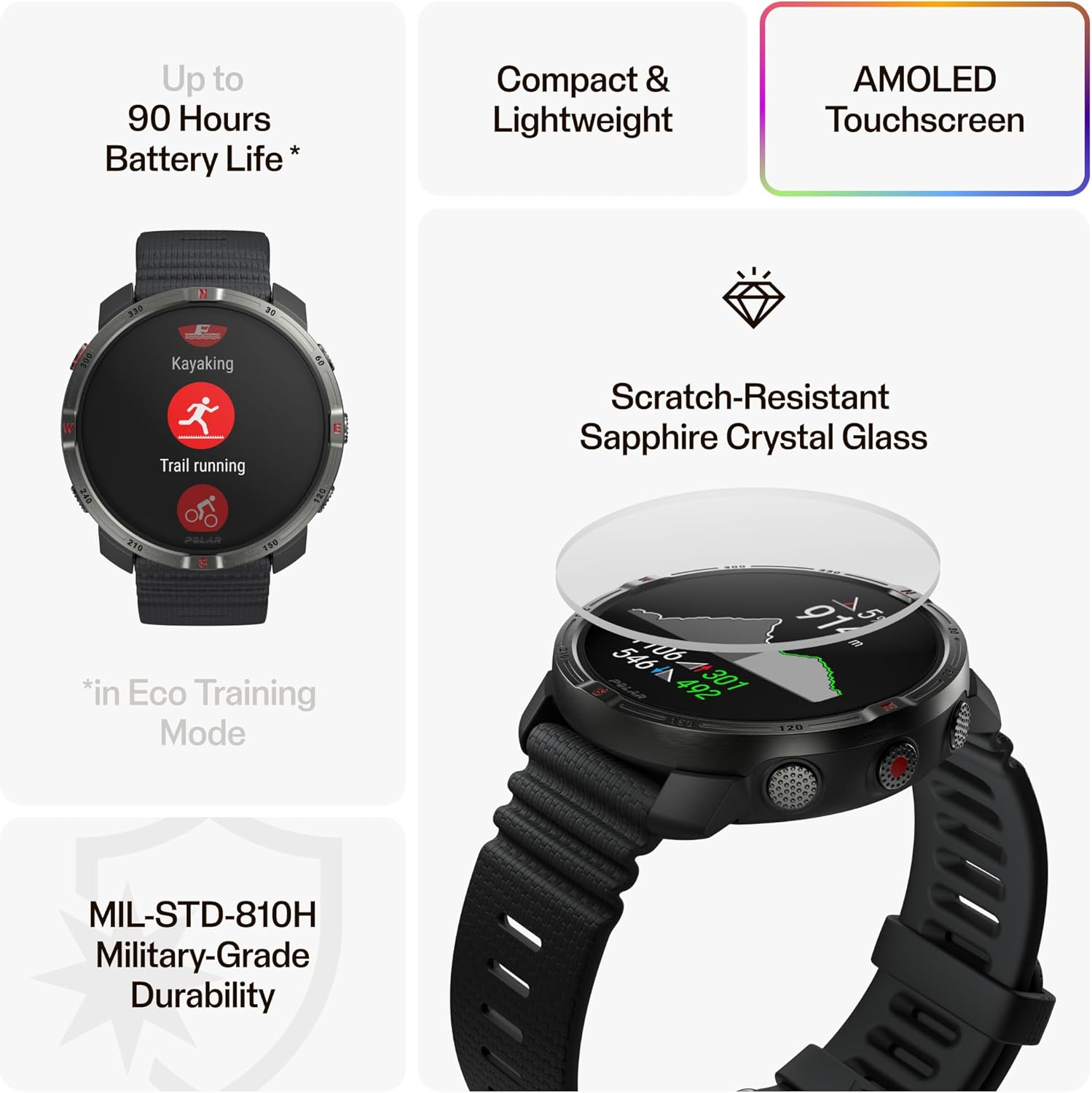
The Grit X2 is marketed as an outdoor watch with MIL-STD 810H durability, sapphire glass, and a stainless-steel bezel. In the hand and on the wrist, it does feel solid. The sapphire glass is the big one for me: I’ve knocked it against door frames, metal gym equipment, and rock edges on a hike, and so far there are no scratches on the screen. One Amazon reviewer also mentioned knocking it a few times with no damage, which makes sense with sapphire.
The steel bezel has held up fine so far, no big dings or chips, just a couple of tiny marks you only see if you look closely. The case itself is plastic, but it doesn’t feel cheap. It’s more like the typical tough plastic you find on most high-end sports watches. I wore it in the rain, in the shower a few times, and during sweaty workouts; no fogging, no weird condensation under the glass, no issues with buttons or touchscreen afterwards. Water resistance is enough for swimming, though I didn’t do long swim tests with it.
The band is a standard 22 mm silicone strap with a tang buckle. It feels sturdy and didn’t show any wear after a few weeks, but like all silicone bands, it can collect sweat and dust. A quick rinse fixes that. The good news is that it uses a standard width, so if you hate the stock band, you can easily swap it for another 22 mm strap. The pin system is straightforward and doesn’t feel like it’s going to fail.
Long-term durability is hard to judge after only a few weeks, but based on the materials (sapphire + steel) and the way it’s held up to bumps so far, I’m not worried. It feels more durable than cheaper plastic watches, obviously, and roughly in line with other rugged outdoor models. It’s not a tank you can throw off a cliff, but for normal outdoor use – trail running, hiking, gym, daily wear – it feels more than up to the task.
GPS, heart rate, and training tools: solid tracking with a few quirks
On performance, this is where the Grit X2 feels most at home. The dual-frequency GPS locks on quickly, usually within a few seconds, and I never had a run where it lost signal completely. I compared a few runs with old Garmin tracks on similar routes: in open areas the paths overlap nicely, in wooded areas the Polar track often looked a bit smoother and less jumpy. For trail running and hiking, that’s exactly what you want. Pace and distance felt consistent and matched what I’d expect from those routes.
The optical heart rate sensor is, like all wrist sensors, not perfect, but it’s decent. On steady runs and hikes, it matched pretty closely with a chest strap I used on a couple of tests (within a few bpm most of the time). During interval sessions or sudden sprints, it lagged a bit or smoothed spikes, which is normal for wrist HR. If you’re really picky about HR data, I’d still pair a chest strap. One Amazon reviewer said it’s consistent and provides quality data, and I’d say that’s fair for wrist-based HR.
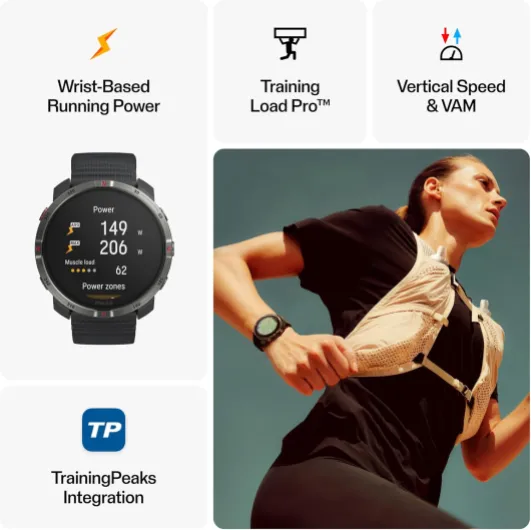
The training tools are where Polar shows its experience. Running Power from the wrist, Training Load Pro, Vertical Speed, and all the recovery metrics give you a good picture of how hard you’re pushing and how much rest you need. Nightly Recharge and HRV data were quite useful: on days when the watch said my recovery was poor, I usually did feel more tired. It’s not magic, but it’s a decent guide to avoid overdoing it. Syncing structured workouts from TrainingPeaks worked well, no weird bugs or missed sessions.
Daily tracking (steps, calories, basic activity) is fine but nothing special. One reviewer mentioned calorie counting being accurate, and I’d say it lined up with what I’d expect based on my usual numbers. Notifications are okay but basic; sometimes the “time to stand up” or activity reminders can be annoying, and one user even said they came back after being turned off, which I also noticed once after a firmware update. So as a pure performance and training tool, it’s strong. As a polished smartwatch experience, it’s more on the “good enough” side.
What the Polar Grit X2 actually offers in real life
On paper, the Polar Grit X2 sounds like a small tank full of sensors: dual-frequency GPS, offline color maps, wrist ECG, SpO2, HRV, skin temperature, barometer, compass, gyroscope, and accelerometer. In day-to-day use, the main things I actually touch are: GPS for outdoor workouts, heart rate and HRV for training and recovery, sleep tracking, and maps for hikes. The rest (like skin temperature) is nice to have, but it doesn’t change my life.
During workouts, you get the usual Polar tools: Running Power on the wrist, Training Load Pro, and the recovery features like Nightly Recharge. I used TrainingPeaks to sync a few interval workouts and it worked smoothly: the watch buzzes, shows the target zone, and guides you through the steps without you fiddling with buttons. For structured training, this is actually practical and not just a bullet point on the box.
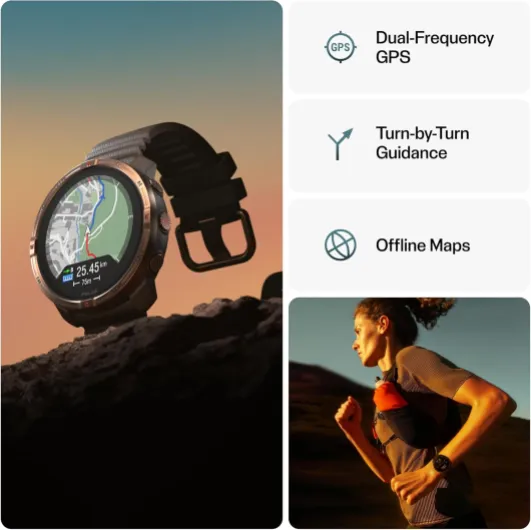
Navigation-wise, you can load offline maps and follow routes with turn-by-turn guidance via Komoot. I used it on a couple of trail runs and a long hike. It’s not as fancy as a phone map, but it’s good enough to stop you from getting lost. The dual-frequency GPS locked on quickly and stayed stable even in tree cover. I compared a few tracks to my old Garmin data and the lines were at least as clean, sometimes better in wooded areas.
As a “smartwatch”, it’s basic: notifications, alarms, timers, watch faces, that’s about it. No full app store, no contactless payments, no deep music features. If you want a training watch that does a bit of smartwatch stuff on the side, that’s fine. If you want a mini smartphone on your wrist, this isn’t the right product. So overall, it’s clearly aimed at people who train regularly and care more about metrics and guidance than about Instagram on the wrist.
Pros
- Compact and comfortable for an outdoor watch, suitable even for smaller wrists
- Dual-frequency GPS and offline maps work well for running and hiking
- Strong training and recovery tools (Running Power, Training Load Pro, HRV, Nightly Recharge, TrainingPeaks integration)
Cons
- Price feels high compared to competitors with similar core features
- Real-world battery life closer to 4–5 days than the advertised 7 with regular use
- Smartwatch features (notifications, apps, extras) are basic for the price
Conclusion
Editor's rating
Overall, the Polar Grit X2 is a solid outdoor and training watch that focuses on the essentials: accurate GPS, useful training metrics, recovery insights, and decent maps. It’s compact and light enough to wear all day, the AMOLED screen is easy to read in any light, and the sapphire glass plus steel bezel give it a reassuring, durable feel. The Polar Flow ecosystem, Training Load Pro, Running Power, and TrainingPeaks integration make it interesting for people who actually train regularly and want more than just basic step counts.
On the downside, the price is high and the battery life, while good, doesn’t fully match the marketing numbers for heavy users – expect more like 4–5 days than a full week if you train often and keep the screen reasonably bright. Smartwatch features are basic compared to Apple or Samsung, and even some Garmin models feel more complete on that front. A few small annoyances like recurring stand-up notifications or slightly laggy wrist HR on intervals are there, but nothing that breaks the experience.
If you’re an outdoorsy runner, hiker, or multisport user who wants strong training and recovery tools in a slightly smaller, comfortable package and you don’t want to jump into the Garmin Fenix pricing, the Grit X2 is a pretty solid pick. If you mainly want smartwatch features, flashy apps, or the absolute best value per dollar, you should probably look elsewhere or drop to a cheaper model. It’s a good training partner, just not a bargain.