
Summary
Editor's rating
Value for money: good if you accept the quirks
Looks more expensive than it is, but still feels budget
Battery life: honest 4–6 days with everything on
Comfort is okay… unless you wear it tight all day
Calls, notifications, Alexa… and the annoying late-night calls
What you actually get and setup experience
Health tracking and sports: decent for casual use, not for data nerds
Pros
- Good set of features for the price: calls, Alexa, health tracking, 100+ sport modes
- Battery life of around 4–6 days with normal use
- Screen is clear and readable, and overall design looks decent on the wrist
Cons
- Risk of accidental calls, especially at night, can be really annoying
- Health and sport metrics are rough estimates, not suitable for serious training
- App is basic and sometimes needs manual opening to sync properly

Specifications
View full product page →| Brand | Fitpolo |
A budget smartwatch that tries to do everything
I’ve been using this Fitpolo IDW19 smartwatch (the 1.8" pink one) for a little over two weeks, paired with an Android phone. I bought it mainly to track steps, sleep, and get call notifications without spending Apple or Samsung money. On paper it’s packed: Alexa, Bluetooth calls, 100+ sport modes, heart rate, SpO2, sleep tracking, IP68, the whole lot. The question is: does it actually hold up in daily life, or is it just spec-sheet bait?
In everyday use, it feels like a budget watch that gets most basics right, with a few annoying quirks you need to know about. Some things are better than I expected for the price, like the screen and battery. Other things feel half-baked, especially around calls and notifications. If you’re thinking of using it at night or in meetings, that part matters a lot.
I’ll go through how it behaved for me: setup, design, comfort, tracking, calls, Alexa, and battery. I’ll also mention a couple of issues that match what I saw in other reviews, like accidental calls in the middle of the night. This isn’t a lab test, just normal daily use: work, walks, light workouts, shower, sleep.
Overall, I’d say it’s good value if you know its limits and you’re not too picky about perfect accuracy or super-polished software. If you’re expecting an Apple Watch clone for a fraction of the price, it’s not that. It’s more like: “does most things decently, with some rough edges you’ll either accept or hate”.
Value for money: good if you accept the quirks
For the price bracket this Fitpolo sits in, you get quite a lot on paper: big screen, Alexa, Bluetooth calls, 100+ sport modes, health tracking, and IP68 water resistance. In practice, most of it works well enough for everyday users. That’s why I’d say the value is pretty good, as long as you’re not expecting premium polish.
Where the value shows is in things like: the screen is readable and fairly sharp, battery life is solid, and the basic tracking (steps, sleep, casual workouts) is on the level of many other budget brands. If you mainly want a watch that counts steps, shows notifications, and lets you answer a call here and there, it gets the job done without costing as much as the big names.
On the downside, you do pay for some features that are a bit rough. The accidental call issue is not just a minor bug; it can be seriously annoying if it wakes people up or embarrasses you in quiet settings. The app is usable but not as clean or detailed as something from Fitbit or Garmin. And the health data is more “ballpark estimate” than “trustworthy metric”, which is normal at this price but still worth pointing out.
Compared to other cheap smartwatches I’ve tried (random Amazon brands), this Fitpolo feels a bit more thought-out and supported, with a better-known app (VeryFit) and a decent community of users. So if you catch it at a discount, it’s good value for money. At full price, it’s still okay, but you might want to compare with Amazfit or Huawei if you care more about app quality and slightly better refinement.
Looks more expensive than it is, but still feels budget
Design-wise, the watch is pretty solid for the price. The 1.8" screen is big enough to read notifications without squinting, and the square/octagonal shape looks a bit like generic Apple Watch clones. The pink version I have is more of a soft rose pink, not neon, so it doesn’t scream toy. On the wrist, it looks fine for everyday wear, office, or gym. No one asked me if it was a premium brand, but no one laughed at it either.
The bezels around the screen are there but not ridiculous. With darker watch faces, they blend in and you don’t notice them much. With bright or white faces, you can clearly see the black border. The screen is LCD, not OLED, so blacks are more dark grey than true black. Still, brightness is good enough to see outdoors in daylight if you push it to higher levels. Indoors at medium brightness is fine and doesn’t kill the battery too fast.
There’s one side button that wakes the screen and opens the menu. The rest is all touch navigation: swipe down for quick settings, up for notifications, left/right for widgets (steps, heart rate, weather, etc.). The touch response is okay, sometimes a tiny bit laggy, but nothing crazy. For this price range, I expected worse. Occasionally I had to swipe twice to get it to register, but it wasn’t a daily headache.
If you compare it to something like a cheap Amazfit or older Huawei Band, this Fitpolo sits in the same league: looks decent, feels a bit plasticky if you pay attention, but passable on the wrist. It doesn’t feel premium, but it also doesn’t feel like a kid’s toy. For a budget smartwatch, the overall design is acceptable and neutral enough to fit most outfits, especially in this pink color.
Battery life: honest 4–6 days with everything on
The battery is one of the strong points. The spec says 300–350 mAh and 5–8 days, and in real life I got about 4–6 days depending on how hard I pushed it. With always-on heart rate, sleep tracking, notifications on, and some workouts, I was charging it roughly twice a week. That’s acceptable and better than a lot of big-brand watches that need daily or every-other-day charging.
On a lighter week where I turned off 24/7 SpO2 and didn’t use call functions much, I got close to 6 days. On a heavier week with more calls and screen brightness higher, it was more like 4 days. So the marketing isn’t completely off, just a bit optimistic as usual. The good thing is that battery drain feels predictable: no random 20% drops, just a steady few percent every few hours.
Charging is via a magnetic cable that snaps onto the back. It’s not the strongest magnet in the world, but it holds as long as the watch is lying flat. A full charge took around 2 hours for me, going from about 15% to 100%. I usually just plugged it in while working at the desk or during a shower and a bit of downtime, and that was enough to top it up significantly.
So if you hate babysitting your watch, this one is pretty low maintenance. It’s not a two-week monster like some basic fitness bands, but considering it handles calls, a biggish screen, and constant tracking, 4–6 days is decent. You just need to remember a couple of charge sessions per week, which is manageable.
Comfort is okay… unless you wear it tight all day
Comfort is a bit mixed. The strap is a standard silicone band with a buckle. It’s soft enough and didn’t irritate my skin, even when I got a bit sweaty during walks or light workouts. The watch itself isn’t heavy. On the wrist, you notice it at first, but after a day or two you get used to it. It’s not bulky like some big sports watches.
Where it gets tricky is how tight you have to wear it for the sensors to work properly. If you wear it loose like a metal bracelet, the heart rate and SpO2 readings jump around or fail. So you’re basically forced to keep it a bit snug. After 8–10 hours like that, I started to feel the back sensor area pressing into my skin, especially when typing at a desk. Not painful, just a bit annoying. I found myself loosening it when I didn’t care about tracking, then tightening again for workouts or walks.
Sleeping with it is hit or miss. It’s light enough to sleep with, but you do feel it if you’re not used to watches in bed. I tried three nights in a row. The first two nights were fine, but by the third night I got tired of having it pressed on my wrist and the occasional screen lighting up when I moved. Also, because of the accidental call issue (I’ll get to that), I eventually stopped wearing it at night with Bluetooth fully connected, which kind of defeats the purpose of sleep tracking plus call functions at the same time.
So in practice: if you’re used to wearing watches and don’t mind a slightly snug strap, you’ll be okay. If you like loose metal bands or barely-there fitness bands, this will feel a bit more intrusive. I’d rate comfort as decent but not great, especially for long, tight wear 24/7.
Calls, notifications, Alexa… and the annoying late-night calls
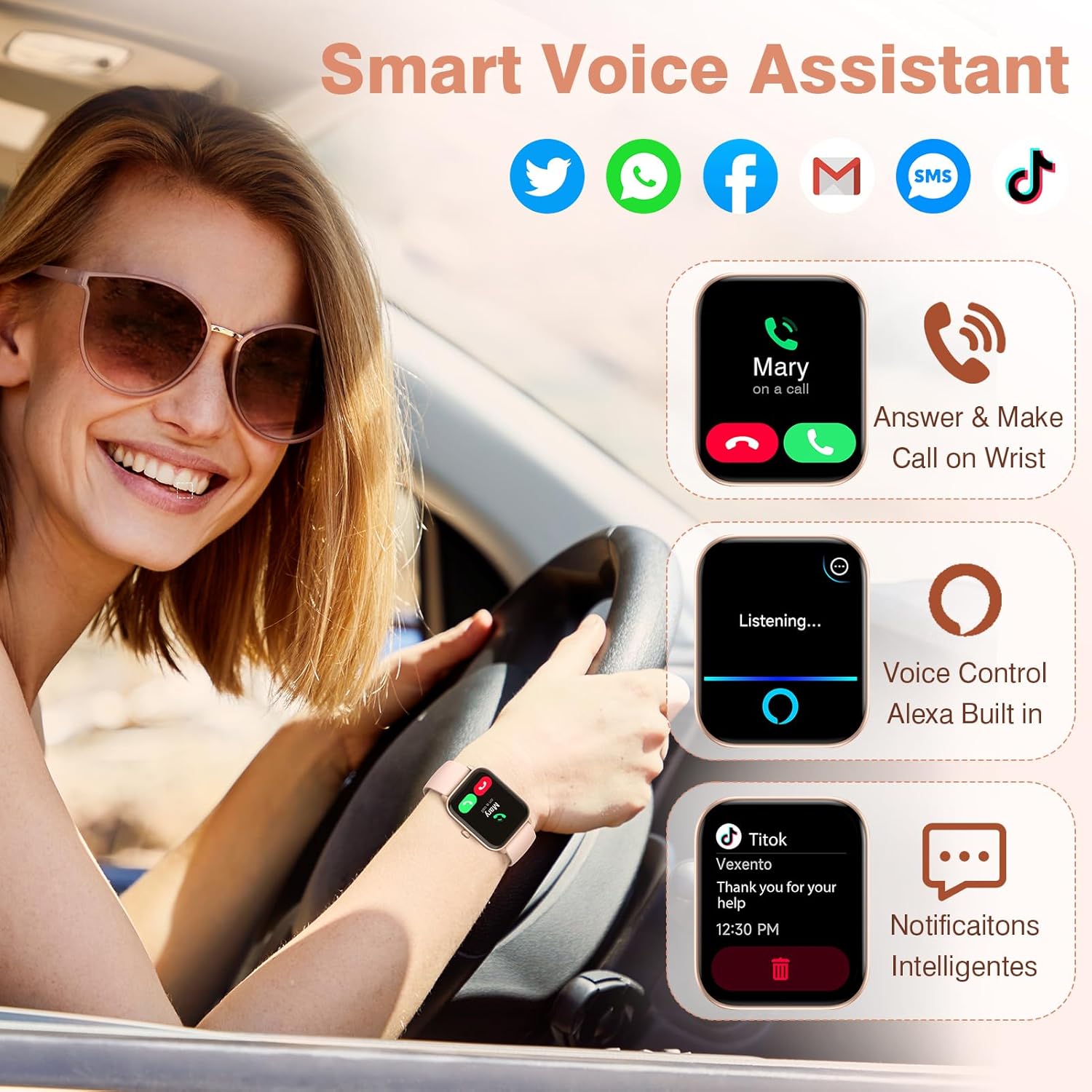
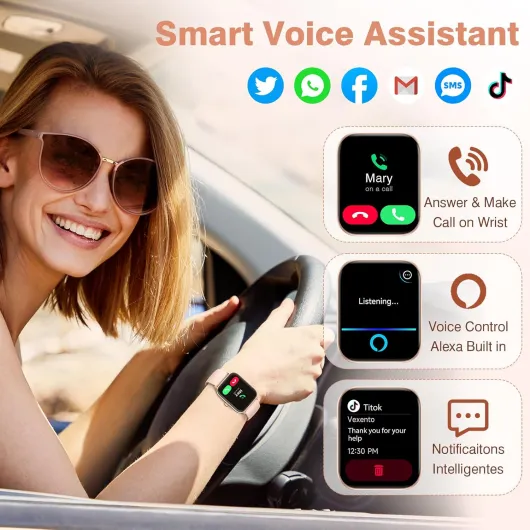
This is where the watch is both interesting and slightly annoying. Let’s start with the good: notifications and calls work, and for a cheap watch, that’s not nothing. You can receive calls on your wrist, answer, and talk through the built-in speaker and mic. The sound is clear enough indoors; outdoors you need to bring the watch closer to your mouth, but it still works. For quick calls when your phone is in your bag, it’s handy.
Notifications from WhatsApp, SMS, email, etc. come through reliably once you’ve given the app all the permissions. You can’t really reply from the watch (at least not in any meaningful way), but you can see who’s messaging and read short texts. For me, this is enough: I mainly want to know if I should grab my phone or ignore it. Vibration is strong enough that I didn’t miss alerts.
Now the problem: accidental calls. This matches other reviews. If you wear the watch at night or when you move a lot, it’s pretty easy to trigger the call function by mistake. One night I apparently pressed the screen in my sleep and ended up calling a contact at a stupid hour. Another time I brushed the screen while getting dressed and almost dialed someone again. There is a Do Not Disturb mode, but it didn’t fully stop the risk when the Bluetooth call connection was active. The only 100% safe way I found was to disable the call Bluetooth profile or cut the connection at night, which kind of kills the convenience.
Alexa is a nice extra but not life-changing. You press and hold, speak to the watch, and it sends the request through your phone. It works for basic stuff like asking the weather, setting timers, or quick questions. Response time is okay, but you do need your phone nearby and connected. It’s more of a fun bonus than a core feature. Overall, performance is decent for the price, but the accidental-call behavior is a real downside if you plan to sleep with it or wear it constantly.
What you actually get and setup experience
Out of the box, you get the watch, a magnetic charging cable, and a small manual. That’s it. No extra straps, no fancy stand, just the basics. The watch itself comes with a protective film on the screen. The manual is short but usable; I barely looked at it because most of the setup is done through the VeryFit app. You have to install that on your phone (Android or iOS), create an account, and then pair the watch via Bluetooth. It took me about 10 minutes from opening the box to having the time, steps, and notifications working.
One thing to know: there are effectively two Bluetooth connections. One low-energy one for syncing health data and notifications, and another for calls/audio. If you want to make and receive calls from the watch, you need to allow the second connection and give the app a bunch of permissions (contacts, calls, notifications). It’s normal for smartwatches, but if you’re privacy-sensitive, you might not like that. Also, if you mess with those permissions later, some functions randomly stop working until you reconnect.
The watch faces are handled through the app. There are lots of them, but many look pretty generic. Still, you can find a few clean ones that show time, steps, heart rate, and battery. You can also set a custom photo, which works, but the layout is pretty basic. Syncing a new face takes 10–20 seconds. Not a big deal, but it’s not instant either.
In daily syncing, VeryFit is… fine. It connects automatically most of the time, but once every couple of days I had to open the app manually to force a sync. Data then shows up in the app with basic graphs for steps, heart rate, sleep, and workouts. It’s not as polished as Fitbit or Garmin, but you can still see trends and daily stats. For the price, the app is acceptable, but don’t expect super detailed analysis or deep customization.
Health tracking and sports: decent for casual use, not for data nerds
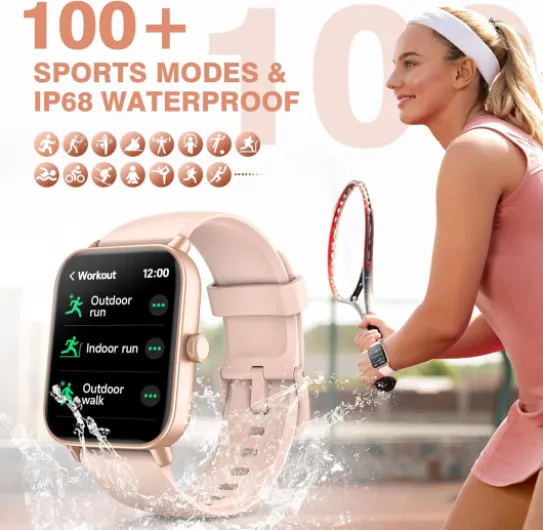
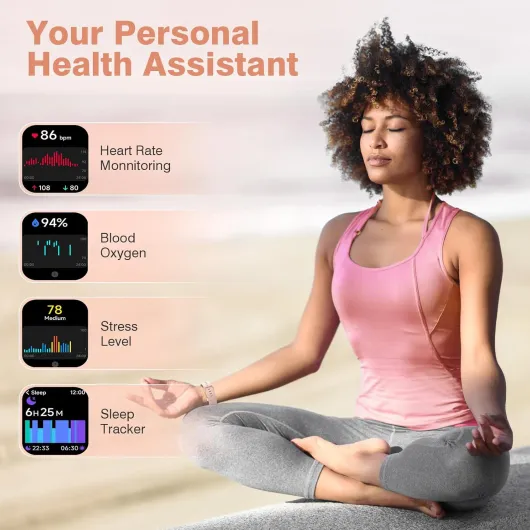
On the health side, the watch tracks heart rate, SpO2, sleep, steps, calories, stress, and it has female cycle reminders. There are 100+ sport modes, but realistically you’ll probably use 5–10 of them: walking, running, cycling, maybe swimming, yoga, and some generic gym stuff. I mostly used walking, running, and a couple of indoor workouts.
Steps seemed reasonably accurate. Compared with my phone in my pocket, the daily totals were usually within 5–10% difference. For casual step tracking, that’s fine. Heart rate during steady walking or light jogging looked believable, but during short intense bursts it lagged or gave weird spikes. This is normal for cheap wrist sensors. If you’re just checking roughly how hard you’re working, it’s good enough. If you’re training by heart rate zones seriously, I wouldn’t trust it blindly.
Sleep tracking is basic but useful. It splits the night into light, deep, and awake periods. It usually caught my bedtime and wake-up times within about 10–20 minutes, which is acceptable for this price. The breakdown (how much deep sleep, etc.) I take with a big grain of salt. It’s more of a rough idea than scientific data. Still, it was nice to see a weekly pattern: shorter nights during the week, longer on weekends. That’s about as far as I’d use it.
The sports modes mostly just change which metrics are highlighted (distance, calories, heart rate), but in the end they all use the same sensors. There’s no built-in GPS; it uses your phone’s GPS if you bring your phone, which works okay. For casual fitness, the watch does the job: logs sessions, shows a summary, syncs to the app. If you’re a serious runner or cyclist who cares about precise pace and heart rate curves, this isn’t the tool. For normal people who just want to move more and see some numbers, it’s perfectly serviceable.
Pros
- Good set of features for the price: calls, Alexa, health tracking, 100+ sport modes
- Battery life of around 4–6 days with normal use
- Screen is clear and readable, and overall design looks decent on the wrist
Cons
- Risk of accidental calls, especially at night, can be really annoying
- Health and sport metrics are rough estimates, not suitable for serious training
- App is basic and sometimes needs manual opening to sync properly
Conclusion
Editor's rating
Overall, the Fitpolo IDW19 is a solid budget smartwatch that covers the basics well: step tracking, simple workouts, sleep overview, notifications, and even Bluetooth calls and Alexa. The screen is decent, the battery easily lasts several days, and the design looks fine on the wrist, especially for the price. For someone who just wants a simple all-in-one gadget without spending a lot, it makes sense.
It’s not perfect, though. Health metrics are okay for casual tracking but not for serious training or medical-level accuracy. The app is functional but plain. The biggest annoyance is the risk of accidental calls, especially at night, which matches some Amazon reviews and my own experience. You can work around it by disabling the call connection or using Do Not Disturb carefully, but it’s something you have to manage.
Who is it for? People who want a cheap smartwatch that does many things reasonably well: students, casual users, anyone curious about smartwatches but not ready to drop serious money. Who should skip it? If you’re picky about software polish, need reliable heart rate for training, or hate fiddling with settings to avoid accidental calls, you’re better off saving for a mid-range Amazfit, Huawei, or an older Apple/Samsung model. If you accept its quirks, this Fitpolo is a practical and low-cost way to get into smartwatches.