
Summary
Editor's rating
Value: strong training features, but competition is tough
Design: sport-focused and a bit plasticky, but practical
Battery: genuinely strong, but not magic
Comfort: light on the wrist, but the strap is pretty basic
Durability and build: tough enough, but quality control seems mixed
GPS, heart rate and training tools: strong overall, with some quirks
What this watch actually offers on paper
Pros
- Strong battery life: easily 5–6 days in real mixed use with several GPS workouts
- Accurate dual-frequency GPS and solid wrist heart-rate for most training sessions
- Offline maps and rich training/recovery tools for runners and triathletes
Cons
- Plasticky feel and basic strap for the price, not very premium
- Sleep tracking and software polish are a bit inconsistent compared to some competitors
- Ecosystem and smartwatch features are limited if you want lots of apps and integrations

Specifications
View full product page →| Brand | Polar |
A watch built for training, not for showing off
I’ve been using the Polar Vantage V3 for a few weeks now as my main training watch. I run 4–5 times a week, do a bit of cycling, and some strength work, so I’m not an elite athlete but I do train regularly. Before this, I used a Garmin Forerunner and briefly a Samsung Galaxy Watch, so I had some points of comparison in mind when I strapped this on.
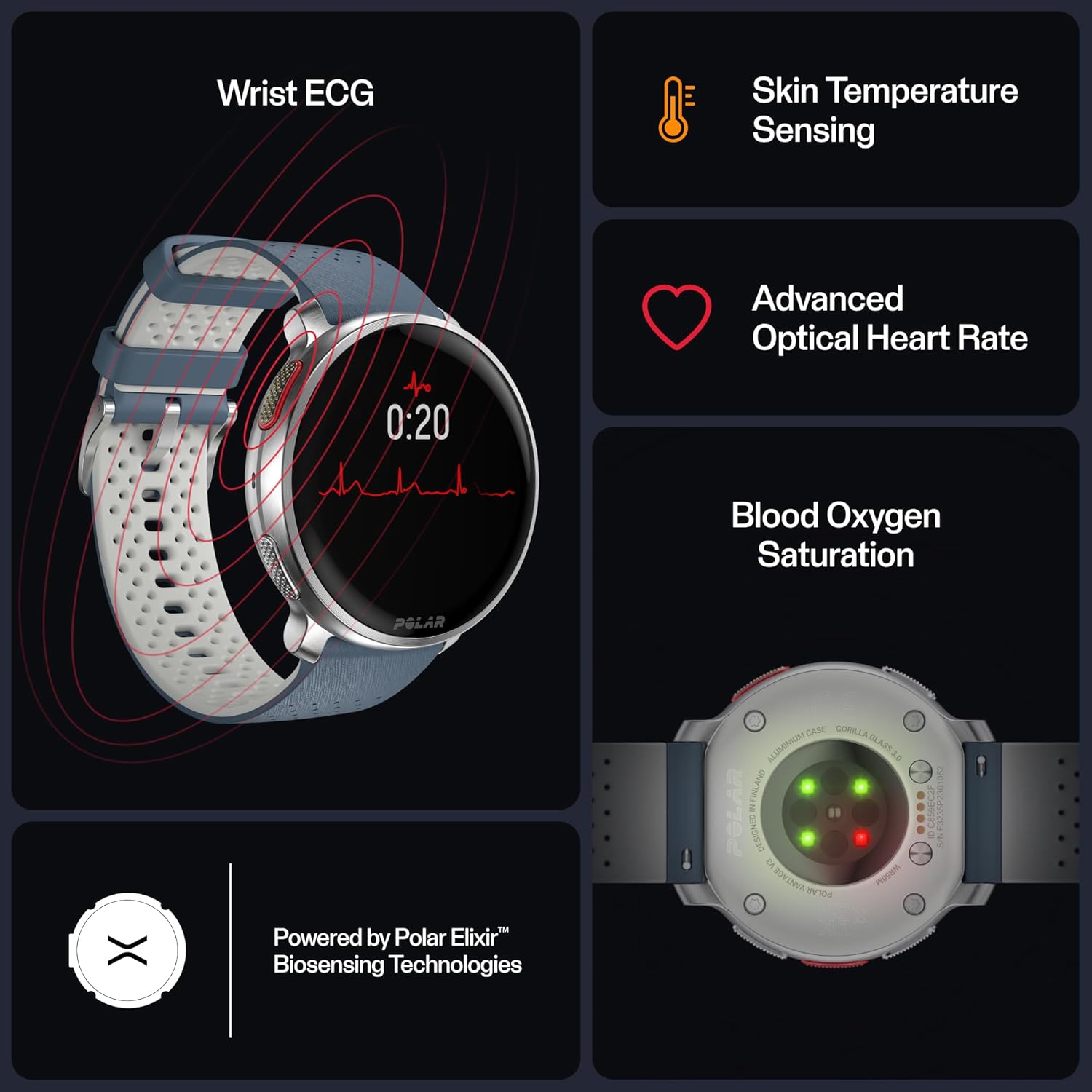
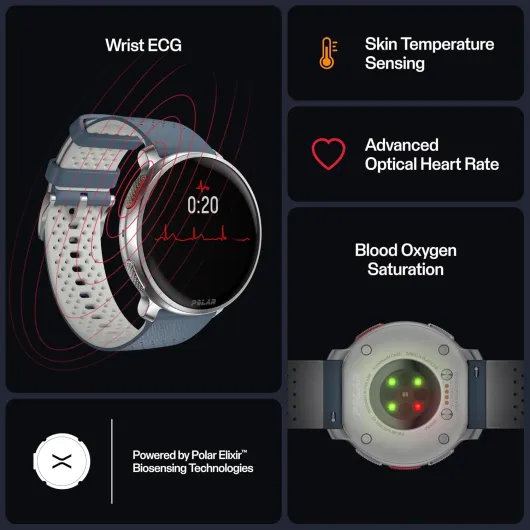
What pushed me to try this model was the mix of long battery life, dual-frequency GPS, and offline maps. On paper, it ticks a lot of boxes for someone who wants proper sports features without charging every night. The marketing talks a lot about the new Elixir biosensing stuff (ECG, SpO2, temperature, etc.), but I was mostly interested to see if the basics were solid: GPS accuracy, heart rate, comfort, and if the software doesn’t get in the way.
After a few days, it was clear this is more of a training tool than a lifestyle smartwatch. It does notifications and all that, but the focus is clearly on workouts, recovery, and stats. If you’re expecting a mini phone on your wrist with a ton of third‑party apps, this isn’t it. If you want structured training and data, it starts to make more sense.
Overall, my first impression was: solid watch with serious features, but not the most polished product on earth. It does many things well, a few things just okay, and there are some small annoyances you need to accept. I’ll break down what actually works in day‑to‑day use and what feels half‑baked or simply not as good as some competitors.
Value: strong training features, but competition is tough
On value, this watch sits in a crowded price segment. You’re basically paying for serious sports features: dual-frequency GPS, offline maps, advanced HR and biosensing, and long battery life. If you’re going to use those features regularly, the price makes some sense. The training and recovery tools are well thought out, and for runners and triathletes who like data and structure, it has a lot to offer. You also get a 2-year manufacturer warranty, which is reassuring.
However, compared to some Garmin models or even Coros, you have to accept a few trade-offs. The overall software polish and ecosystem on Garmin, for example, still feels a bit ahead: more third‑party integrations, more established routing tools, and often more refined sleep tracking. On the smart side, if you compare it to an Apple Watch or Samsung, the Polar looks weaker: fewer apps, less fancy smartwatch stuff, and a more basic overall interface. So you really have to want the Polar training approach and be okay with a slightly more niche ecosystem.
The good points for value are: battery that easily covers several days, accurate GPS and heart rate (for a wrist sensor), and genuine sports-focused features like offline maps and multi-sport support. The downsides: basic strap, plasticky feel, some small software quirks, and those user reports of used/defective units slipping through sellers. If you find it at a discount, I’d say it’s a pretty solid deal for a serious amateur athlete. At full price, it’s decent value, but not a no‑brainer, especially if you’re already deep into another ecosystem.
In short, if your main goal is training performance and you don’t care much about fancy smartwatch apps, the value is good enough. If you want both top sports features and polished smartwatch experience, there are other options that might suit you better for similar money. It really depends whether you see this as a training tool or as an everyday gadget.
Design: sport-focused and a bit plasticky, but practical
Design-wise, the Vantage V3 goes for a classic round sports watch look. The Silver-Blue version I used looks clean enough, but it’s clearly more “training gear” than fashion watch. The bezel and case are mostly plastic/composite with a metallic look, and you feel that when you touch it. It doesn’t feel cheap, but it doesn’t feel premium either. I’d call it functional. On the wrist, the 47 mm case is noticeable but not huge; on a small wrist it will stand out, on a medium or large wrist it looks normal for a sports watch.
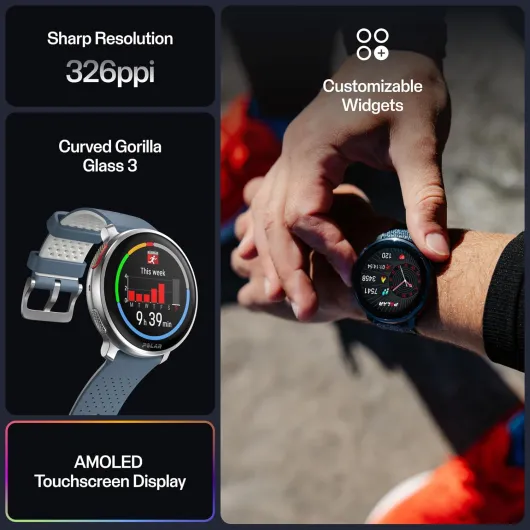
The AMOLED screen is the nicest part of the design. It’s sharp, bright (up to 500 nits), and easy to read outdoors. I had no trouble seeing my pace and heart rate in direct sunlight. Indoors, at low brightness, it’s still clear without burning your eyes at night. The bezels around the screen are there but not huge. It’s not as edge‑to‑edge as a smartwatch like a Galaxy Watch, but that’s not a big problem in real use.
The watch uses a mix of touchscreen and physical buttons. The button layout is fine: you can start/stop workouts, go back, and scroll without relying on the touchscreen if your fingers are sweaty or it’s raining. I found the buttons a bit stiff at first, but you get used to it quickly. The touchscreen is responsive enough, not super buttery like a smartphone, but totally usable for navigating menus and maps.
In daily life, the design is low-key enough to wear to work or in casual settings, but don’t expect any wow factor. It’s a sport tool, and it looks like one. If you want metal, glass, and a more polished feel like an Apple Watch, this won’t scratch that itch. If you want something that looks like it can take a beating and you don’t care if it looks a bit plasticky, then the design does the job without drama.
Battery: genuinely strong, but not magic
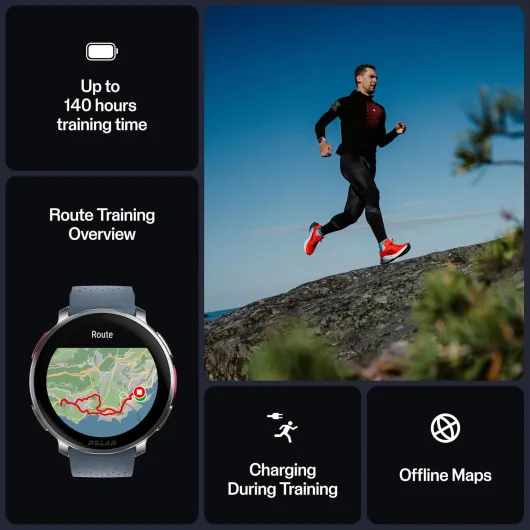
The battery is one of the main selling points, and here the Vantage V3 does a good job overall. The brand claims up to 8 days of regular use and up to 140 hours of training in certain modes. In real life, with always-on heart-rate, notifications, a few GPS runs per week, and the screen on auto brightness (no permanent always-on display), I got between 5 and 6 days before needing a charge. For me, that’s solid: I don’t have to think about charging every night, just once or twice a week.
On heavy training days with GPS, battery drain was reasonable. A 1-hour GPS run with full dual-frequency tracking and the screen waking up often cost me around 4–5% battery. That lines up with the idea that you can do several long runs or rides in a week without killing the watch. If you start playing with maps a lot and the screen stays on more, the drain goes up, but still nothing crazy. I never felt anxious about the battery dying mid-workout.
Charging is done via the Polar Charge 2.0 USB‑C cable. It’s a proprietary connector, which is a bit annoying if you lose it, but the upside is it clips on firmly. No random disconnects if you bump the cable. Charging speed is decent: from about 20% to full took me roughly an hour and a bit. Not lightning fast, but fine given you don’t charge every day. I usually plugged it in while working at my desk and it was done before I needed it.
So, is the battery life as long as the marketing numbers? Not quite, unless you really baby the settings and don’t use the brighter screen modes. But in normal mixed use, it’s still clearly better than typical smartwatches like Samsung or Apple, and in the same ballpark as other serious GPS sports watches. For my use, it’s one of the strong points of this model: it just quietly gets the job done without constant charging.
Comfort: light on the wrist, but the strap is pretty basic
On comfort, the Vantage V3 is surprisingly light for its size. At 57 g, once the strap is adjusted, I honestly forgot I was wearing it most of the day. During runs, it didn’t bounce or twist, even when I was sweating. The silicone band is soft enough, but it’s the standard sporty rubber feel, nothing fancy. It’s 22 mm, S–L size, so it fits a range of wrists. I have a medium wrist and ended up around the middle holes with no issue.
For sleep tracking, I kept it on most nights. Because of the size, you do feel it a bit when you lie on your side and your wrist bends under the pillow, but that’s the case with most sports watches this size. The underside with the sensors is smooth and didn’t irritate my skin, even after long runs with sweat and salt. I rinsed the band with water after harder sessions, and it didn’t pick up any strong smell, which is always a plus.
Adjustment-wise, the buckle is standard and secure. I never had it open accidentally. The strap has enough holes to fine‑tune the fit, which is important for heart-rate accuracy: too loose and the readings go crazy. Once I found the right tightness (a bit tighter for workouts, a bit looser for everyday), it stayed put. The weight distribution is good; the head of the watch doesn’t feel top-heavy.
My only real complaint: the strap feels a bit cheap for the price of the watch. It works, but it’s nothing special in terms of feel. If you’re sensitive to silicone or you want something nicer, you’ll probably end up buying a third-party band pretty quickly. Still, for most people, comfort is solid: light, no major pressure points, and fine for wearing 24/7 if you’re not too picky about bulk at night.
Durability and build: tough enough, but quality control seems mixed
In terms of pure build, the Vantage V3 feels robust enough for regular training. The plastic/composite case doesn’t scream luxury, but it does handle bumps and sweat without worry. I knocked it against a door frame and some gym equipment a few times and didn’t see any major marks. The watch is water resistant to 50 m, and I used it in the shower and for a couple of pool sessions with no issues. The buttons kept working fine, and there was no fogging under the screen.
The screen itself seems decently protected. I didn’t put a screen protector on, and after a few weeks there were no obvious scratches, even with some accidental scrapes. That said, it’s still a bright AMOLED screen, so I’d be a bit careful if you’re doing very rough activities like climbing or regular MTB crashes. The strap pins and buckle feel secure, not flimsy. The silicone strap will probably last a while, though like all rubber straps it may get tired after a year or two of heavy use.
Where I do have a concern is quality control, based on user reviews and my own paranoia. One Amazon review mentioned receiving a watch that was clearly used, dirty, and even stuck in a boot loop. That’s more on the seller/Amazon than Polar itself, but it does show things can slip through. My unit worked fine out of the box, no boot loops or weird bugs, but I did notice the firmware needed an update right away for some stability fixes. After updating, I didn’t have crashes, but the interface did stutter once or twice when loading maps.
Overall, I’d say the durability is good for sports use, with materials that can handle sweat, water, and daily knocks. It’s not a tank like some metal-bodied watches, but it feels like it will last if you don’t abuse it. Just be aware that, as with many electronics, not every unit seems perfect out of the box, so check yours thoroughly when you get it and don’t hesitate to return it if something feels off.
GPS, heart rate and training tools: strong overall, with some quirks
This is where the Vantage V3 is meant to shine: sports performance tracking. The dual-frequency GPS is generally very good. On my usual 10 km route with a lot of buildings and some tree cover, the tracks were clean, with only small deviations at tight corners. Compared to my old Garmin, the distance and pace were almost identical, sometimes the Polar even tracked corners a bit more cleanly. Lock-on time was usually under 10–15 seconds once it had a fix in the area before.
The heart rate sensor is better than what I had on my Samsung watch. On steady runs, the readings matched pretty closely with a chest strap (usually within 2–3 bpm). During intervals or hill sprints, there was still a slight delay on sudden changes, which is normal for wrist-based sensors, but it wasn’t totally off. For serious training, I’d still pair a chest strap for key sessions, but for most users the built-in sensor is good enough. The extra data like SpO2, ECG, and temperature is there, but honestly, after the first few days of testing, I didn’t check them much. They’re nice to have, not essential.
Where Polar does well is the training and recovery tools. You have tons of sport profiles (running, cycling, swimming, strength, triathlon, etc.), and the watch gives you structured workouts, training load, recovery suggestions, and sleep-based guidance. The sleep tracking itself is decent but not perfect: one Amazon review mentioned it, and I saw the same thing sometimes – it thought I fell asleep later than I did. Not horrible, but not flawless. Still, the overall picture of how recovered you are and whether you’re overdoing it is useful.
The offline maps are a big plus if you run or hike in new places. You can download maps and see your position and route directly on the watch. The screen is a bit small for detailed navigation, but it’s enough to avoid getting lost. It’s not as smooth as a smartphone map app, but it’s usable. In short: as a training tool, performance is pretty solid. Not perfect, but good enough for serious amateurs and probably many more advanced athletes too.
What this watch actually offers on paper
The Polar Vantage V3 is sold as a multi-sport GPS watch with a strong focus on training and recovery. On the spec sheet, you get dual-frequency GPS, over 150 sport profiles, offline maps, advanced heart-rate monitoring, ECG, SpO2, skin temperature, and a bright 1.39" AMOLED screen with 400 x 400 resolution. It also runs on a Wear OS base according to the listing, but with a heavy Polar layer focused on sports rather than app stores and gimmicks.
Battery-wise, the brand claims up to 140 hours of training in certain GPS modes and up to 8 days of regular use. In reality, that depends a lot on how much you use the always-on display, GPS, and heart-rate tracking. The watch weighs 57 g, which is fairly light for a full-featured sports watch, and it comes with a 22 mm silicone band in S–L size. It’s water resistant to 50 m, so swimming and showers are fine, but I wouldn’t treat it like a dive computer.
The watch is clearly positioned against things like Garmin Forerunner / Fenix and higher-end Coros models: it’s for runners, triathletes, and people who want structured plans and recovery metrics. It’s not trying to be a fashion accessory. The box includes the watch, a Polar Charge 2.0 USB‑C cable, and basic paper guides. No fancy extras, no extra straps.
On the smart side, you get Bluetooth, NFC, and basic notifications from your phone. There’s no big app ecosystem like on Apple Watch or Samsung, but that’s honestly fine if your priority is training. In short, on paper it’s a very complete sports watch with pretty much all the sensors you might want, a bright screen, and decent battery life. The real question is how all that feels once you actually start using it every day, which is where things get more mixed.
Pros
- Strong battery life: easily 5–6 days in real mixed use with several GPS workouts
- Accurate dual-frequency GPS and solid wrist heart-rate for most training sessions
- Offline maps and rich training/recovery tools for runners and triathletes
Cons
- Plasticky feel and basic strap for the price, not very premium
- Sleep tracking and software polish are a bit inconsistent compared to some competitors
- Ecosystem and smartwatch features are limited if you want lots of apps and integrations
Conclusion
Editor's rating
The Polar Vantage V3 is a serious sports watch that focuses on training and recovery rather than flashy smartwatch tricks. The main strengths are clear: reliable dual-frequency GPS, solid wrist heart-rate performance, long battery life that easily covers several days, and useful features like offline maps and a big library of sport profiles. The AMOLED screen is bright and easy to read outdoors, and the watch is light enough to wear all day without feeling like a brick on your wrist.
On the flip side, it’s not perfect. The design and materials feel more functional than premium, the strap is pretty basic for the price, and the software, while usable, isn’t as polished as what you get from some competitors. Sleep tracking can be off sometimes, and the ecosystem is more limited if you’re used to the app stores and integrations from Apple, Samsung, or even Garmin. There are also a few worrying user reports about units arriving used or defective, so it’s worth checking your watch carefully when you receive it.
Who is this for? It’s a good fit if you’re a runner, triathlete, or multi-sport user who cares more about training metrics, recovery insights, and battery life than about having a full-blown smartwatch on your wrist. If you want a watch that feels more premium, has deeper smart features, or you’re already comfortable in another ecosystem, you might be happier with a different brand. Overall, I’d call the Vantage V3 a solid training partner with some flaws, not a perfect all-round gadget.