
Summary
Editor's rating
Value for money: niche product with a price to match
Design: dress watch vibes with one obvious compromise
Battery life: better than most smartwatches, not as magical as the box says
Comfort: fine for daily wear, less great for sleep
Durability & build: solid case, but water rating is oddly limited
Performance & health tracking: strong app, mixed on-wrist experience
What this watch actually is (beyond the marketing buzzwords)
Pros
- Looks like a real watch and not a gadget, good for office or dressy settings
- Multi‑week battery life in real use (around 2 weeks with most features on)
- Strong Withings app with clear health data and good ecosystem if you own other Withings devices
Cons
- Notifications are basic, hard to read on the tiny screen, and easily missed
- ECG and SpO2 can be unreliable unless conditions are perfect, which gets annoying
- Price is high for what you actually get in terms of smart features compared to full smartwatches

Specifications
View full product page →| Brand | Withings |
A fancy watch that secretly wants to be your health nerd
I’ve been wearing the Withings ScanWatch Nova (39 mm, Blue Nova) pretty much non-stop for a few weeks, swapping it in and out with my usual Garmin and an Apple Watch SE. I wanted to see if this thing could really replace a full smartwatch while still looking like a normal watch you’d wear to work or a night out. Short version: it gets close in some areas, and misses pretty clearly in others.
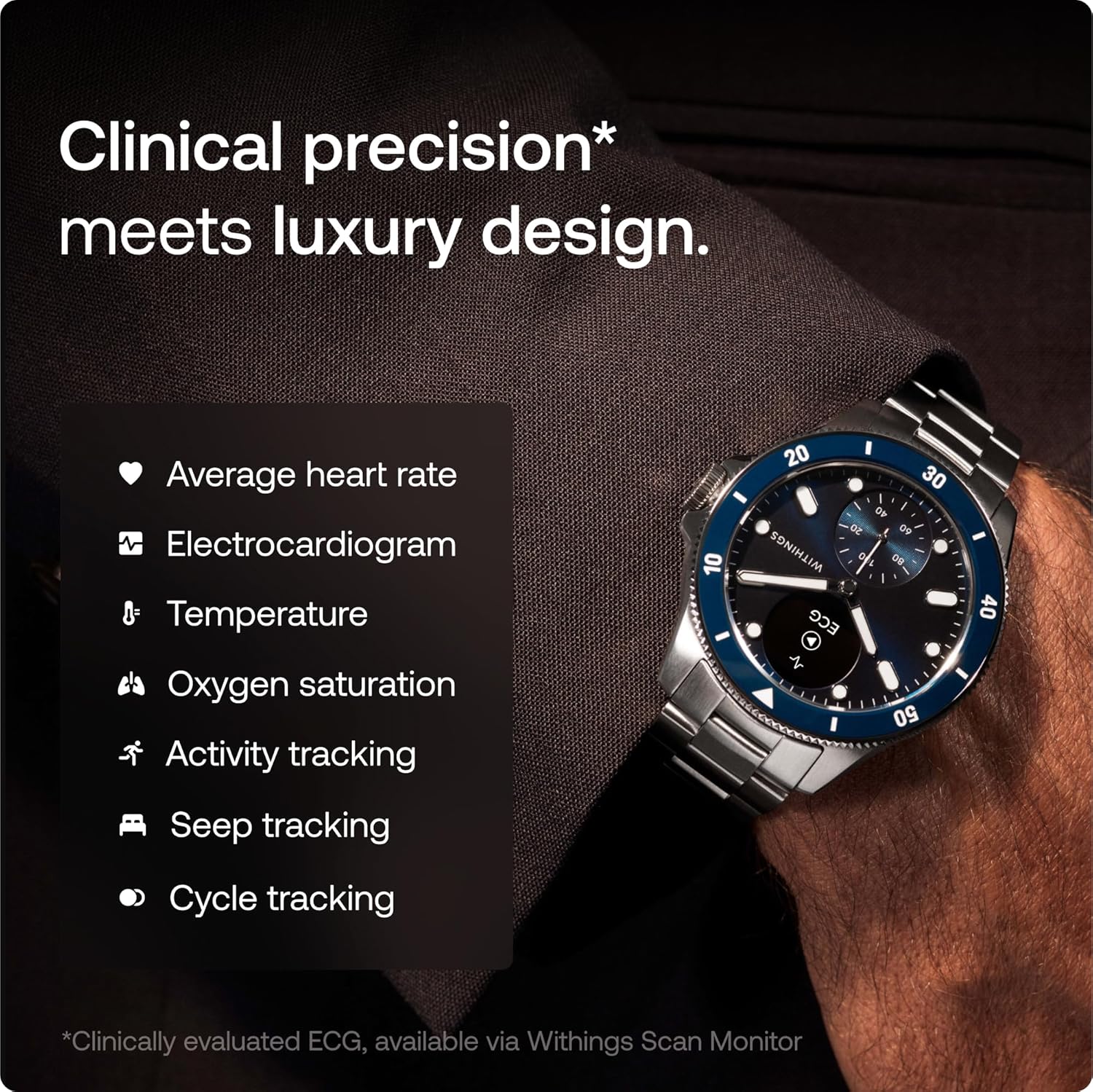
The big promise here is simple: proper health tracking (ECG, SpO2, sleep, temperature, etc.) with multi‑week battery life and a classic watch look. So if you hate charging every night and don’t like a full touchscreen slab on your wrist, this is probably the kind of product you’re already considering. On paper it ticks a lot of boxes: ECG, blood oxygen, sleep tracking, respiratory tracking, cycle tracking, and a claimed 30–35 days of battery.
In practice, it’s more of a hybrid compromise. It’s better than a cheap fitness band, much nicer on the wrist than most plasticky smartwatches, but it’s also less practical than a full smartwatch for notifications and quick interactions. Some health features are useful, some feel fussy or unreliable, especially ECG and SpO2 if you’re not perfectly still. And the menu system through that tiny round screen can get annoying after the initial novelty wears off.
If you go in thinking “classic watch first, smart features second”, you’ll probably be happy. If you expect Apple Watch or Garmin-level smart features with a fancy case, you’ll hit the same frustrations I did: notifications are basic, interaction is limited, and some of the marketing promises (battery life, ease of ECG readings) are optimistic in real life. It’s not garbage, but it’s not magic either – it’s a decent hybrid with clear pros and cons.
Value for money: niche product with a price to match
Price-wise, the ScanWatch Nova sits in an awkward but understandable spot. It’s more expensive than basic fitness trackers and older Withings models, and in the same ballpark as some Garmins and Apple Watches on sale. One reviewer mentioned it’s expensive and they wished there was a cheaper version without the clinical-grade stuff – I kind of agree. You’re paying for the design plus the medically oriented features, whether you actually use ECG and validated metrics or not.
If what you want is maximum smart features per euro, this is not the best value. For similar money, you can get a full touchscreen smartwatch with better notifications, more workouts, contactless payments, music controls, and so on. The Nova gives you fewer smart interactions in exchange for a more classic look and longer battery. So the value really depends on how much you care about that trade-off. If you just want a tool for running and messages, it’s not great value. If you want something that looks like a real watch but still tracks your health decently, it becomes easier to justify.
Where it gains points is if you’re already in the Withings ecosystem. Paired with a Withings Body Scan or Body Comp scale and the Withings+ subscription, the whole setup starts to make more sense. You get a unified view of your health data, and the watch becomes one piece of a bigger puzzle. In that scenario, the higher price feels more logical because you’re using the app and ecosystem properly, not just the watch on its own.
So for value, I’d say: fair but not cheap. It’s not a bargain, and there are better deals if you only care about fitness or smart functions. But if you’re specific about wanting a dressy watch with solid health tracking, multi‑week battery, and you like the Withings app, then the price is acceptable. Just be honest with yourself about how often you’ll really use ECG, SpO2 spot checks, and all those fancy metrics before paying the premium.
Design: dress watch vibes with one obvious compromise
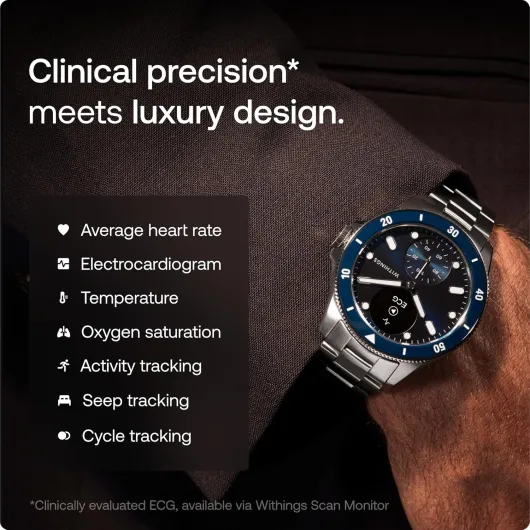
Design-wise, this is where the ScanWatch Nova actually stands out. On the wrist, it looks more like a dive-style or dressy sports watch than a gadget. The Blue Nova version has a nice dark dial, steel case, and steel bracelet. From a couple of meters away, most people won’t notice it’s a “smart” device at all, except maybe when the little round screen lights up. Compared to a Garmin Venu or an Apple Watch, it’s less techy and fits better with a shirt or blazer.
The flip side is that little black circular LCD at the top. When it’s off, it’s just a dark hole in the dial. Some people won’t care; I personally think it looks a bit odd once you notice it. One Amazon reviewer said they wish the LCD matched the blue of the dial – I agree. When the screen comes on, it’s bright enough and readable in most indoor conditions, but don’t expect OLED-level clarity or color. It’s tiny, monochrome, and just good enough to show a line or two of text or a small icon.
The case itself feels solid and premium enough. The watch is thicker than a regular dress watch, closer to a mid-sized diver. On my wrist (average male wrist), it sits fine but you definitely feel the height under a tight cuff. The lugs are well integrated, and the bezel style gives it that “serious watch” look. It doesn’t scream fitness tracker at all, which is exactly what some people want. But if you’re used to ultra-light sport watches, this will feel chunkier and a bit heavier.
Overall, the design is the main reason to pick this over a cheaper Withings model or a standard smartwatch. It looks like a real watch and not a square gadget. Just be ready for that weird black circle on the dial and the fact that every time you want something smart, you’re squinting at a tiny screen. For me, the look is strong enough to justify the compromise, but if you’re picky about dial symmetry or want big bright notifications, it may annoy you over time.
Battery life: better than most smartwatches, not as magical as the box says
Battery life is one of the main selling points, so I paid attention to it. With all the main features active (24/7 heart rate, sleep tracking every night, a few workouts per week, some notifications, occasional ECG/SpO2), I was getting roughly 12–18 days before I felt I should charge. That’s a lot better than an Apple Watch (where I’m charging daily or every other day), but it’s not the 30–35 days printed in the specs unless you really tone things down.
One Amazon reviewer mentioned about two weeks with everything active, which lines up with my experience. Another said they barely got two weeks even with screen off most of the time and just HR, which also sounds plausible. I suspect that 30–35 days is with minimal notifications, fewer health checks, and maybe some features disabled. So yes, the marketing number is optimistic. But in day-to-day life, going two weeks between charges is already a big step up from most full smartwatches, so I’m not too upset about it, as long as you manage your expectations.
Charging itself is straightforward. You drop it on the included dock, plug the USB‑A end into any charger or laptop, and it fills up in a couple of hours. The dock is light and small, but because the watch just sits on it instead of snapping strongly, you have to place it properly. It’s not as idiot‑proof as Apple’s magnetic puck, but after the first time it’s fine. I didn’t have any random disconnect issues while charging.
So overall: battery life is a strong point, but not magic. If you come from a Garmin with a big battery, you might not be impressed. If you come from an Apple Watch or Wear OS watch, you’ll be happy not to hunt for the charger every night. Just don’t buy it thinking you’ll get a full month with everything turned on and constant measurements; that’s just not realistic in normal mixed use.
Comfort: fine for daily wear, less great for sleep
On the comfort side, I’d call it pretty solid but not ultra‑light. With the stainless steel bracelet, you definitely feel the weight. The listed weight on Amazon (645 g) is clearly wrong; it’s nowhere near that heavy, but it’s still a proper steel watch, not a featherweight fitness band. After a day at the office, I didn’t feel bothered, but when I swapped back to a silicone‑strap Garmin, the difference in lightness was obvious.
For daytime wear, once I sized the bracelet properly, it sat well. The clasp is a standard buckle style; nothing fancy, but it holds. Adjusting the bracelet with the included tool took me about 5 minutes, same as mentioned in one of the reviews. If you’re not used to metal bracelets, there’s a bit of trial and error to get the right tightness: too loose and the watch flops around and feels heavier; too tight and the thickness becomes annoying. I’d suggest taking the time to get it right or swapping to a leather or silicone strap if you’re sensitive to weight.
For sleep tracking, comfort is more debatable. Sleeping with a steel bracelet and a thick case isn’t ideal. I managed, but I was more aware of the watch than with a fabric or silicone band. If you mainly bought this for sleep tracking, I’d really recommend budgeting for a second, softer strap. The sensors sit flush enough and didn’t dig into my skin, but the overall bulk is still there. After a few nights, I got used to it, but it’s not as forgettable as a simple fitness band.
In workouts, the watch stayed in place and didn’t chafe, but again, it doesn’t disappear on your wrist. Sweat under a steel bracelet is never fun. I ended up loosening it slightly after a run because it felt sticky. So comfort-wise: good enough for office and daily life, acceptable for sleep if you’re not too sensitive, a bit annoying for long sweaty workouts unless you swap the strap. Not a deal-breaker, but it’s not a “you forget it’s there” kind of device either.
Durability & build: solid case, but water rating is oddly limited
In terms of build quality, the ScanWatch Nova feels like a real watch, not a toy. The stainless steel case and bracelet feel sturdy, no creaks, and the finish doesn’t look cheap. Over a few weeks of wearing it daily – including banging it on a door frame once or twice because I’m clumsy – I didn’t see any major scratches on the case. The bracelet picked up the usual tiny hairline marks you get on any steel band, but nothing out of the ordinary.
One thing that bothers me on paper is the water resistance rating. Amazon lists IPX7 / 1 meter depth and “not water resistant” in another line, which is confusing. IPX7 basically means it can handle splashes and short immersion, but it’s not a real dive watch. For something that looks like a diver‑style watch, that’s a bit disappointing. I wouldn’t swim laps with it regularly, and I definitely wouldn’t take it in the sea. Showers and rain were fine for me, but I treated it more like a dress watch than a sports dive watch because of that rating.
The crystal (glass) held up fine in my time with it. I didn’t baby it, but I also didn’t do any construction work or rock climbing with it. For typical office, commuting, and light sports, it seems robust enough. The caseback didn’t show any wear, and the sensors kept working normally. The crown and buttons didn’t loosen or feel mushy after use; the click is still clean.
Long term, I don’t see any obvious weak point besides the limited water rating and the usual wear on a steel bracelet. The software side is always a question mark: will Withings keep updating it for years? Hard to say, but their older ScanWatch models are still supported so far. So from a durability angle: decent, watch-like build, just don’t expect true dive-watch water performance and you’ll be fine.
Performance & health tracking: strong app, mixed on-wrist experience
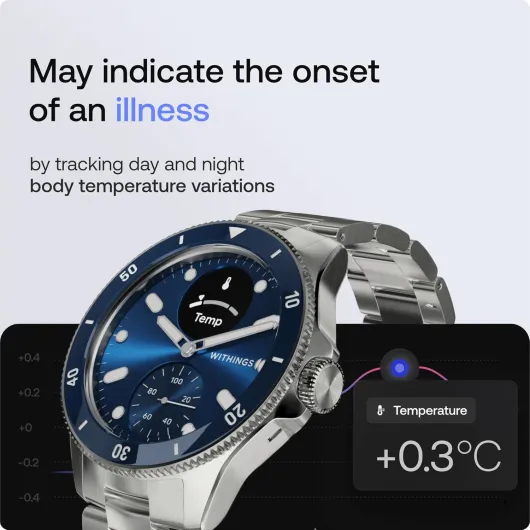
Let’s talk actual performance, because this is where opinions split. On the positive side, the Withings app is genuinely well done. Data from the watch (heart rate, sleep, steps, SpO2, temperature) syncs reliably, and the way it’s displayed is clear. I liked how you can see trends over days and weeks without digging through weird menus. If you already own a Withings scale, the combo is nice: weight, body metrics, and watch data all in one place. That part feels coherent and thought-through.
On the wrist, it’s more of a mixed bag. Heart rate and step tracking are in the “good enough” category for everyday use. Steps were roughly in line with my Garmin and phone, usually within a 5–10% margin. Heart rate during the day looked fine, but during workouts it sometimes lagged a bit or smoothed spikes too much. If you’re a serious athlete who wants detailed workout metrics, this is not the right tool. For casual runs, walks, and general activity, it’s okay.
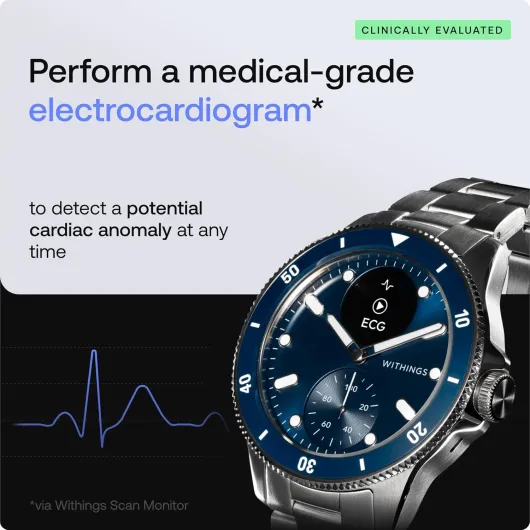
ECG and SpO2 are where I had more issues. They work, but only if conditions are just right: wrist still, strap tight, no movement. A negative Amazon review saying ECG fails 9 times out of 10 sounded harsh, but I get the frustration. I had several failed attempts when I was a bit fidgety or not paying attention. When it does work, you get a PDF you can export, which is nice, but it’s not something I see myself using every day. SpO2 is similar: readings are plausible, but I wouldn’t rely on it for anything medical without cross-checking with a proper device.
Notifications are frankly basic and a bit annoying. They vibrate, scroll very small text on that tiny round screen, and if you miss it, it’s gone – no real history on the watch. No icons for different apps, no real memory. That matches what one of the 1‑star reviewers complained about, and I agree. It’s okay for a quick buzz to tell you “check your phone”, but reading a long message on that screen is a pain. I quickly stopped trying to interact and just used it as a nudge. If you’re buying this for rich notification handling, you’ll be disappointed.
What this watch actually is (beyond the marketing buzzwords)
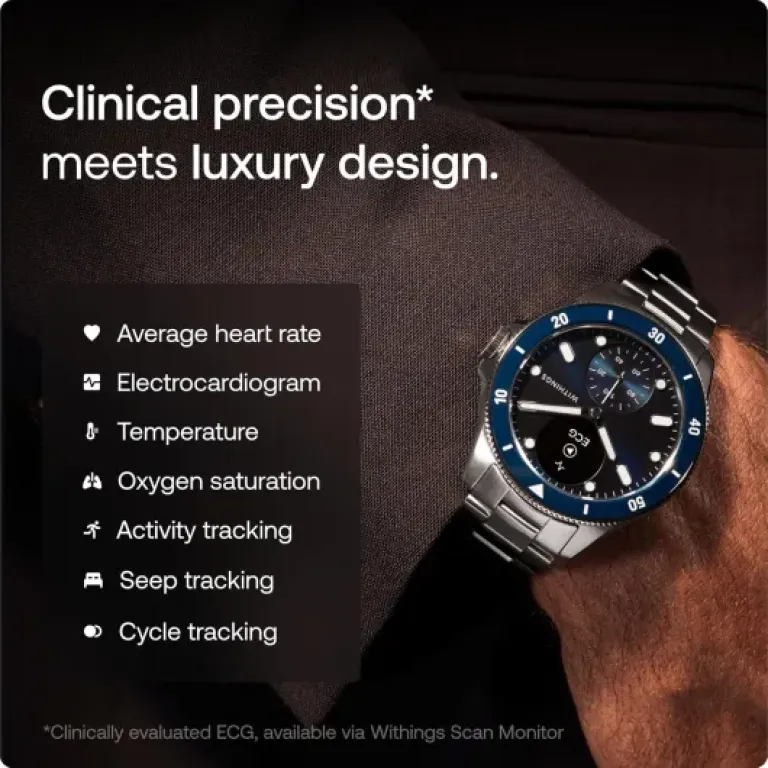
On the spec sheet, the ScanWatch Nova looks packed. You get ECG, SpO2, heart rate, temperature monitoring, sleep tracking, respiratory health, and cycle tracking. It connects via Bluetooth to iOS or Android, uses GPS via your phone, and Withings claims up to 30–35 days of battery life thanks to the tiny 0.4-inch LCD instead of a full touchscreen. It’s IPX7 rated, stainless steel case and bracelet, and it’s sold as a unisex adult watch.
In reality, the everyday experience is more like this: it behaves as a normal analog watch most of the time, with a small circular LCD at the top of the dial that lights up when you press the crown. That little screen shows notifications, health metrics, workouts, and basic settings. You scroll and click with the crown, and there are physical hands for the time plus a small analog subdial for your daily activity progress. The operating system is very stripped-down compared to Wear OS or watchOS; it’s basically just menus stacked in a line.
The included box contents are straightforward: the watch, a docking station, USB‑C to USB‑A cable, and some paperwork. No extra strap in my case, just the steel bracelet. The charger is a small dock where the watch lies flat; it’s compact but not magnetic like Apple’s. The app you need is the Withings app (same one for their scales and other devices). Setup took me about 10–15 minutes including firmware updates, which is fine, but expect a mandatory app account and a bit of initial calibration.
So, if you’re picturing a mini smartphone on your wrist, that’s not what this is. It’s a traditional watch with a health module bolted on, and most of the clever stuff actually happens in the phone app. The watch gathers data and shows you basic numbers; the app is where you really see trends, sleep stages, and health insights. That’s important to understand before buying, because if you don’t like using your phone for details, this product loses a lot of its point.
Pros
- Looks like a real watch and not a gadget, good for office or dressy settings
- Multi‑week battery life in real use (around 2 weeks with most features on)
- Strong Withings app with clear health data and good ecosystem if you own other Withings devices
Cons
- Notifications are basic, hard to read on the tiny screen, and easily missed
- ECG and SpO2 can be unreliable unless conditions are perfect, which gets annoying
- Price is high for what you actually get in terms of smart features compared to full smartwatches
Conclusion
Editor's rating
The Withings ScanWatch Nova is basically a nice-looking analog watch with a health tracker hidden inside. It does a lot of things decently: solid build, good app, multi-week battery, and proper health metrics for everyday people who want more than just steps. But it’s not perfect, and it’s definitely not for everyone. Notifications are basic and sometimes frustrating, ECG and SpO2 can be fussy, and the UI on that tiny screen gets old fast if you try to do too much from the wrist.
If you’re the kind of person who wants a watch that looks normal in the office or at dinner, hates charging every day, and mainly cares about health tracking and long battery over fancy apps, this is a good fit. It’s even better if you already own other Withings products and like their app. On the other hand, if you want rich smartwatch features, smooth notifications, and deep workout tracking, you’ll be happier with an Apple Watch, Garmin, or similar. You’ll charge more often, but you’ll get a lot more interaction and convenience.
So, I’d sum it up like this: good hybrid for health-focused users who value style and battery more than pure smart features. There’s better tech for the same money if you don’t care how your watch looks. There are cheaper trackers if you just want steps and sleep. The Nova sits in the middle: not cheap, not perfect, but a decent choice if its specific mix of looks and health tools lines up with what you actually want.