SUUNTO Race 2 Review: a serious training watch that finally makes Garmin sweat

SUUNTO Race 2 Review: a serious training watch that finally makes Garmin sweat

Michael Katz
Michael Katz
Healthcare Wearables Researcher
25 May 2026 1 min read

Summary

Editor's rating

★★★★★ ★★★★★

Value: who should spend their money on this instead of Garmin?

★★★★★ ★★★★★

Design: big screen without feeling like a brick

★★★★★ ★★★★★

Battery: finally a bright screen that doesn’t die in two days

★★★★★ ★★★★★

Comfort: light enough to forget, strap is good but not perfect

★★★★★ ★★★★★

Durability and build: tough enough, but not a tank

★★★★★ ★★★★★

GPS, HR and sport tracking: this is where it actually shines

★★★★★ ★★★★★

What you actually get with the Race 2

★★★★★ ★★★★★

Pros

  • Strong battery life for an AMOLED watch, with around 9–11 days in real mixed use and up to 55 hours in best GPS mode
  • Accurate dual-band GPS and useful offline maps/route features for running, cycling and trail
  • Comfortable 65 g design with a bright, readable 1.5-inch AMOLED screen and plenty of sport modes

Cons

  • Fewer smartwatch features and third‑party integrations than Garmin (no payments, no onboard music)
  • Ecosystem and app selection are more limited if you rely heavily on connected services beyond sports tracking
Brand SUUNTO

A watch that actually made me think about leaving Garmin

I’ve been using GPS watches for years, mostly Garmin, with a short detour via Polar. I grabbed the SUUNTO Race 2 in Coral Orange out of curiosity, mainly because I was tired of bulky watches and I wanted something with a bright screen and strong battery for long runs and weekend hikes. I’ve used it daily for a few weeks: runs, gym sessions, bike commutes and just as a normal everyday watch.

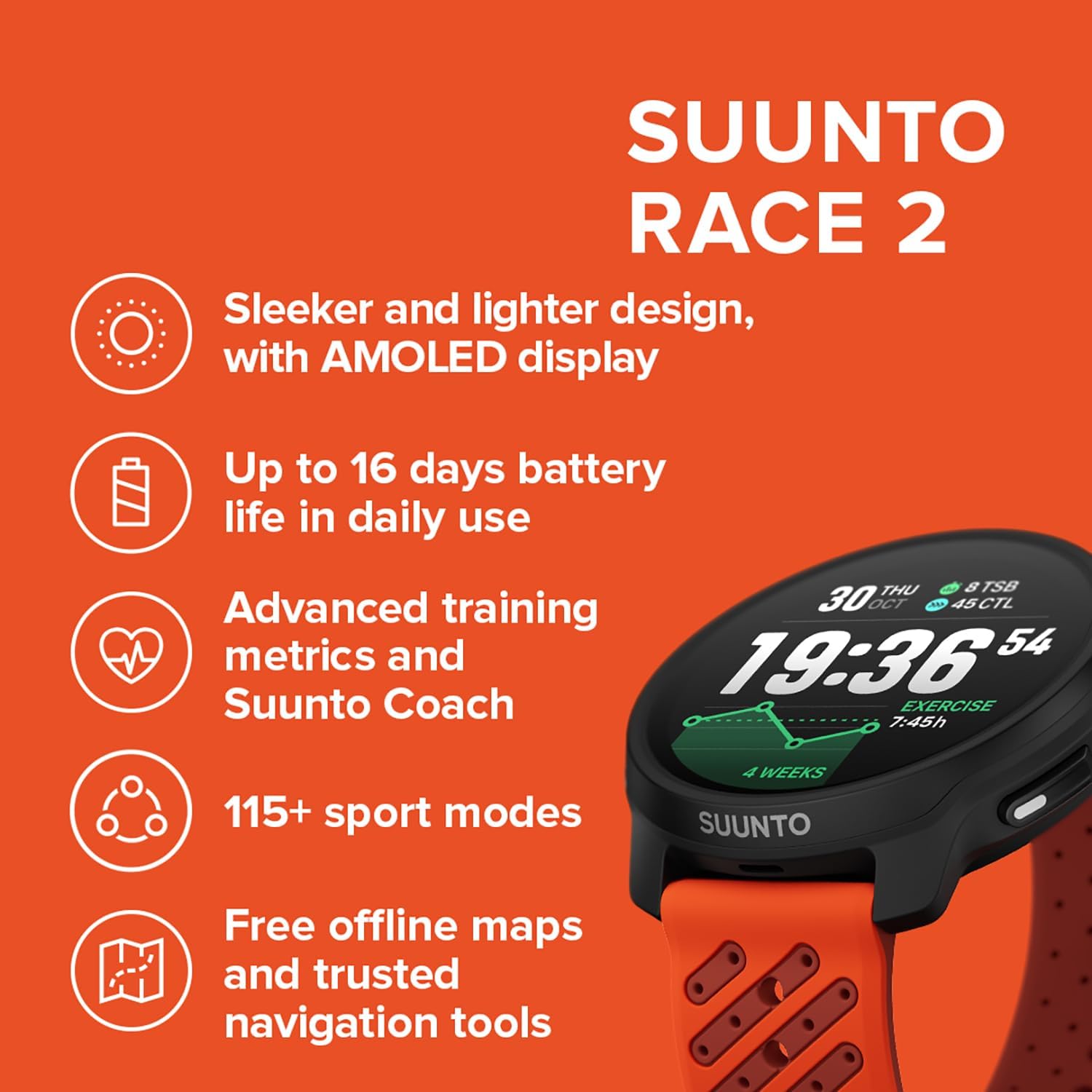
The first thing that hit me was the screen. The 1.5-inch AMOLED really is bright, even outside. Coming from a more classic transflective screen, it feels much more readable for quick glances at pace and heart rate. At the same time, I was a bit worried about battery life, because AMOLED usually drains faster. On paper they say up to 16 days / 12 days depending how you count, and up to 55 hours in best GPS mode. I tried to see what that looks like in real life, not just spec sheet talk.

I used it mostly paired with an Android phone, with Bluetooth always on, around 4–5 workouts per week (between 45 minutes and 2 hours), plus sleep tracking. I also played a lot with the maps and navigation features because that’s something I actually use on trails. During this period I kept notifications on, always-on display off, and brightness on auto. So, not battery-saving mode, but not maxed out either. I’d say a fairly typical sports user setup.

Overall, my feeling is pretty clear: this is a serious training watch, not a lifestyle toy. It’s not perfect, there are still some rough edges on the software side and fewer third‑party integrations than Garmin, but the mix of battery, screen, maps and sport modes is honestly pretty solid. If you’re a stats nerd or a long-distance runner, it’s worth a look. If you mostly want smartwatch apps and contactless payments, it’s probably not the one.

Value: who should spend their money on this instead of Garmin?

★★★★★ ★★★★★

In terms of value for money, the SUUNTO Race 2 sits in an interesting spot. It’s clearly cheaper than the top-tier Garmin Fenix models, while offering a lot of the same core stuff: strong GPS, big bright screen, long battery, offline maps, multi-sport modes. Several Amazon reviewers even say they switched from Garmin and prefer this, mainly because of price and the Suunto app. I’m not as radical, but I get where they’re coming from: you’re getting a lot of watch for the money.

Where you feel the price difference is in the ecosystem and extras. Garmin still wins on third‑party app support, golf, advanced cycling integrations and general smartwatch features like payments or wide widget libraries. Suunto is more focused: it does sports and navigation very well, daily tracking decently, and that’s about it. If you’re fine with that and you mainly want a solid training partner, this is good value. If you expect your watch to replace half your phone functions, the Race 2 will feel limited.

For someone who runs or cycles several times a week, likes planning routes and wants offline maps without paying full Fenix prices, the Race 2 hits a nice balance. The screen and battery combo is good, the GPS is reliable, and the watch feels comfortable enough for all‑day wear. The fact that Suunto keeps pushing software updates and has a pretty clean app also adds to the value, because you’re not stuck with a static product.

On the flip side, if you’re a casual user who just wants steps and occasional GPS walks, this is almost overkill. You’d be paying for features you won’t really use. In that case, a cheaper fitness tracker or mid‑range watch makes more sense. So, value-wise, I’d say: great deal for serious hobby athletes, less interesting for pure smartwatch fans or very casual movers.

71vzgEY3U0L._AC_SL1500_

Design: big screen without feeling like a brick

★★★★★ ★★★★★

Design-wise, the Race 2 sits somewhere between chunky outdoor watch and everyday wearable. The 1.5-inch round AMOLED screen dominates the look, but because the body is relatively slim and the weight is only 65 g, it doesn’t feel like a dive computer strapped to your arm. On my medium-sized wrist, it covers a good chunk, but it doesn’t look ridiculous. The Coral Orange color is pretty bold – you either like that sporty look or you don’t. Personally, I got used to it, and it’s easy to spot in a pile of gear.

The watch has both buttons and a touchscreen, which is practical. Touch works well for maps and menus when you’re calm, and the buttons are handy when you’re sweating or it’s raining. The AMOLED screen is sharp (390 x 390 resolution), and the watch faces are clear. The UI is fairly simple, not overloaded with animations, which I prefer. During runs, the data fields are readable at a glance, even in bright sun. At night, the backlight is strong, maybe even a bit too strong on max, but you can tweak it.

What I liked is that Suunto didn’t try to make it look like a fashion watch. It’s clearly a sporty, modern design: round case, chunky bezel, visible buttons, and a straightforward buckle. It’s not trying to pass as a dress watch. With casual clothes, it looks fine; with a shirt, it’s a bit out of place, but that’s the trade-off for a big, readable screen. The bezels could be a bit thinner, but it’s not awful, and at least you’re not constantly hitting the edge of the glass.

If I compare it to a Garmin Fenix line or similar, the Race 2 feels a bit sleeker and less tank-like, especially in thickness. On the other hand, it doesn’t feel as premium as some titanium or steel models from other brands. It’s more in the “robust plastic sports tool” category than luxury gadget. For training and everyday casual use, that’s fine by me, but if you want something that looks very high-end, this won’t scratch that itch.

Battery: finally a bright screen that doesn’t die in two days

★★★★★ ★★★★★

Battery is where I was the most skeptical because of the AMOLED screen. Suunto claims up to 16 days (the spec sheet also mentions 12 days in daily use) and up to 55 hours in best GPS training mode. Obviously, that’s in ideal conditions with some settings tuned. In real life, with Bluetooth on, notifications enabled, auto-brightness, no always-on display, and around 4–5 workouts per week, I was getting roughly 9–11 days per charge. That’s actually pretty solid for a bright screen watch.

For GPS activities, consumption looked reasonable. On a 2-hour run with best GPS mode, I lost around 6–7% battery. On a 3.5-hour hike with navigation and maps always visible, it ate closer to 15–18%. That lines up roughly with the 55-hour claim if you do the math. If you start a full ultra with 100% battery and don’t go crazy with backlight, you’re safe for a long day out, maybe even more. For multi-day mountain trips, you’d still want a power bank, but that’s normal.

Charging is via a proprietary USB cable that snaps on the back. It’s fine, but as always, if you lose it, you’re stuck. From around 15% to full took me about 1.5 hours. Not blazing fast, not slow either. I usually just plug it in while showering and having breakfast and it picks up enough juice for a few more days of casual use. The watch also gives decent battery estimates before starting an activity, so you can decide whether to switch to a more economical GPS mode or not.

Overall, I’d say battery life is one of the strong points of the Race 2. It’s not the absolute king like some monochrome watches that last a month, but for an AMOLED watch with this level of features, it’s very good. If you’re coming from an Apple Watch or Wear OS device that needs daily or every other day charging, this feels like a relief. If you already use a high-end Garmin with solar, the difference is smaller, but still competitive.

71pWaNgC1OL._AC_SL1500_

Comfort: light enough to forget, strap is good but not perfect

★★★★★ ★★★★★

On the wrist, the 65 g weight is probably the main positive point. For a watch that big, it’s surprisingly easy to wear all day. I wore it 24/7 for a couple of weeks: work, sleep, long runs up to 2–3 hours, and some sweaty gym sessions. No skin irritation, no pressure points. The polyamide strap feels soft enough and doesn’t trap too much sweat. It dries quickly after a shower or swim, which is handy if you’re lazy about taking your watch off like me.

The 22 mm strap is standard, so you can swap it for something else if you want silicone, nylon or leather. The included strap is fine for sports, but after a long very sweaty session, it can feel a bit sticky on the skin. Not dramatic, just something I noticed compared to softer silicone straps. The buckle is classic and secure, I never felt like it would fall off, even during trail runs with a lot of arm movement and when taking off a backpack repeatedly.

For sleep tracking, comfort is always a big point for me. Some big watches feel like a rock when you’re on your side. Here, the Race 2 is acceptable. You feel it, obviously, but the curved underside and moderate thickness make it bearable. After a few nights, I just stopped thinking about it. If you’re very sensitive to wearing watches at night, you might still find it a bit much, but compared to other outdoor watches I’ve tried, this one is on the more comfortable side.

One small downside: the heart rate sensor bump on the back is a bit pronounced, which is normal, but if you wear the strap too loose, the watch can shift around and readings get worse. So you do need to wear it relatively snug, which can bother some people. I found a middle ground where it stays in place without cutting circulation, but it took a couple of days of adjusting. Overall, for a big sport watch, comfort is pretty solid, but don’t expect the feel of a tiny smartwatch.

Durability and build: tough enough, but not a tank

★★★★★ ★★★★★

The Race 2 is clearly built with sports in mind, but it doesn’t feel like a pure military brick either. Over a few weeks, I wore it in the rain, sweat, shower and pool, and also bumped it a couple of times on door frames and gym equipment. No scratches on the screen so far, and the case only picked up a tiny mark that you really have to look for. I didn’t baby it, but I also didn’t deliberately try to destroy it. The 100 m water resistance rating is reassuring; I did a few swim sessions and showers without any issues.

The buttons still click properly and the touchscreen responsiveness didn’t change over time. The strap holes didn’t stretch out, and the buckle is holding up. The polyamide strap material feels like it will last, but like all synthetic straps, it may get a bit tired after a year or two of heavy daily use. Thankfully, the 22 mm standard width means replacements are easy and cheap, either from Suunto or third parties. That’s important if you train a lot and sweat into it daily.

Compared to some heavy-duty Garmins with steel bezels, the Race 2 feels a bit less bombproof, simply because it’s lighter and uses more plastic. That’s not necessarily bad: it’s a trade-off between comfort and raw toughness. If you’re into construction work or very rough mountain stuff where your wrist constantly hits rocks, you might prefer a watch with more metal and a raised bezel. For typical running, cycling, gym, hiking, and even skiing, the Race 2 feels solid enough.

I can’t speak to multi-year durability yet, but Suunto gives a 2-year manufacturer warranty, and historically their hardware tends to last. The real long-term question is more about software updates and battery health over time. Given that they push updates and promise more features later, I’m moderately confident it will stay usable for several seasons. Just don’t expect it to survive extreme abuse like a dedicated tactical watch; it’s tough, but not indestructible.

71L6GV-S2YL._AC_SL1500_

GPS, HR and sport tracking: this is where it actually shines

★★★★★ ★★★★★

Let’s talk about the stuff that really matters for a sports watch: GPS, heart rate and sport tracking. I mainly used it for road running, some light trail, cycling and a few pool sessions. The dual-band GPS is one of the big selling points. Compared to my older Garmin, the tracks are cleaner, especially in areas with tall buildings or in wooded sections. On my usual 10 km loop that passes under trees and near a railway bridge, the Race 2 track stayed much closer to the actual path, while my old watch would sometimes cut corners.

For pace and distance, I didn’t see any weird jumps. Auto-lap every 1 km was consistent with distance markers on a local track and with Strava after sync. Elevation also looked reasonable, though like all wrist-based barometers it can drift a bit with weather. ClimbGuidance is handy on trail routes with lots of ups and downs: it shows upcoming climbs so you can manage effort. Not magic, but practical when you’re tired and trying to decide whether to push or save energy.

Heart rate from the wrist felt more accurate than older Suunto models I’d tried in the past. During steady runs and cycling, it lined up well with perceived effort. On intervals, it still lags a bit, which is normal for optical sensors, but it’s usable. For really precise work, I’d still pair a chest strap, but for 90% of people, the built-in sensor is fine. Sleep and resting HR trends also looked consistent from night to night, which is what I care about more than the exact number.

The 115+ sport modes are honestly more than I need, but at least the main ones are well thought out: running, trail, cycling, swimming, gym, triathlon. You can customize data screens pretty deeply, which is a big plus. During a triathlon-style brick session (bike + run), I had no trouble switching and keeping track of total time and each leg. In short, as a pure training tool, the Race 2 gets the job done very well. It’s not perfect, but I didn’t run into any big bugs or weird crashes during my tests.

What you actually get with the Race 2

★★★★★ ★★★★★

On paper, the SUUNTO Race 2 is positioned as a full-on multisport and outdoor watch: 1.5-inch AMOLED, 115+ sport modes, offline maps, dual-band GPS, 32 GB storage, water resistance to 100 m, and a claimed 16 days of battery in daily use. It runs on Suunto’s own system, not Wear OS, so think Garmin-style sports watch rather than a mini smartphone on your wrist. It connects via Bluetooth to Android and iOS and syncs with the Suunto app, which is where you handle routes, training analysis and watch settings.

In the box, you get the watch, a 22 mm strap (polyamide), the charging cable and the usual paper manual. No fancy extras, no spare strap. The watch itself weighs around 65 g, which is lighter than many chunky outdoor watches I’ve worn, especially some Garmin Fenix models. The memory (32 GB) is mainly useful for offline maps and future updates; you don’t really use it like a phone where you install a ton of apps. It’s more of a dedicated training tool than a smartwatch platform.

The advertised features are focused on training and navigation: Suunto Coach for adaptive training guidance, ClimbGuidance for uphills, detailed route planning and offline maps via the app, plus all the standard metrics: heart rate, sleep, steps, calories, VO2max estimates, etc. It also has music control (for your phone), but you can’t store music directly on the watch. So you’re still depending on your phone for audio, which may annoy some people used to leaving their phone at home.

In practice, this watch is clearly aimed at people who actually train: runners, cyclists, triathletes, trail runners, maybe skiers. If your main use is WhatsApp notifications on your wrist and NFC payments at the supermarket, this is overkill and also not the right ecosystem. But if your priority is reliable GPS, good battery and easy route navigation, the Race 2 lands in a pretty sweet spot, especially compared to similarly priced Garmins.

Pros

  • Strong battery life for an AMOLED watch, with around 9–11 days in real mixed use and up to 55 hours in best GPS mode
  • Accurate dual-band GPS and useful offline maps/route features for running, cycling and trail
  • Comfortable 65 g design with a bright, readable 1.5-inch AMOLED screen and plenty of sport modes

Cons

  • Fewer smartwatch features and third‑party integrations than Garmin (no payments, no onboard music)
  • Ecosystem and app selection are more limited if you rely heavily on connected services beyond sports tracking

Conclusion

Editor's rating

★★★★★ ★★★★★

The SUUNTO Race 2 is a serious sports watch that focuses on the essentials: accurate GPS, long battery life, clear AMOLED screen, and robust training features. In day-to-day use, it handles running, cycling, swimming and trail sessions without fuss. The route planning and offline maps are genuinely useful if you like exploring new paths, and the dual-band GPS gives clean tracks even in tricky areas. Comfort is good for a watch of this size, and the 65 g weight makes it bearable 24/7, including at night for sleep tracking.

It’s not trying to be a full smartwatch replacement. No onboard music storage, no payments, fewer third‑party integrations than Garmin. If those things matter more to you than pure training performance, you’ll probably end up frustrated. But if your priority is reliable sports tracking, solid battery, and a screen that’s easy to read in all conditions, the Race 2 delivers. The price point compared to high-end Garmin models makes it pretty attractive, especially if you care more about training and navigation than an overloaded app store.

So, who is it for? Runners, triathletes, cyclists and trail fans who train regularly and want a watch that can follow them on long sessions without daily charging. Who should skip it? People who mainly want smartwatch functions, or very casual users who will never touch half the sport modes or the map features. For the right user, it’s a pretty solid buy that does the job without too much nonsense.

See offer Amazon

Sub-ratings

Value: who should spend their money on this instead of Garmin?

★★★★★ ★★★★★

Design: big screen without feeling like a brick

★★★★★ ★★★★★

Battery: finally a bright screen that doesn’t die in two days

★★★★★ ★★★★★

Comfort: light enough to forget, strap is good but not perfect

★★★★★ ★★★★★

Durability and build: tough enough, but not a tank

★★★★★ ★★★★★

GPS, HR and sport tracking: this is where it actually shines

★★★★★ ★★★★★

What you actually get with the Race 2

★★★★★ ★★★★★
Race 2 GPS Sport Watch, Bright 1.5-inch AMOLED Touchscreen, Sleeker and Lighter Design, 16-Day Battery Life, Offline Maps, Accurate Navigation, 115+ Sport Modes Coral Orange
SUUNTO
Race 2 GPS Sports Watch — 1.5" AMOLED, 16-Day Battery
🔥
See offer Amazon