Summary
Editor's rating
Value: good deal if you care about battery and outdoor use
Design: rugged tool first, pretty object second
Battery life: the real selling point
Comfort: good once you fix the strap situation
Durability: built to be knocked around
Performance and GPS: strong tracking, clunky software choices
What this watch actually offers on paper
Pros
- Very good battery life (easily over a week, often close to two with regular training)
- Bright 1.5-inch AMOLED screen that stays readable outdoors
- Rugged build with 100 m water resistance and solid GPS performance with offline maps
Cons
- Software and interface feel clunky, with too many settings only editable in the app
- Original silicone strap is stiff and not the most comfortable for long sessions
- Missing some convenience features like tap-to-wake and more flexible in-workout navigation of menus

Specifications
View full product page →| Brand | SUUNTO |
A serious outdoor watch without the marketing glitter
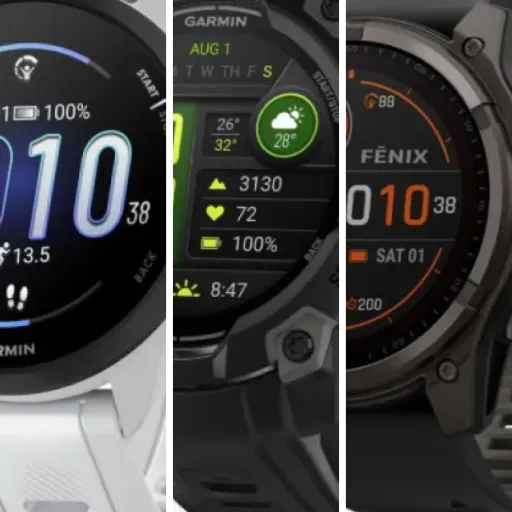
I’ve been using the SUUNTO Vertical 2 (Pine Green) for a few weeks as my main sports and everyday watch. Before this, I was mostly on Garmin (Fenix line) and tried a couple of cheaper Chinese multisport watches. So I’m not coming at this as a hardcore Suunto fan, more as someone who wanted good battery life, solid GPS, and a screen I can actually read outside without squinting. This watch clearly targets the same crowd as the big Garmin outdoor models, but with a slightly different philosophy.
Right away, the thing that stands out is the AMOLED screen plus the rugged feel. On the wrist, it feels like a serious tool, not a fashion gadget. At the same time, the interface is a bit more old-school and less flashy than Garmin’s. That can be good or bad depending on what you like. Personally, I care more about reliability and clear data than fancy animations.
During these weeks, I used it mainly for running, cycling (indoor and outdoor), some pool swimming, and day-to-day stuff like notifications and sleep tracking. I also played with the offline maps and the built-in flashlight during a couple of evening runs and a hike. I didn’t baby it: it got sweat, light rain, and a couple of bumps against a door frame and a wall at the gym. So what follows is not a lab test, just normal user abuse.
Overall, my impression is that the Vertical 2 is a strong outdoor watch with very good battery and GPS, but it’s held back a bit by some weird software choices and a few missing quality-of-life features. It’s not bad at all, but it’s also not perfect, especially if you’re coming from a highly polished Garmin ecosystem. I’ll break it down by what actually matters in daily use: design, comfort, performance, battery, durability, and value.
Value: good deal if you care about battery and outdoor use
In terms of value for money, the Vertical 2 sits in that mid-to-high price bracket, roughly in the same territory as some Garmin Fenix and Forerunner models. It’s not cheap, but you’re paying for a specific combo: rugged build, big AMOLED screen, long battery life, offline maps, and a ton of sport modes. If you’re the kind of person who actually uses those things (regular running, hiking, cycling, maybe triathlon), then the price starts to make sense. If you mostly want notifications and step counting, this is overkill and you’d be better off with a cheaper tracker.
Compared to Garmin, you’re trading some software polish and ecosystem depth for better perceived value on hardware. One Amazon reviewer said it plainly: the GUI isn’t as flashy as Garmin, but the screen is bigger and brighter, and GPS battery life is better for the money. I tend to agree. You can feel that SUUNTO doesn’t have the same huge platform of apps, watch faces, and integrations. But if your main use is recording workouts and navigating outdoors, you’re not missing much that actually matters day to day.
Where value dips slightly is the user experience quirks: needing the app to edit sports screens, being locked out of some settings during recordings, and missing small features like tap-to-wake or palm-to-turn-off for the screen. These aren’t deal-breakers, but they make the watch feel less refined than it could be. For the price, I expected a bit more flexibility on-device. On the plus side, you do get a 2-year manufacturer warranty, which is decent, and the hardware feels like it will last longer than that if not abused.
Overall, I’d rate the value as pretty solid if your priorities are: long battery, tough build, clear screen, and reliable sports tracking. If you’re very picky about software convenience and fancy smartwatch features, you might feel the price is a bit steep for what you get. It really depends if you see this as a training tool or as a lifestyle gadget.
Design: rugged tool first, pretty object second
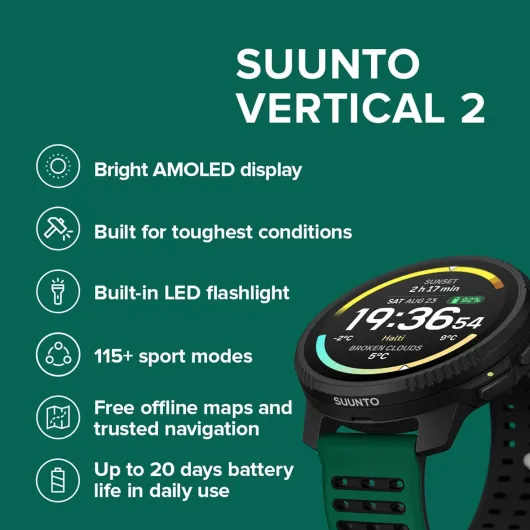
Design-wise, the Vertical 2 is clearly built as a rugged outdoor watch. It’s on the larger side with the 1.5-inch round display and chunky bezel, so if you have a very small wrist, it will look and feel big. On my average male wrist, it looks like a proper sports watch, not ridiculous, but definitely not discreet. The Pine Green color actually works well in real life: it’s a muted green, not neon, so it doesn’t scream “toy gadget”. The bezel and case feel solid, and nothing rattles or flexes when you press the buttons.
The AMOLED screen is the main design highlight. The colors are punchy and text is sharp enough that you don’t need to guess numbers during a run. In direct sunlight, it holds up better than older LCD watches I’ve used, although you still sometimes need to tilt your wrist for the best angle. Indoors and at night, it looks very clean. The bezels are not ultra thin, but for a sports watch that doesn’t bother me; I’d rather have protection than edge-to-edge glass I’m scared to hit.
Button layout is pretty classic SUUNTO: you’ve got physical buttons plus the touchscreen. The buttons have a clear, firm click, which I like for workouts because sweaty fingers on a touchscreen are never ideal. The downside is that the interface design feels a bit dated compared to Garmin or Apple. It works, but it’s not super intuitive at first, and the icons and menus don’t look very modern. Once you get used to it, it’s fine, but the first days I had to fumble a bit to find certain options.
Overall, I’d describe the design as functional and tough, not stylish or refined. If you want a watch that passes as a dress watch with a suit, this is not it. If you want something that looks like it can handle a hike, a trail run, and a muddy bike ride without crying, this fits the bill. Personally, I prefer this honest, tool-like approach, but it’s clearly not made for people who care a lot about fashion or slim profiles.
Battery life: the real selling point
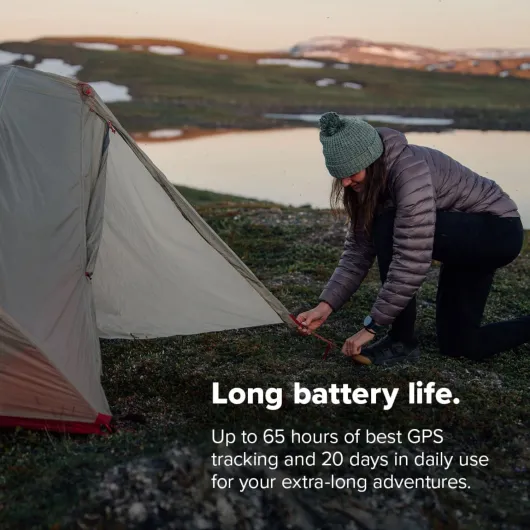
The battery life is probably the main reason to pick this watch over a more smartwatch-style device. SUUNTO advertises up to 20 days of daily use and around 65 hours of GPS tracking, depending on mode. In my actual mixed use, I got roughly a bit over two weeks on a full charge with:
- Daily wear with notifications (moderate volume, not buzzing every minute)
- 3–4 GPS workouts per week (45–90 minutes each)
- Always-on heart rate tracking
- Screen not always-on, but waking frequently
During long GPS sessions, the battery drain is predictable and not too aggressive. A 1-hour run on full GPS accuracy cost me around 3–4% battery, which lines up with the 65-hour claim. If you do ultra-distance stuff or long hikes, that’s comforting because you’re not forced to constantly think about saving power. There are different GPS and power modes you can pick depending on whether you want maximum accuracy or maximum endurance.
Charging is via a proprietary cable (of course…), which snaps on easily enough. Full charge from low battery takes roughly a couple of hours, which is fine given how rarely you need to do it. I would have liked USB-C directly on the cable side, but that’s nitpicking. At least the connection is stable and doesn’t randomly disconnect with a slight bump on the table. The watch doesn’t heat up noticeably while charging.
Compared to something like an Apple Watch, the Vertical 2 feels liberating in battery terms. You don’t have to plan your workouts around charging or worry about it dying halfway through a long ride. Against Garmin Fenix-type devices, it’s in the same league, maybe even slightly better in some GPS modes. For me, this is one of the clearest strengths of the watch: if you hate charging, you’ll be happy here. Just don’t expect miracles if you crank every feature to max and run GPS all day; physics still applies.
Comfort: good once you fix the strap situation
Out of the box, the Vertical 2 comes with a silicone strap and a classic buckle. The strap is sturdy but a bit stiff, especially the first days. One Amazon reviewer mentioned swapping it for a nylon elastic strap with a magnetic clasp, and I ended up doing something similar after a week. With the original strap, I had to choose between wearing it slightly too tight for good heart rate readings or slightly too loose and feeling it move around during runs. Not terrible, but not ideal either, especially for long workouts.
With a softer, more flexible strap, comfort improved a lot. The watch still has weight (around 87 g), but once the strap distributes it better, it stops being annoying. I wore it to sleep for a few nights to test sleep tracking; you can feel it, but it didn’t wake me up or dig into the wrist. If you’re used to slim lifestyle watches, you will notice the bulk. If you’ve worn a Fenix or similar, this is in the same ballpark and perfectly manageable.
In terms of daily comfort, the watch case doesn’t have sharp edges, and the back sensor area sits flat against the skin. I didn’t get any irritation or redness, even with sweat and showering with it on. The silicone band is fine for water and cleaning; you just rinse it and you’re done. For longer runs (over an hour), I did notice that I had to adjust the strap a couple of times because it would either feel a bit too tight as my wrist warmed up or slightly loose. That’s pretty standard for silicone bands, not unique to this watch.
So from a comfort point of view: it’s okay to good, depending heavily on the strap you use and how much you tolerate a bigger, heavier watch. I’d recommend budgeting a bit for a different strap if you’re picky about fit. Once that’s sorted, it’s a watch you can wear all day and night without real problems, but it won’t disappear on your wrist like a tiny fitness band.
Durability: built to be knocked around
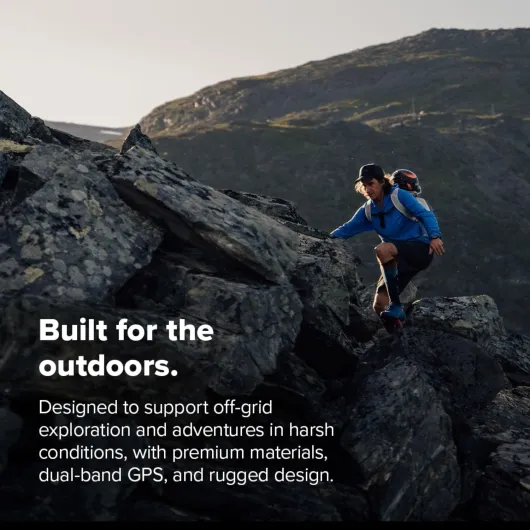
Durability-wise, the Vertical 2 feels reassuringly tough. The case has a solid, dense feel, and after several weeks of daily wear plus sports, I don’t see any major scratches or damage. I definitely bumped it into a metal door frame and scraped it lightly against a rough gym wall, and it came out without anything more than maybe tiny hairline marks you have to hunt for. The bezel protects the screen edges reasonably well, so you’re not constantly worried about chipping the glass with every accidental tap.
The 100 m water resistance is more than enough for normal users. I used it for pool swimming and showering, no issues at all. Buttons still click fine after being wet and sweaty multiple times. The silicone strap also holds up well to water and sweat; no peeling or weird smell so far, and it’s easy to rinse clean. Over a longer period, silicone straps can crack or stretch, but that’s true of almost any brand. At least the watch uses standard 22 mm straps, so replacing them is easy and cheap.
One area I can’t fully judge long-term yet is the AMOLED screen burn-in or fading. So far, brightness is still good and colors look the same as day one. AMOLED can be a bit more fragile than older transflective displays, but with the Vertical 2, I haven’t seen any signs of ghosting or burn-in. The watch does a decent job of managing screen timeouts to avoid leaving static images up for hours.
Overall, I’d say the durability is very decent for an outdoor watch. It’s not indestructible, and if you smash it straight into rocks on a climb, you’ll probably mark it, but for running, cycling, hiking, and everyday bumps, it absolutely holds its own. If you want extra peace of mind, a cheap screen protector might be worth it, but I didn’t feel like it was mandatory. The build quality matches the price point and target use pretty well.
Performance and GPS: strong tracking, clunky software choices
On the performance side, the Vertical 2 does what it’s supposed to: track your sports reliably. GPS lock is reasonably fast in my experience: usually 10–20 seconds in open areas, maybe a bit longer in dense city streets. Once locked, the tracks look clean on the map. On my usual running route, the path overlay was very close to reality, and it didn’t cut corners or throw me into buildings like some cheaper watches do. Compared with a friend’s Garmin on the same run, distance and pace numbers were basically the same, with only small differences you’d expect from wrist placement and sampling.
Heart rate tracking from the wrist is decent but not perfect, which is exactly what I expected. For steady runs and bike rides, it follows my effort pretty well. For short intervals or sudden changes, it lags a bit. That’s normal for optical wrist sensors. With the strap tightened properly (and especially after switching to a softer strap), the readings improved. If you’re serious about training zones, I’d still pair a chest strap for intervals. Blood oxygen (SpO2) works, but I treat it more as a rough indicator than a medical reading.
Where performance gets mixed is the software and user experience. A few annoying points line up with what one Amazon reviewer said:
- When you’re in a sport recording, you’re basically locked into that mode; you can’t freely browse all other menus.
- Some basic things like reordering sports or editing screens must be done from the app, not the watch.
- If the watch is doing certain tasks (e.g., recording HR or a workout), some watch settings are blocked in the app.
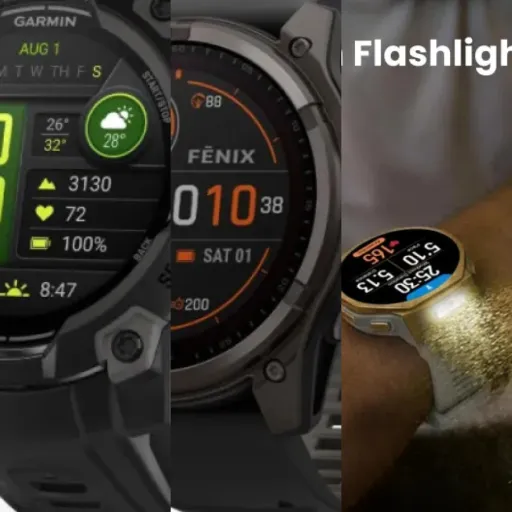
Navigation performance is solid: offline maps load fine, and following a route is straightforward once you get used to the interface. The built-in LED flashlight is more useful than it sounds; I used it a few times in dark stairwells and on a night run to check the ground. It won’t replace a real headlamp, but as a backup light it’s handy. Overall, performance is technically strong (GPS, sensors, navigation) but dragged down a bit by software that could be smoother and more flexible. If you’re patient and don’t mind a slightly clunky interface, it gets the job done very well.
What this watch actually offers on paper
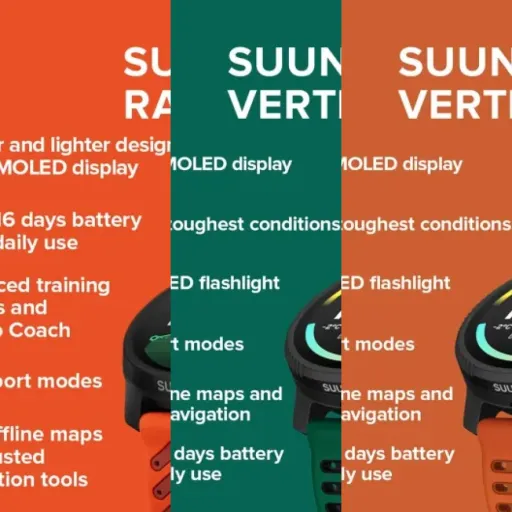
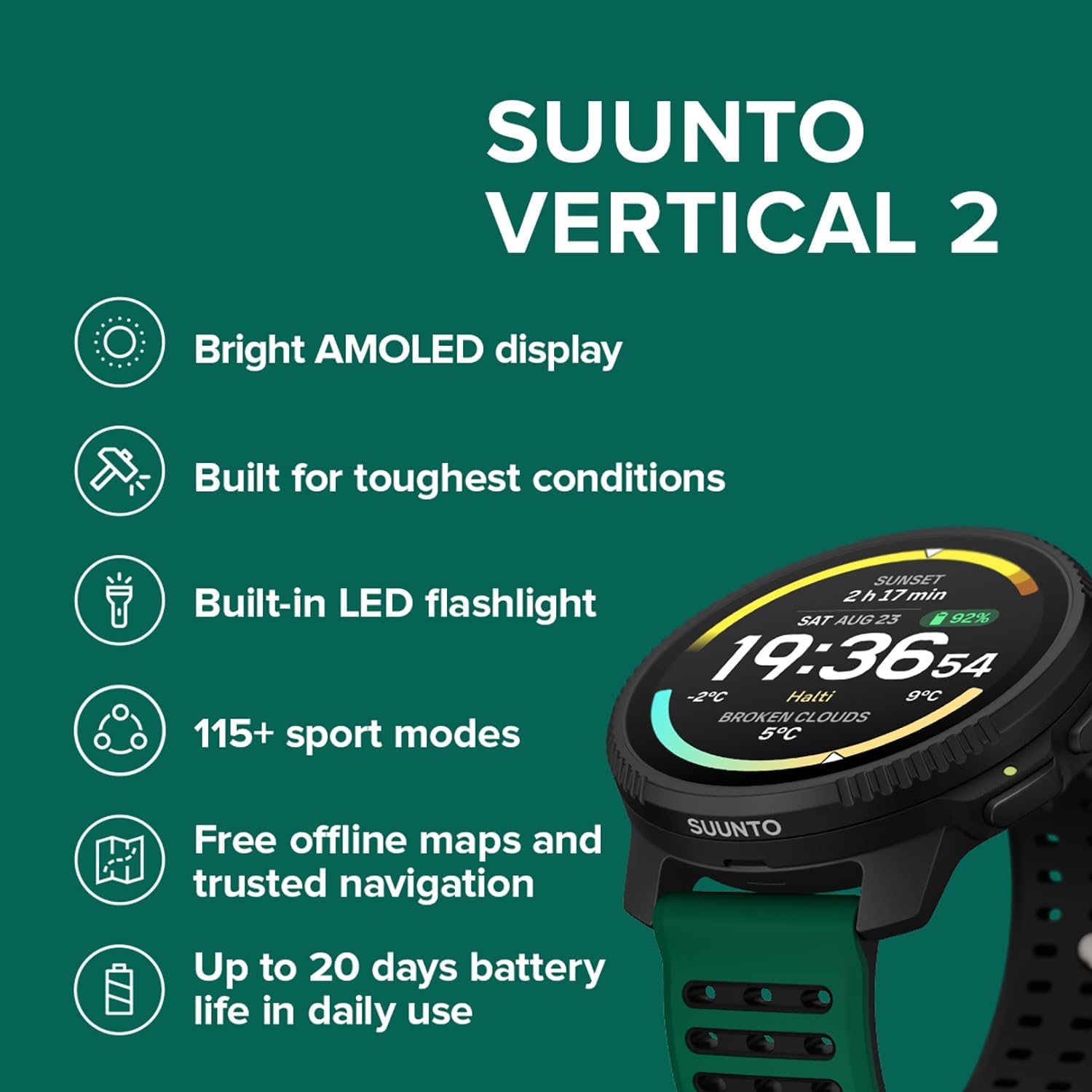
On paper, the SUUNTO Vertical 2 is packed. You get a 1.5-inch AMOLED display with 320 x 320 resolution and up to 500 nits brightness, which is plenty for outdoor use. There’s built-in GPS with support for major satellite systems, offline maps, 115+ sport modes, and a built-in LED flashlight. Storage is 32 GB, so there’s room for maps and some extras. SUUNTO claims up to 20 days of battery in daily use and around 65 hours in GPS mode, depending on settings. It’s water resistant to 100 meters, so swimming is no issue.
In terms of smart features, it connects via Bluetooth to Android and iOS, does heart rate and blood oxygen tracking, and supports common things like alarms, weather, basic notifications, and some music control (through the phone). It’s not trying to be a full smartwatch like an Apple Watch; it’s more of a sports and outdoor tool with some smart extras. The watch weighs around 87 grams, which is noticeable but normal for this type of rugged GPS watch. Band is 22 mm silicone with a classic buckle.
One thing to keep in mind is the software approach. A lot of configuration goes through the SUUNTO app: editing sport profiles, changing data fields, and so on. Some users like that because it’s easier to do on a phone; others find it annoying because you can’t tweak everything directly on the watch. Several Amazon reviews mention this, and I felt it too. Also, if the watch is in the middle of a sport recording or measuring something, the app is basically locked out for some settings, which feels clumsy in 2026.
So in short: on paper you get a feature-packed outdoor watch with a bright screen, long battery, offline maps, and a focus on sports tracking over fancy smartwatch features. If you’re expecting a mini smartphone on your wrist, this is not it. If you’re expecting a reliable training and navigation tool that can live on your wrist all week, that’s more in line with what this device is built for.
Pros
- Very good battery life (easily over a week, often close to two with regular training)
- Bright 1.5-inch AMOLED screen that stays readable outdoors
- Rugged build with 100 m water resistance and solid GPS performance with offline maps
Cons
- Software and interface feel clunky, with too many settings only editable in the app
- Original silicone strap is stiff and not the most comfortable for long sessions
- Missing some convenience features like tap-to-wake and more flexible in-workout navigation of menus
Conclusion
Editor's rating
The SUUNTO Vertical 2 is a serious outdoor and sports watch that focuses on the basics: strong GPS, long battery life, rugged build, and a bright AMOLED screen you can actually read outside. In everyday use, it tracks runs, rides, swims, and hikes reliably, and the offline maps plus built-in flashlight are genuinely useful, not just marketing bullets. The hardware feels solid and trustworthy, and the 2+ weeks of real-world battery life is a clear advantage over more smartwatch-like devices.
On the downside, the software feels a bit clunky. You have to use the app for too many basic tweaks, you get locked out of some settings during workouts, and some small convenience features (tap-to-wake, better alarm behavior, more shortcuts) are missing. If you’re coming from Garmin, you’ll probably notice the drop in polish and ecosystem depth. If this is your first serious GPS watch, you might just think “it’s a bit old-school, but it works”.
I’d recommend the Vertical 2 to people who train regularly outdoors, care a lot about battery and durability, and don’t obsess over having the slickest software on the market. Trail runners, hikers, cyclists, and triathletes who want a tough watch that can stay on the wrist for days without charging will get good use out of it. If you mainly want a stylish smartwatch with rich apps, or if you’re deeply invested in Garmin’s platform, I’d look elsewhere. For what it is—a robust sports tool with strong GPS and battery—it delivers good value, with some rough edges you have to accept.