
Summary
Editor's rating
Value: worth it if you’ll actually use the H10 and Polar’s training tools
Design: light on the wrist, a bit generic on the eye
Battery: good for training, not the longest but decent
Comfort: good for long sessions, with one thing to watch out for
Performance: strong on metrics, average on smartwatch stuff
What you actually get with the Vantage V2 + H10 bundle
Pros
- Very good training features: training load, recovery tracking, and performance tests are genuinely useful
- H10 chest strap provides accurate and stable heart rate data, much better than wrist-only for intervals and cycling
- Light, comfortable watch with solid battery life for several days of mixed GPS and daily use
Cons
- Smartwatch features are basic: no music storage, no payments, limited interaction with notifications
- Screen is functional but not very bright or sharp compared to AMOLED competitors
- Some concerns about strap durability based on user reviews, potential quality control inconsistency

Specifications
View full product page →| Brand | Polar |
A watch for people who actually train, not just count steps
I’ve been using the Polar Vantage V2 with the H10 chest strap for a few weeks, mainly for running, indoor cycling and some strength sessions. Before this, I was on a basic Garmin Forerunner and a cheap fitness band, so I’m not coming from some super high-end setup. I wanted something that tracks heart rate properly, has decent GPS, and doesn’t die after two runs. This combo is clearly aimed at people who actually train several times a week, not just want phone notifications on their wrist.
Right away, what struck me is that this feels more like a training tool than a lifestyle gadget. The menus, the Polar Flow app, the tests, the training load stuff – it’s clearly built for people who care about stats and structure. If you’re used to simple step counters, the amount of data here can feel a bit overwhelming at first. I actually had to sit down one evening and click through everything to understand what was what.
On the positive side, the pairing with the H10 strap was smooth and the watch kept connection during runs and bike rides. No weird dropouts for me. I also liked that I could import all my old Polar data through Polar Flow, a bit like one Amazon reviewer mentioned migrating from an older Polar. If you’re already in the Polar ecosystem, the transition is pretty painless. If you’re new, expect a small learning curve but nothing dramatic.
Overall, my first impression is that the Vantage V2 + H10 combo is pretty solid if you care about heart rate, training load and structured workouts. It’s not perfect – some smart features feel basic compared to Apple Watch or high-end Garmin, and the strap situation seems hit-or-miss based on some reviews. But if you want a watch that focuses on training and recovery instead of flashy apps, this one gets the job done without being just hype.
Value: worth it if you’ll actually use the H10 and Polar’s training tools
Price-wise, the Vantage V2 with the H10 strap sits in the mid-to-high range for sports watches. You can find cheaper GPS watches that track runs and rides, and you can also find more expensive models with maps, music storage, and payments. Where this bundle makes sense is if you actually care about accurate heart rate and structured training, not just step counts and pretty screens. The fact that you get the H10 in the box is a big plus; buying a chest strap separately can add a fair chunk to the bill.
Compared to a similar Garmin + HR strap combo, the Polar often comes in a bit cheaper or about the same depending on deals. The trade-off is that Polar is more focused on training metrics and less on smartwatch features and fancy mapping. If you want a watch that does everything – maps, music storage, contactless payments, app store – you might be happier spending your money on a higher-end Garmin or an Apple Watch, and then adding a separate HR strap if needed. If, instead, you mainly want solid training data and don’t care about paying at the supermarket with your wrist, the Vantage V2 bundle is decent value.
The main downside from a value point of view is the potential strap issue mentioned in the one-star Amazon review. If you’re unlucky and get a bad strap, dealing with returns or warranty is just a hassle you don’t want at this price. My unit was fine, but it’s worth mentioning because it affects how confident you feel about the purchase. On the upside, you do get a 2-year manufacturer warranty, and Polar generally has a decent reputation in the endurance sports world.
So, is it good value? I’d say yes if you’re training 3–4 times a week or more and will actually use the training load, recovery, and performance tests. In that case, the data you get out of it justifies the price. If you’re more casual and just want something to count steps, show messages, and track the odd run, there are cheaper watches that will do that job without all the extra metrics you’ll probably ignore.
Design: light on the wrist, a bit generic on the eye
The design is pretty straightforward: a round aluminium case, minimal bezel, and a simple buckle strap. It weighs about 52 g for the watch head, which is light for a multisport watch. On the wrist, it doesn’t feel bulky like some chunky outdoor models. During runs and intervals, I barely noticed the weight, which is good if you’re used to lighter running watches. The lime accent on the band gives it a sporty look. Personally, I found the grey/lime combo fine for training, but a bit loud for the office. You can swap the band, but that’s an extra cost.
The screen is a 240×240 MIP panel. It’s not going to impress anyone who’s used to a bright smartwatch display. Indoors, especially under dim light, it can look a bit dull and washed out. Outdoors, though, it stays readable, which is what really matters when you’re trying to check pace mid-interval. The always-on nature of these MIP screens is practical; no need to flick your wrist dramatically to wake it up. Touch plus physical buttons is a good combo: I actually used the buttons more during runs because sweaty fingers and touchscreens don’t mix well.
Build-wise, the aluminium case feels solid and doesn’t scream cheap. I didn’t baby it and knocked it on a door frame and some gym equipment; no major marks so far. However, Amazon reviews mention strap issues, including one user who had the strap detach and a pin go missing after ten days. My unit hasn’t done that, but it’s worth checking the pins and attachment points when you first get it. The watch is rated waterproof and is fine for swimming, though the spec sheet shows IP67 in places and generic “waterproof” in others, which is a bit confusing. I used it for pool swims and showers with no problem.
Overall, the design is functional rather than pretty. It looks like a sports watch, not a piece of jewellery. If you want something flashy to wear with a suit, this isn’t it. But if you want a light, comfortable training watch with a simple layout and usable screen outdoors, the design does the job. Just keep in mind the screen is more about practicality than visual punch, and you may want a second strap if the lime colour doesn’t fit your daily style.
Battery: good for training, not the longest but decent
Battery life is one of the reasons I wanted something more serious than a standard smartwatch. The Vantage V2 is advertised at about 7 days, and in real use I got something close to that, but it depends a lot on how much GPS you use. With roughly 4–5 GPS workouts per week (around 5 hours total), plus daily wear, phone notifications on, and sleep tracking, I was landing around 5–6 days per charge. If I cut back on GPS and used it more like a basic activity tracker, I could stretch it a bit longer.
During continuous GPS workouts, the battery drain seemed reasonable. On a 1-hour run with GPS and HR strap, I saw around 6–8% drop, which lines up with what you’d expect for a watch in this category. That means marathon-level runs or long bike rides are not a problem. You’re not going to kill the battery in a single long session unless you go ultra-distance. There are also power-saving options (like reduced GPS accuracy), but I didn’t really need them for my training.
Charging is done through a proprietary cable that clips onto the back. Not my favourite type of connector, but it’s solid enough and didn’t disconnect easily when bumped. From near-empty to full, it took roughly 1.5–2 hours on a normal USB charger. I got into the habit of plugging it in while working on the laptop once or twice a week, and that was enough. If you’re coming from a daily-charging smartwatch, this feels like a nice upgrade. If you’re used to some ultra-endurance watches with multi-week battery, this will feel more middle of the road.
Overall, I’d say the battery is good but not mind-blowing. It handles regular training plus daily wear without stress, and you don’t have to think about it every night. For most runners, cyclists, and triathletes who train a few times a week, it’s plenty. If you’re expecting 2–3 weeks of heavy use without charging, this isn’t that, but it’s reliable enough that battery life doesn’t get in the way of training.
Comfort: good for long sessions, with one thing to watch out for
On the wrist, the Vantage V2 is comfortable. The weight is low enough that it doesn’t feel like a brick, and the round shape sits nicely even during longer runs. I wore it day and night for several days in a row, including sleep, and didn’t feel the need to take it off because of discomfort. The strap is soft enough and has enough holes to adjust tightness properly. I tended to wear it slightly tighter for workouts to keep the optical sensor stable, and a bit looser the rest of the day.
For the H10 chest strap, comfort is decent once you get used to it. I’ve used cheaper chest straps before that felt like sandpaper. The H10 is a bit better: the material is softer and the strap doesn’t slip much once you adjust it. On longer runs (over an hour), I pretty much forgot it was there. For indoor cycling, with more sweat, I had to re-adjust it once or twice but nothing dramatic. Obviously, if you hate the feeling of anything around your chest, you won’t magically like it, but as chest straps go, this one is fine.
One thing I did pay attention to after reading the Amazon review about the strap failing: the connection points. After a week, I checked the pins and the plastic where the band attaches. Mine looked fine, no oxidation or cracks. But it’s fair to say quality control might be inconsistent if someone had a strap fall off in 10 days. If you buy it, I’d suggest giving the strap a good tug test early on and maybe contacting support quickly if anything feels loose. It’s annoying to worry about your watch falling off mid-run.
For sleep tracking, the watch is okay. The thickness is noticeable if you’re not used to sleeping with a watch, but after a few nights I didn’t pay attention to it anymore. The band didn’t irritate my skin, and the back of the watch didn’t leave any weird marks. Overall, in terms of comfort, I’d say it’s pretty solid: light enough for daily wear, stable enough for workouts, and the chest strap is manageable even on longer sessions. Just keep an eye on the strap hardware early on, given the one-star complaint.
Performance: strong on metrics, average on smartwatch stuff
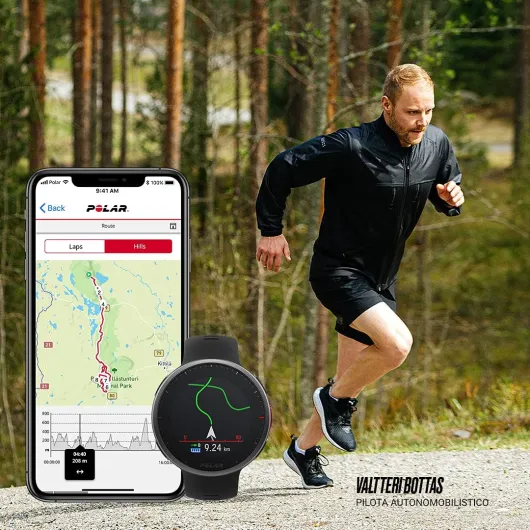
This is where the Vantage V2 + H10 combo actually shines. In workouts, the GPS lock was quick most of the time – usually under 20–30 seconds for me in open areas. On my usual 10 km loop, distance and pace were consistent from run to run. When I compared it to my older Garmin data, the totals were very close, with small differences that you’d expect from any GPS device. No weird zig-zag tracks or random dropouts. For cycling, GPS behaved similarly, and the route guidance feature was handy once I loaded a GPX route through Polar Flow.
Heart rate with the H10 strap is where this setup really pulls ahead of wrist-only watches. With the strap, HR curves looked smooth, and intervals were picked up quickly. When I tried a couple of runs with just the wrist sensor, it was okay but clearly less responsive at the start of intervals and during sudden changes. For steady runs or daily tracking, the wrist HR is fine. For serious interval work or cycling, the chest strap is simply better. That’s probably the biggest reason to get the bundle instead of just the watch alone.
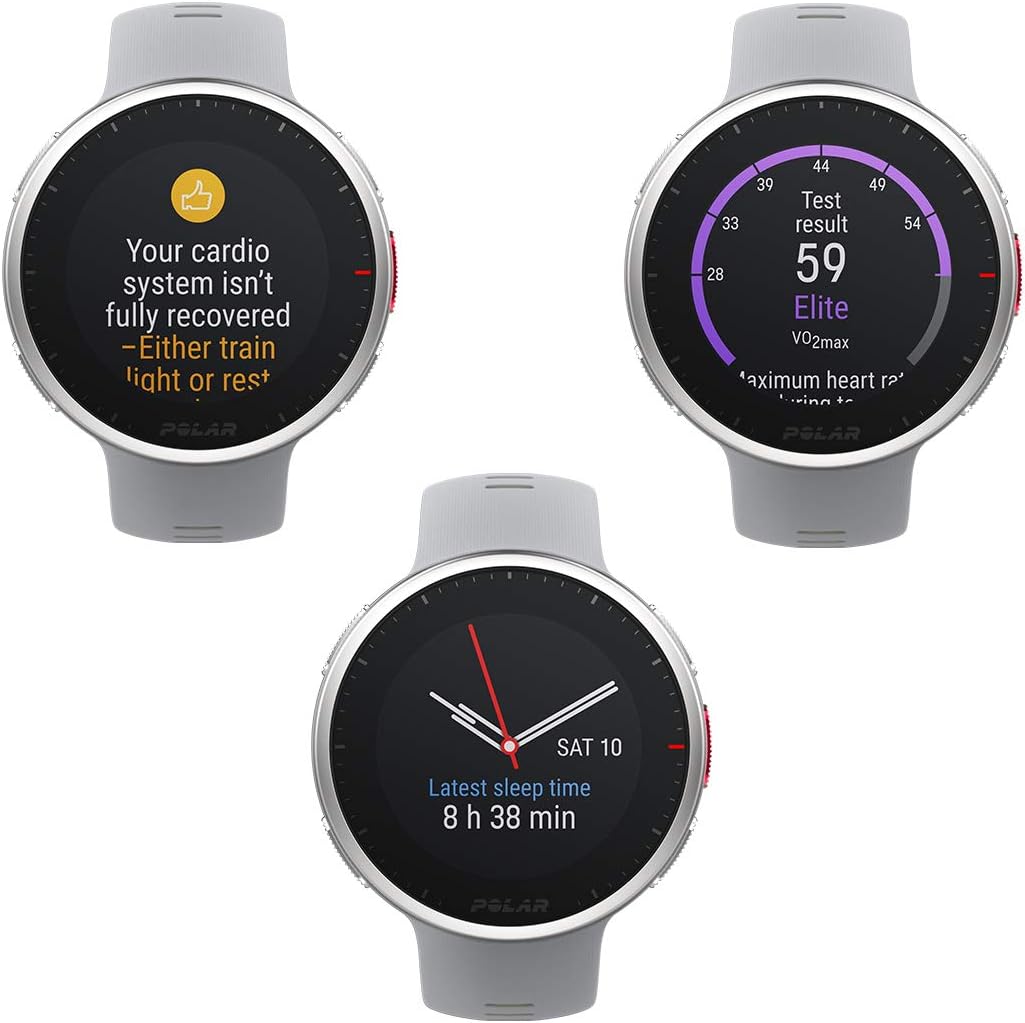
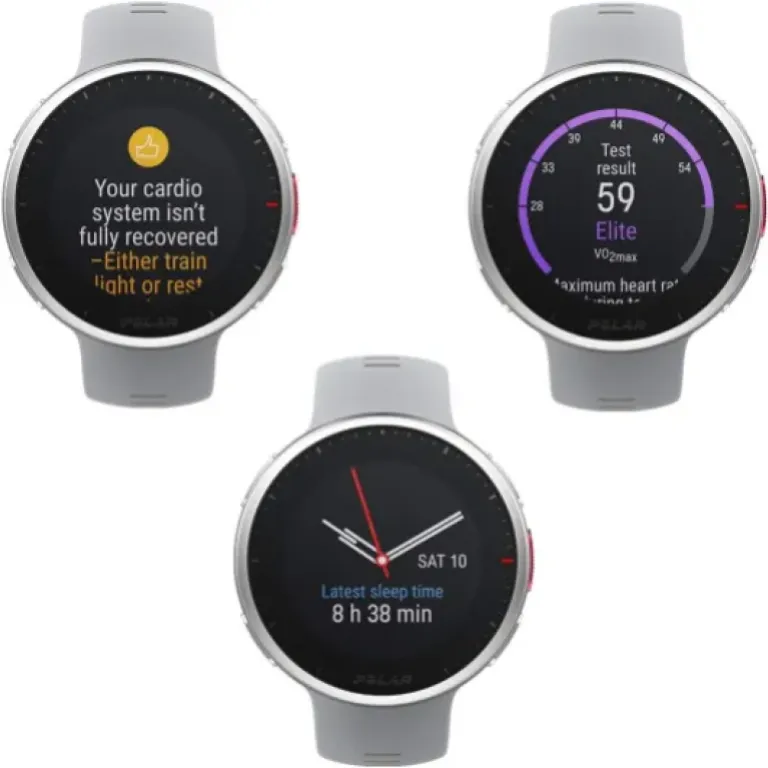
The training load and recovery features are useful if you like structured training. The watch and app estimate how strained your cardiovascular system is and how recovered you are based on sleep and previous sessions. I found the recovery suggestions mostly reasonable: after a hard interval day and a short night, it suggested taking it easy, which matched how I felt. It’s not magic, but it’s a nice sanity check to avoid stacking too many hard days. The running performance test was also helpful to update my pace and HR zones without guessing.
On the smartwatch side, it’s basic. You get phone notifications (texts, calls, app alerts) but you can’t really interact much with them. Music controls work fine: you can skip tracks and adjust volume on your phone, but there’s no onboard storage. Weather is simple but does the job. No app store, no contactless payments, no voice replies. If you’re used to an Apple Watch or a Samsung Galaxy Watch, this will feel barebones. But if your main priority is training data, and you’re okay with simple notifications and music controls, the performance is solid where it matters for sports.

What you actually get with the Vantage V2 + H10 bundle
Out of the box, you get the watch, the charging cable, and the H10 chest strap. That’s it – no fancy extras, but at least everything you need to start tracking properly is there. The bundle is clearly positioned as a more serious training pack: you have wrist-based heart rate for casual tracking and the H10 strap when you want proper accuracy. I used the strap for pretty much all my runs and indoor rides, and the watch alone for daily wear and casual walks.
The watch itself is a round, aluminium unit, 47 mm wide and about 13 mm thick, with a MIP display at 240×240 resolution. On paper that sounds fine, but it’s not as sharp or flashy as an AMOLED screen. In practice, it’s readable outdoors and that’s what matters during workouts. The bundle is unisex, and I’d say it fits medium to larger wrists best. On a very small wrist it might feel a bit big, but not ridiculous. The included band is a grey/lime combo – looks sporty, not really discreet, so if you want something more neutral for work you might end up buying another strap.
Function-wise, the watch covers the usual: GPS, wrist HR, sleep tracking, training load, recovery tracking, music controls (note: controls only, no music storage), weather, and phone notifications. It syncs to the Polar Flow app, and from there you can link to Strava, TrainingPeaks, Adidas Running, and the rest. That’s handy if you already have a training setup. The watch can also run performance tests for running and cycling, and there’s the FuelWise feature that reminds you to eat/drink on longer sessions. I tried the running test once; it’s basically a structured run where the watch pushes you through different intensities to estimate your thresholds.
In terms of position in the market, this is not a pure smartwatch like an Apple Watch, and not the most loaded multisport device like top-tier Garmin Fenix models. It lands somewhere in between: more focused on training science than on apps and flashy watch faces. If you expect app stores and contactless payments, you’ll be disappointed. If you want solid metrics, decent GPS and good HR with the H10, the bundle makes sense. The main thing to know is: you’re buying a training tool first, a smartwatch second.
Pros
- Very good training features: training load, recovery tracking, and performance tests are genuinely useful
- H10 chest strap provides accurate and stable heart rate data, much better than wrist-only for intervals and cycling
- Light, comfortable watch with solid battery life for several days of mixed GPS and daily use
Cons
- Smartwatch features are basic: no music storage, no payments, limited interaction with notifications
- Screen is functional but not very bright or sharp compared to AMOLED competitors
- Some concerns about strap durability based on user reviews, potential quality control inconsistency
Conclusion
Editor's rating
After using the Polar Vantage V2 with the H10 strap for a while, my take is pretty clear: it’s a solid training watch for people who care about data more than flashy smartwatch features. GPS is reliable, the H10 strap gives you proper heart rate accuracy, and the training load and recovery tools in Polar Flow are genuinely useful if you like structured training. Battery life is good enough that you’re not charging every day, and the watch is light and comfortable for long sessions and sleep.
On the flip side, this is not the most advanced smartwatch. Notifications are basic, there’s no music storage, no payments, and the screen is functional rather than impressive. The design is sporty and a bit generic, and there’s at least one user report of a strap failing early, which is something to keep an eye on. If you want a watch that does everything your phone does, this isn’t it. If you’re more into running, cycling, swimming, and actually following a training plan, it’s a good fit.
I’d recommend this bundle to runners, triathletes, and serious gym-goers who train several times a week and want accurate heart rate plus good training insights. It’s also a good step up if you’re already in the Polar ecosystem and want to keep your data history. People who are casual exercisers, or who mainly want a smartwatch for apps and lifestyle features, should probably look at cheaper fitness watches or something like an Apple Watch or a more feature-packed Garmin instead.