
Summary
Editor's rating
Value for money: better deal if you care about sports more than fancy software
Design: big, rugged, and not trying to be a fashion item
Battery life: finally a watch you don’t have to baby every night
Comfort: good once adjusted, but the stock strap isn’t for everyone
Durability and water resistance: built to be knocked around
Sports and GPS performance: solid tracking, a few software quirks
What this watch actually offers (beyond the buzzwords)
Pros
- Excellent battery life for an AMOLED sports watch (roughly 12–16 days real use)
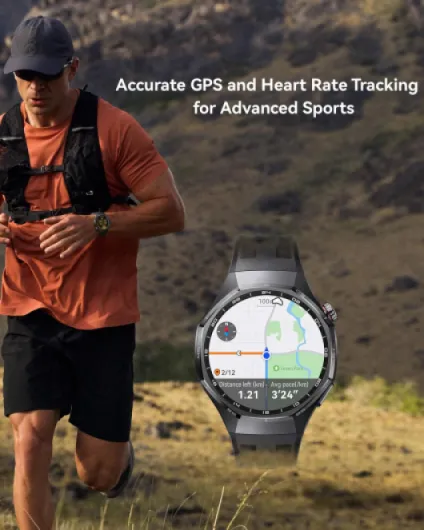
- Bright, readable screen and solid GPS tracking with offline maps
- Rugged, water‑resistant build (100 m) that feels ready for real outdoor use
Cons
- Interface and app feel less polished, with some odd limitations during activities
- Bulky and fairly heavy on the wrist, stock strap is stiff until replaced or broken in

Specifications
View full product page →| Brand | SUUNTO |
A big, serious watch for people who actually go outside
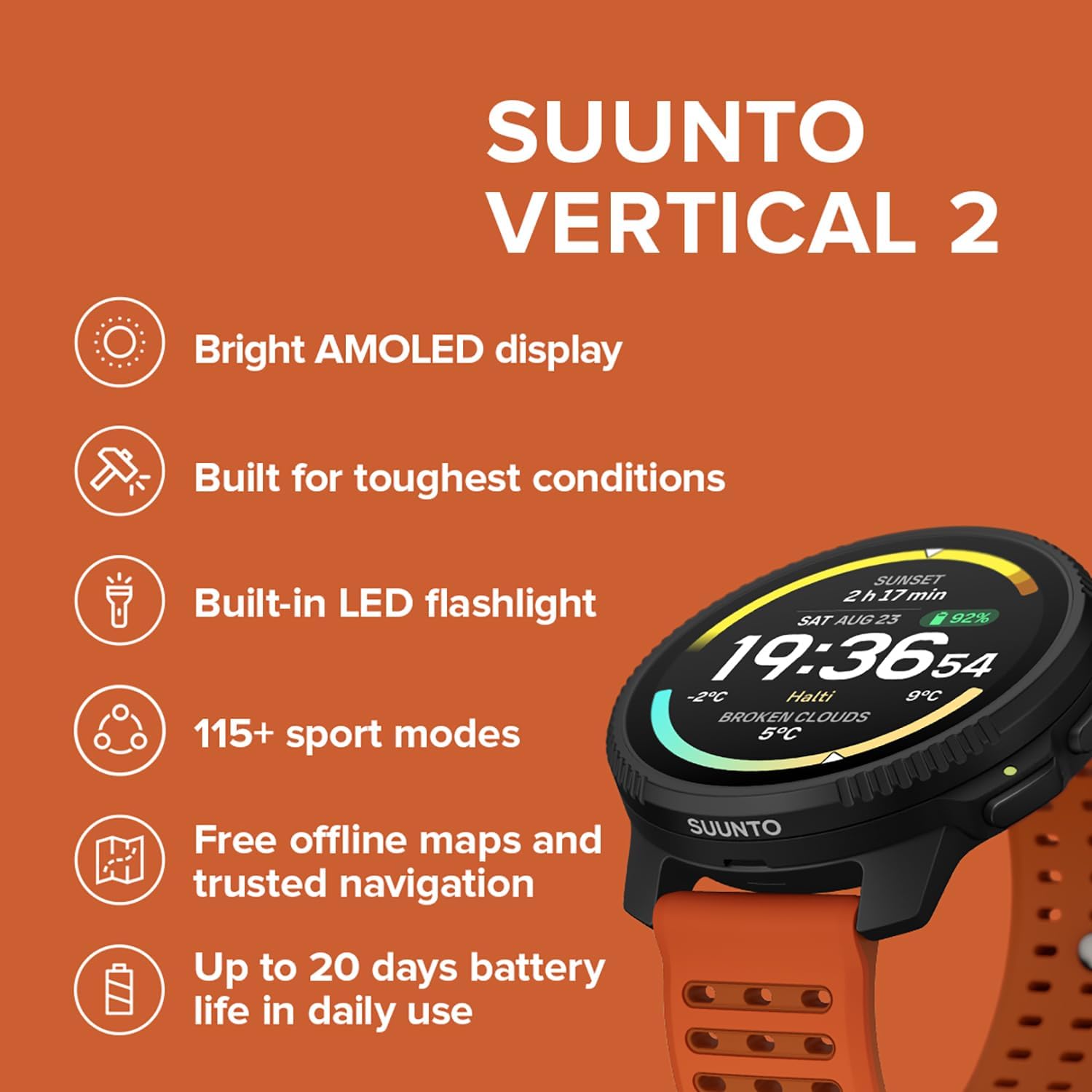
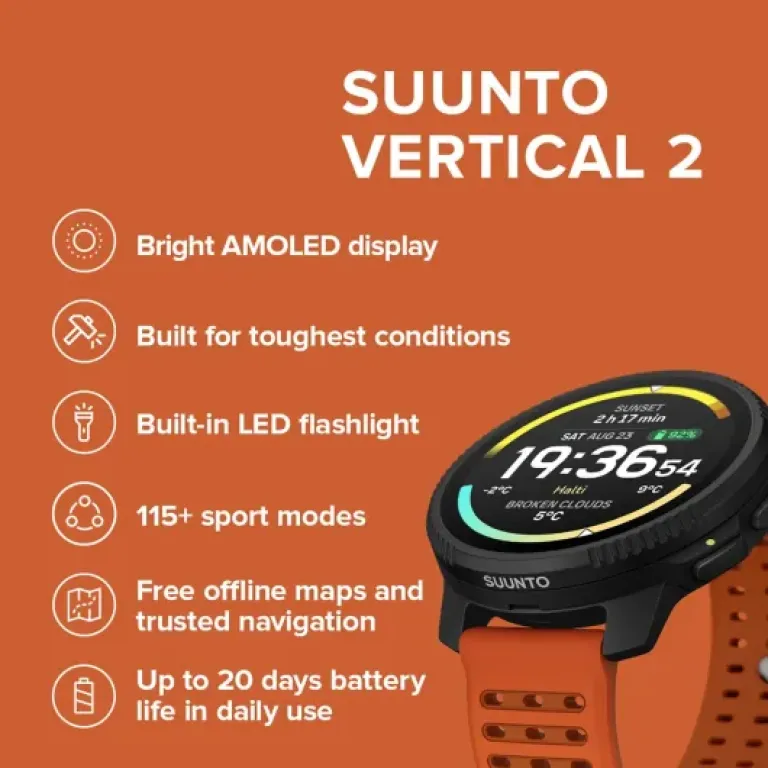
I’ve been using the SUUNTO Vertical 2 (Canyon color) for a few weeks now, mainly for running, cycling and some short hikes. I came from a Garmin (Fenix line), so I wasn’t exactly new to this type of watch. I wanted something with strong GPS, long battery life, and a screen that doesn’t look like it’s from 2012. On paper this Suunto ticks all those boxes: AMOLED, 20‑day battery, offline maps, 115+ sport modes and all the usual tracking stuff.
In everyday use, the first thing that hit me is that this is a big and quite heavy watch. At 87 grams, you feel it on the wrist, especially if you’re used to lighter watches or bands. It’s clearly made more for people who are fine with a chunky tool watch than for someone who wants something discreet under a shirt cuff. For outdoor sports it’s fine, but you won’t forget you’re wearing it.
The second thing is the screen. The AMOLED display is genuinely bright and readable. Coming from a more washed‑out transflective screen, it’s a pretty clear upgrade. You can see your data easily in sunlight, and the colors on the maps are actually useful, not just cosmetic. That said, the interface design is more functional than pretty. It works, but it doesn’t feel ultra modern or polished compared to some other brands.
Overall, my first impression was: solid device, clearly built for people who train a lot outdoors, but not perfect. Some software choices feel a bit clunky, and you can tell Suunto doesn’t have the same app ecosystem as Garmin or Apple. But if you mainly care about GPS reliability, battery life and a bright screen, it starts off on the right foot. The rest of this review is basically: where it shines, and where it still feels a bit behind.
Value for money: better deal if you care about sports more than fancy software
In terms of price, the SUUNTO Vertical 2 sits in the same rough zone as serious Garmin outdoor watches, but usually a bit cheaper depending on promos. For what you pay, you’re getting very good hardware: bright AMOLED screen, strong GPS, long battery life, rugged build, offline maps, and a proper set of sport modes. On the hardware side, it’s hard to say it’s overpriced. It genuinely feels like a premium sports tool, not a toy.
Where the value question comes up is on the software and ecosystem. Compared to Garmin or Apple, the interface is more basic, some features are missing (like advanced customization of sport tiles directly on the watch, tap‑to‑wake, more flexible multitasking during activities), and the app ecosystem is more limited. If you live inside the Garmin or Apple ecosystem with data fields, apps, and deep integrations, moving to Suunto will feel like a step back in those areas.
On the flip side, if what you really want is reliable tracking, strong battery, and clear stats, without caring too much about fancy visuals or third‑party apps, then the Vertical 2 actually offers good value. You’re not paying extra for features you’ll never use, and the basics are done well. Several users mention that for the price, it’s a better deal than some Garmins that cost more while offering similar or slightly better software polish.
So overall, I’d say value is good to very good if you’re an outdoor or endurance person who prioritizes function over ecosystem fluff. If you’re a tech geek who wants the richest smartwatch experience and tons of customization and apps, then the value is more questionable and you might be happier paying more for a Garmin Fenix/Epix or even going Apple Watch Ultra if you’re on iOS and don’t mind worse battery.
Design: big, rugged, and not trying to be a fashion item
Design‑wise, the SUUNTO Vertical 2 looks and feels like an outdoor tool, not a lifestyle accessory. The Canyon color gives it a bit of personality, but it’s still very much in the “serious sports watch” category. It’s round, thick, and covers a good chunk of the wrist. If you have a small wrist, it will look oversized, no way around it. On my medium wrist, it looks normal for an outdoor watch, but definitely not discreet.
The build feels solid. The buttons have a clear click and don’t feel cheap, and the bezel and body give the impression they can take a few hits. I didn’t baby it: I wore it for runs in the rain, gym sessions, and knocked it against door frames a couple of times. No visible damage or scratches so far. You can tell it’s built to handle rougher use than a typical everyday smartwatch.
The AMOLED screen is a good size at 1.5 inches. You have enough room for multiple data fields during workouts without squinting. The bezels aren’t razor thin, but they’re not ridiculous either. It looks balanced for this type of watch. Visually, the interface is more utilitarian than stylish. Icons and fonts are clear, but don’t expect some fancy, animated UI. Personally, I prefer clear and fast to pretty and slow, so I was fine with it.
One design downside: some basic usability features are missing. For example, there’s no tap‑to‑wake and no palm gesture to turn the screen off, which you find on many other modern watches. Also, you only get one main graphical shortcut, so quick access is a bit limited. These are small things, but when you’re used to other ecosystems, you notice them quickly and they make the watch feel a bit behind the times in user experience.
Battery life: finally a watch you don’t have to baby every night
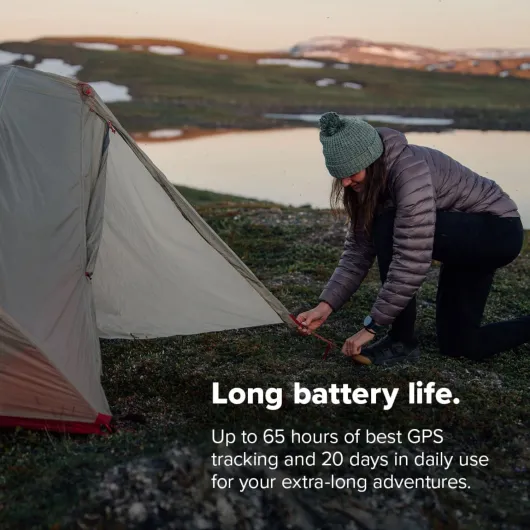
Battery life is one of the main selling points of the SUUNTO Vertical 2, and here it actually delivers. The brand claims up to 20 days in daily use, and in my real‑world use with notifications on, a few GPS workouts per week, sleep tracking, and the screen at a reasonable brightness, I was getting around 12–16 days on a charge. That’s still very good compared to many AMOLED watches that barely last a couple of days.
In pure GPS activity, you also get strong endurance. Long runs of 1–2 hours barely made a dent in the battery percentage. For a long hike day with GPS on most of the time, it held up without any stress. If you’re into ultra‑running, multi‑day trekking, or bikepacking, this kind of battery performance is a real advantage. You don’t need to think about charging every night or carrying a power bank just for the watch.
The watch uses a proprietary charging cable, which is standard in this category but still annoying. Lose it and you’re stuck. Charging speed is decent: you can go from low battery to usable in under an hour. I usually just plugged it in while showering and getting ready, and that was enough to top it up if it wasn’t completely drained. No wireless charging here, so if you’re used to plopping devices on a pad, you’ll have to go back to cables.
Overall, on battery, this watch is one of the strong points. It’s not magic, but it’s clearly above average for an AMOLED sports watch. If you’re coming from a smartwatch that needs a daily charge, this will feel like a relief. If you’re used to the very longest‑lasting Garmins in low‑power modes, you might still get more there, but for the feature set and screen quality here, the balance is pretty solid.
Comfort: good once adjusted, but the stock strap isn’t for everyone
At 87 grams, this is not a light watch. If you’re coming from a slim fitness band or a smaller smartwatch, you’ll definitely feel the difference the first days. For running and cycling, I got used to the weight pretty quickly, but for sleeping and wearing it 24/7, you always know it’s there. It’s not painful or anything, just present. If you hate heavy watches, this might be a problem.
The stock strap is a 22 mm fluoroelastomer band with a buckle. It’s durable and feels solid, but it’s also a bit stiff out of the box. On my wrist, it took a few days to soften up. Some users mentioned switching to a nylon elastic strap with a magnetic clasp, and I get why. With a softer strap, the watch sits better on the wrist and the optical sensors have more consistent contact, which usually means better HR readings and less irritation.
During workouts, once I found the right tightness, it stayed in place well. No sliding around, even with sweat. For long runs (over an hour), I didn’t get hot spots or rubbing. Under a jacket or tight sleeve, though, the thickness is noticeable and can snag. It’s the trade‑off for a rugged build and larger battery. Personally, I’m okay with it for outdoor sports, but I wouldn’t call it discreet office wear.
For sleep tracking, it’s a bit borderline for me. It’s comfortable enough to wear at night, but the combination of size and weight makes it more noticeable than a lighter tracker. If sleep tracking is your top priority, there are more comfortable options. If you mainly care about daytime sports use and occasional sleep tracking, it’s acceptable. I’d strongly recommend budgeting for an alternative strap if you’re picky about comfort.
Durability and water resistance: built to be knocked around
With 100 m water resistance and a rugged construction, the SUUNTO Vertical 2 is clearly made to handle abuse. I didn’t take it to deep dives, but I used it in the shower, in the pool, and in heavy rain with zero issues. No fogging under the glass, no weird behavior with the touchscreen when wet. For swimming, it tracked lengths and time without any obvious problem, and the buttons still worked fine when wet.
Physically, after weeks of use, including some accidental hits against door frames and gym equipment, the watch body and screen held up well. No major scratches, no chips, no loosening of the strap pins. The fluoroelastomer strap also didn’t show signs of cracking or weird wear. It’s the kind of watch you can wear for hiking, MTB, or climbing without stressing too much about breaking it at the first bump.
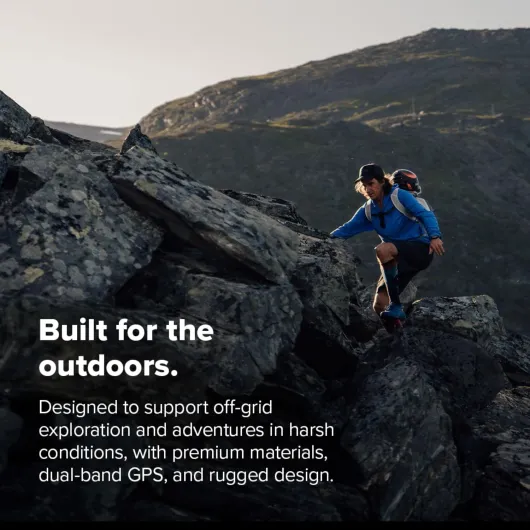
The LED flashlight is integrated into the case, and I was a bit worried it might be a weak point, but so far it hasn’t caused any issue. It doesn’t feel flimsy or like something that will snap off. The buttons are also well protected and not exposed in a way that makes them easy to catch on things. The overall build gives you confidence that it’s meant for real outdoor use, not just looking sporty in the city.
Of course, I can’t simulate years of use in a few weeks, but based on the materials, finish, and early wear, I’d say durability is one of the watch’s strengths. If you’re the kind of person who is rough with gear, this is more reassuring than many slimmer smartwatches. You trade some bulk and weight for that peace of mind, but at least you’re getting something solid for it.
Sports and GPS performance: solid tracking, a few software quirks
On the sports side, the SUUNTO Vertical 2 is very capable. I mainly used it for running (road and trail), cycling, and a bit of swimming. GPS lock was generally quick, and once locked, tracks were clean and consistent. On routes I know well, the distance and pace matched pretty closely with my old Garmin and with Strava on my phone. No crazy zigzags or obvious GPS jumps, even in areas with some tree cover.
The 115+ sport modes are kind of overkill, but at least you have specific profiles for most things: trail running, hiking, indoor cycling, pool swimming, skiing, etc. The data fields during activities are clear and easy to read thanks to the AMOLED screen. Pace, heart rate, elevation, and time are all visible at a glance. Navigation with maps is also pretty good: you can follow routes and see where you are on the map, which is a real plus for trail runs or hikes without pulling your phone out.
Where it feels a bit rough is the software experience during workouts. As one user pointed out, when you’re locked into a sport recording, you can’t freely browse other menus. You’re kind of stuck in the sport mode, which can be annoying if you want to quickly check something else or adjust certain settings. Also, if the watch is busy with HR measurement or an activity, some watch settings in the app get disabled, which feels weird and unnecessarily restrictive.
Sensor accuracy (HR and elevation) was generally decent. Heart rate was close to my chest strap for steady efforts, but like most wrist sensors, it can lag a bit on sudden spikes or intervals. The altimeter can take a while to auto‑calibrate, especially with weaker GPS. In those cases, manually setting it using known elevation is faster. So overall: performance is good for actual tracking, but some of the interface logic and calibration behavior could clearly be smoother.
What this watch actually offers (beyond the buzzwords)
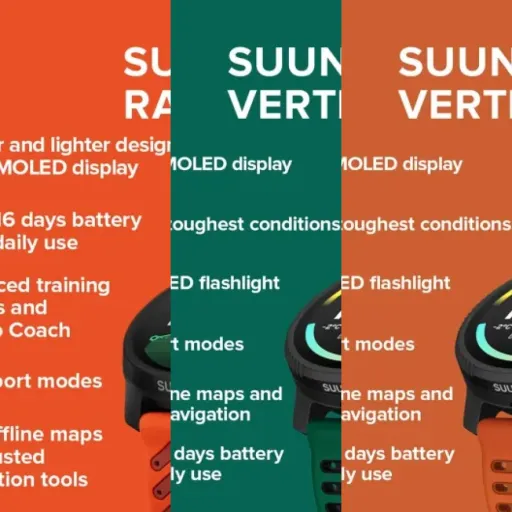
On paper, the SUUNTO Vertical 2 packs a lot: AMOLED 1.5" display with 240x240 resolution, up to 20 days battery in daily mode, 115+ sport modes, built‑in GPS with offline maps, LED flashlight, 100 m water resistance, heart rate and SpO2 monitoring, sleep tracking, and 32 GB of storage. It works with both Android and iOS via Bluetooth, and you get the usual smartwatch extras: notifications, weather, alarms, music control (not full standalone music like some watches), and basic widgets.
In practice, the focus is clearly on sports and navigation, not on being a mini‑smartphone on your wrist. You don’t get a big app store or tons of third‑party stuff. Instead, you get solid tracking for running, cycling, swimming, triathlon, hiking, skiing, etc. The watch supports multiple satellite systems and offers offline maps, which is actually handy if you run or hike in places with poor signal or you just don’t want to rely on your phone.
The LED flashlight sounds like a gimmick, but I ended up using it more than I expected. It won’t replace your headlamp, but for finding keys in the dark car, checking something in a tent or not waking people up at night, it’s useful. It’s not super bright, but as a built‑in tool on your wrist, it gets the job done. Again, very practical, not fancy.
Overall, the feature set is pretty complete for endurance and outdoor sports. If you’re looking for contactless payment, advanced music apps, or deep smart features, this isn’t the strongest. But if you want reliable GPS, long battery life, and proper sport tracking with maps, it’s well equipped. The main trade‑off is clearly: more athlete/outdoor focus, less gadget/smartwatch focus.
Pros
- Excellent battery life for an AMOLED sports watch (roughly 12–16 days real use)
- Bright, readable screen and solid GPS tracking with offline maps
- Rugged, water‑resistant build (100 m) that feels ready for real outdoor use
Cons
- Interface and app feel less polished, with some odd limitations during activities
- Bulky and fairly heavy on the wrist, stock strap is stiff until replaced or broken in
Conclusion
Editor's rating
The SUUNTO Vertical 2 is a serious sports and outdoor watch that gets the essentials right: very good battery life, bright AMOLED display, solid GPS, rugged build, and practical features like offline maps and a built‑in LED flashlight. It’s clearly aimed at people who run, ride, hike, ski or do long outdoor sessions and don’t want to charge their watch every night. In that use case, it performs well and feels reliable.
It’s not perfect though. The software and interface are a bit behind the best from Garmin and Apple. Little things like being locked into a sport mode, limited quick shortcuts, no tap‑to‑wake, and some awkward interactions with the app make it feel less polished than it could be. The watch is also big and relatively heavy, and the stock strap is on the stiff side until you break it in or replace it. If you want something small, sleek and ultra smart‑watchy, this isn’t it.
If your priority is sports tracking, long battery, and durability, and you can live with a more basic but functional interface, the SUUNTO Vertical 2 is a strong option and, in many cases, better value than some pricier competitors. If you’re deeply tied into Garmin’s ecosystem, obsessed with advanced smartwatch features, or very sensitive to watch size and weight, you might want to skip this one and look elsewhere.