Summary
Editor's rating
What you get for the money vs Garmin / Apple / Samsung
Chunky, tactical look – not subtle, but it fits the purpose
Battery that actually lasts – but not quite the marketing number
Big but surprisingly wearable once you forget about it
Takes hits, water, and dirt without complaining
GPS, maps, health tracking: strong outdoors, a bit clunky for structured training
What you actually get with the T-Rex 3 Pro
Pros
- Very good real-world battery life (around 10–14 days with regular GPS use)
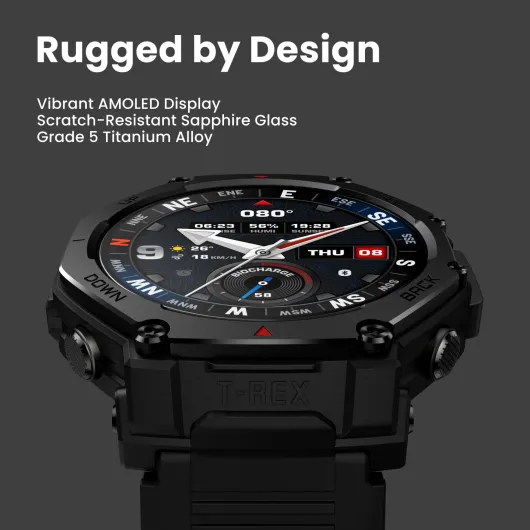
- Bright, durable sapphire AMOLED screen with titanium bezel that handles bumps and scratches well
- Strong dual-band GPS and genuinely useful offline maps and routing for outdoor activities
Cons
- Zepp Pay is limited and awkward to set up compared to Apple Pay / Google Wallet
- Structured HR-based training tools and third-party app integrations are weaker than Garmin
- Chunky 48 mm design may feel too big for smaller wrists or people who prefer discreet watches

Specifications
View full product page →| Brand | Amazfit |
A proper outdoors watch that doesn’t panic at 10% battery
I’ve been using the Amazfit T-Rex 3 Pro (48 mm, Tactical Black) for a few weeks as my main watch, replacing a Garmin Forerunner and a Samsung Galaxy Watch I kept swapping between. I mainly run, hike, and do a bit of strength training, plus the usual office stuff, so I wanted something that could handle long days outside without forcing me to babysit the battery. This one is clearly built with outdoors people in mind: thick case, big screen, chunky buttons, offline maps, and a flashlight stuck in the side for good measure.
What pushed me to try it was the combo of dual-band GPS, offline maps, and long battery at a price that’s way lower than high-end Garmins or Apple Watches. On paper it sounds almost too packed: 180+ sport modes, 10 ATM water resistance, diving to 45 m, contactless payments via Zepp Pay, Bluetooth calls, and a 3,000-nit AMOLED display with sapphire glass and titanium bezel. It looks like someone ticked every box on a spec sheet.
In daily use, it’s not perfect, but it’s pretty solid overall, especially if you care more about battery and toughness than super-polished app ecosystems. There are some annoyances: Zepp Pay is limited, heart-rate training tools feel a bit half-baked compared to Garmin, and the software still has that “good but not premium” feel in some menus and notifications. But for the price, it covers a lot of ground.
If you’re wondering whether this is a serious outdoor watch or just a toy with military styling, I’d say it leans more towards serious. It’s not going to replace a top-end Garmin for hardcore structured training, but for hikers, trail runners, and people who just want a tough, long-lasting smartwatch with good GPS and maps, it gets the job done and then some.
What you get for the money vs Garmin / Apple / Samsung
In terms of value for money, the T-Rex 3 Pro sits in a good spot. It’s not dirt-cheap, but it’s also not in the same price bracket as top-tier Garmin Fenix or Apple Watch Ultra. For the price, you get sapphire glass, titanium bezel, dual-band GPS, offline maps, long battery, and 10 ATM water resistance. Those are features you usually see on much more expensive models. If you mainly care about outdoor tracking, battery, and durability, you’re getting a lot here.
Where you notice the lower price is mostly in the software ecosystem. Zepp OS and the Zepp app are decent and improving, but they’re not as polished as Garmin Connect, Apple’s ecosystem, or Samsung’s. Some things feel clunky: setting up advanced training, integrating with third-party services, and using Zepp Pay. One reviewer mentioned the hassle with Curve and getting a Curve account just to use payments – I had the same feeling. If contactless payment is a priority for you, this setup is a bit of a pain and not as seamless as Apple Pay or Google Wallet.
Compared to Garmin at a similar price, you often get better training tools and more serious metrics from Garmin (especially for runners who follow structured plans), but you might lose out on the AMOLED screen, sapphire + titanium at this price, and strong offline maps with bright display. Also, Garmin’s battery is good, but this watch can go toe-to-toe or beat many mid-range models, especially with that big 700 mAh cell.
So who gets the best value here? People who want a tough, bright, long-lasting outdoor smartwatch and don’t care if the app ecosystem is a bit rough around the edges. If you’re obsessed with deep training metrics, tight app integrations, or super slick notifications, you might be happier paying more for Garmin, Apple, or Samsung. But if you look at the hardware and battery you get here for the price, it’s good value, as long as you’re okay with a few compromises on the software/payment side.
Chunky, tactical look – not subtle, but it fits the purpose
Design-wise, the T-Rex 3 Pro looks like a small tank on your wrist. The 48 mm case is big and thick, and it definitely has that tactical / outdoors vibe. If you’re used to slim dress watches or an Apple Watch, this will feel massive at first. That said, after a few days, I got used to it, and it started to feel normal for outdoor runs and hikes. Under a shirt cuff it’s borderline, but it can work if you don’t care about it looking discreet.
The titanium bezel and metal buttons give it a more serious feel than cheap plastic sports watches. I’ve bumped it against door frames, gateposts, and a rock while scrambling, and so far no visible damage on the bezel or the sapphire glass. The buttons are easy to find with gloves on, and they have a firm, clear click. That’s handy when your fingers are cold or sweaty and you don’t want to rely on the touchscreen.
The screen is round, 1.5 inches across, which feels like a nice balance: big enough to read maps and stats, not so big that it’s stupid. The bezels around the display are there, but not excessive. Visually it’s more “functional” than pretty. You get the usual tactical markings and screws, but it doesn’t look like a toy. The black version is fairly neutral; it doesn’t scream for attention in the office, but it’s clearly a sports/outdoor watch.
If you like slim, minimalist watches, you probably won’t enjoy the look. If you’re used to Garmin Fenix-style designs or G-Shock, this will feel familiar and pretty solid. For me, it hits the right balance: it looks tough, it feels like it can take a beating, and the big screen is actually useful when you’re outside trying to read pace or a map in bright light or rain.
Battery that actually lasts – but not quite the marketing number
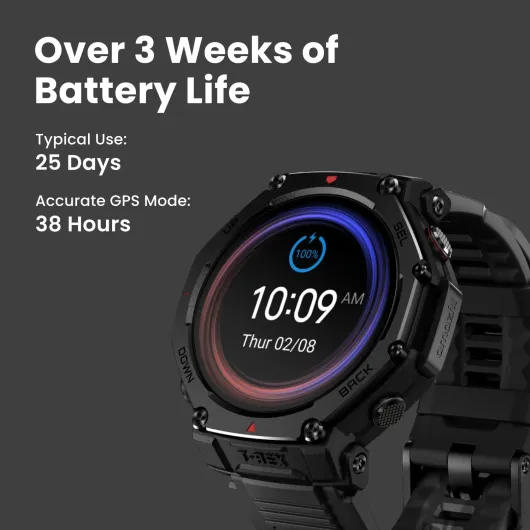
The battery life is one of the main reasons to buy this watch. Amazfit claims up to 25 days, which is obviously under light use. In my real use, with always-on heart rate, sleep tracking, about 4–5 GPS workouts per week (30–60 minutes each), some Bluetooth calls, and plenty of notifications, I was sitting closer to 10–14 days per charge. That lines up with one Amazon review that mentioned around 10 days on standby, not 28. So no, it doesn’t hit the full marketing claim in normal active use, but it still easily beats most mainstream smartwatches.
On a hiking weekend, I used GPS for around 5–6 hours per day with offline maps, brightness fairly high, and I still had enough battery left to not even think about charging until I got home. That’s the key thing: you can go on a multi-day trip and not have battery anxiety. Compared to my old Galaxy Watch, which needed daily charging, this is a big quality-of-life upgrade. I can finally do full sleep tracking without having to choose between “charge or wear”.
Charging itself is pretty straightforward: magnetic puck, snaps on easily, charges in a couple of hours from low to full. The only small annoyance is no USB-C cable in the box, just the puck, so you need to use your own cable. Not a big deal, but worth knowing. The charging connection felt secure; I didn’t have random disconnects like on some cheaper watches.
If you go heavy on features – always-on display, constant GPS, lots of calls, flashlight usage – you’ll obviously burn through the battery faster. But even then, you’re still talking several days, not hours. In practical terms, I was charging it maybe twice a month, which is a big step up from most smartwatches. So yes, the headline “25 days” is optimistic, but battery life is still one of the strong points and a real reason to pick this over an Apple or Samsung if you live outdoors a lot.
Big but surprisingly wearable once you forget about it
I was a bit worried about comfort because 48 mm is not small, and my wrists are on the medium side. First day, it felt big and I definitely noticed it. After two or three days, my brain kind of tuned it out, and it just became “the watch”. The weight distribution is decent, and it sits flat enough that it doesn’t wobble around while running. If you have very slim wrists, it’ll look oversized, but based on my use, it’s still wearable and doesn’t dig in.
The silicone strap is standard but decent. It’s soft enough not to rub, and I didn’t get any irritation even when sweating a lot on runs or wearing it 24/7 for sleep tracking. The buckle is simple and secure. I wore it in the shower, in the rain, and on a long hike where my wrist got dusty and sweaty, and I didn’t get any hot spots or pinching. One Amazon review mentioned expecting bruises but ended up fine; I had a similar experience – it looks harsher than it feels.
For sleep, it’s obviously more noticeable than a slim tracker, but I still managed to sleep with it on most nights. The rounded case back and sensor area are smooth, and the strap holes let you find a setting that’s snug enough for heart-rate accuracy without feeling like a blood pressure cuff. If you’re extremely picky about sleeping with a watch, you might get annoyed, but for me it was tolerable.
In short, yes, it’s chunky, but the comfort is better than the size suggests. The strap is fine out of the box, and the fact that it uses standard 22 mm lugs means you can swap it for a softer or lighter strap if you want. For day-long wear, workouts, and sleep, it did the job without any major complaints from my wrist.
Takes hits, water, and dirt without complaining
Durability is where the T-Rex 3 Pro feels very reassuring. The sapphire glass and titanium bezel are not just marketing buzz; they actually help. I’ve knocked the watch into door frames, scraped it lightly on a rock during a hike, and worn it for DIY jobs where dust and small knocks are normal. So far, I don’t see any scratches on the screen, and the bezel still looks clean. It doesn’t feel fragile at all, more like something you can abuse a bit without babying it.
The 10 ATM water rating and 45 m diving certification give some peace of mind. I’ve worn it in the shower, in the rain, and during a couple of swims, and it behaved like nothing happened. One Amazon user mentioned falling into water and the watch shrugging it off; I didn’t have that dramatic test, but I’d be comfortable taking it in the sea or pool regularly. The buttons still click fine after getting wet, and I haven’t seen any condensation or weirdness on the screen.
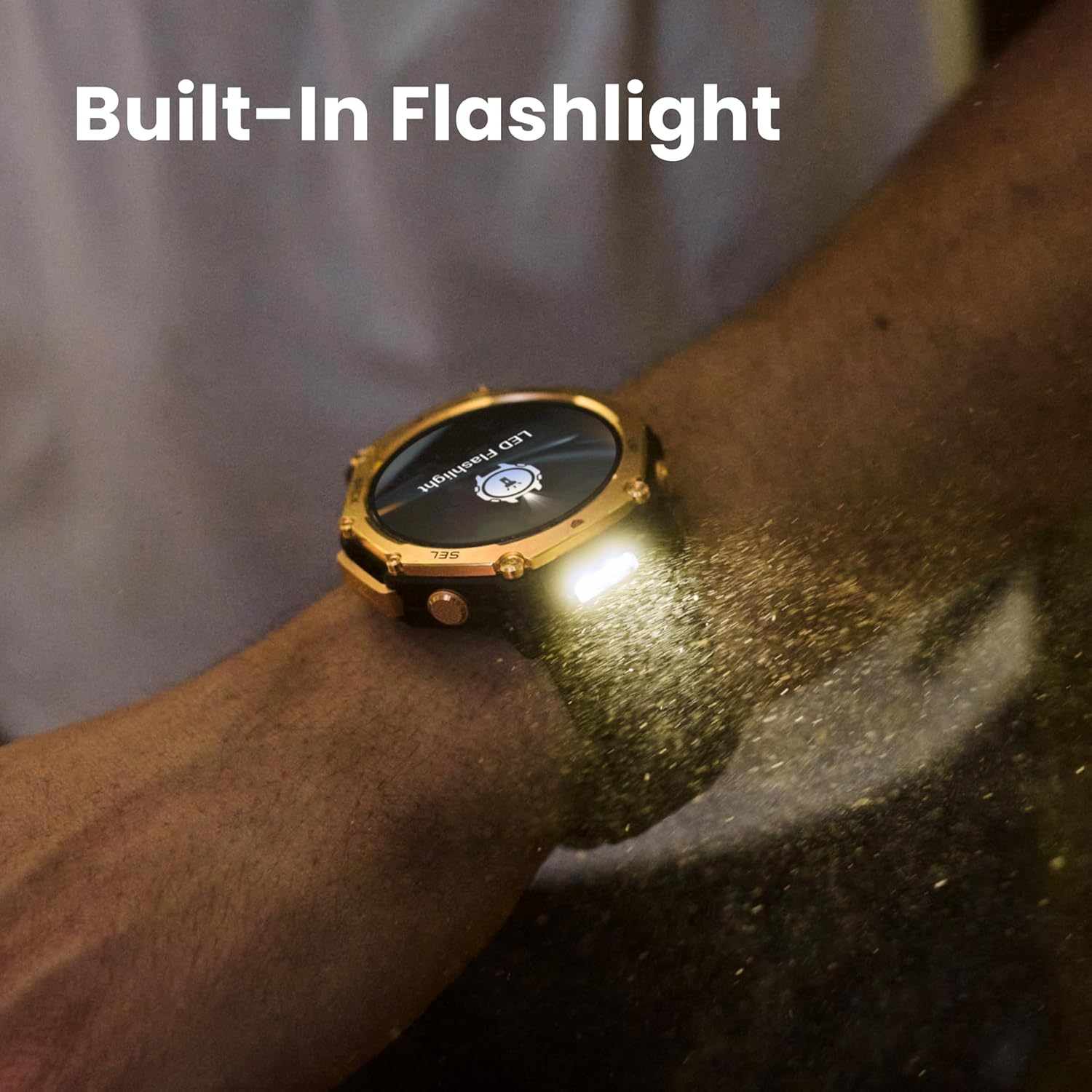
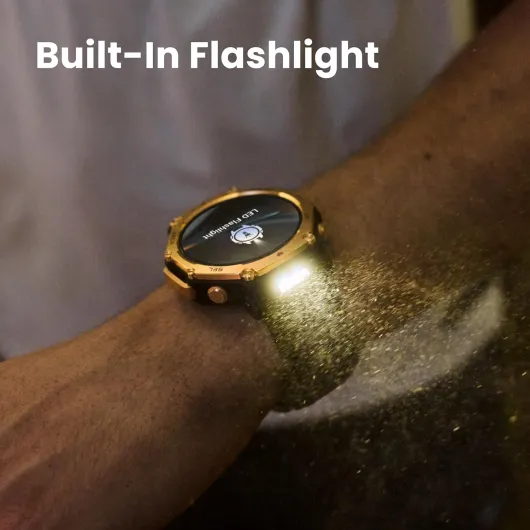
The built-in flashlight sounds like a gimmick but ended up being more useful than expected. I used it at night to find stuff in my bag, avoid stepping on the dog’s toys, and once in a tent to avoid blasting everyone with my phone’s main light. It’s not as bright as a proper headlamp, obviously, but for small tasks it’s handy. The SOS and red-light modes are nice extras for hikers and campers.
The only area where durability is hard to judge long-term is the strap. The silicone feels fine now, but like any rubbery band, it may wear or crack after a year or two of heavy use. The good thing is that it uses standard 22 mm quick-release pins, so you can easily replace it with any third-party strap if it fails or you just want a different look. Overall, if you want a watch you don’t need to treat gently, this one feels ready for rough use.
GPS, maps, health tracking: strong outdoors, a bit clunky for structured training
On GPS performance, this watch is solid. The dual-band GPS usually locks in within a few seconds, even near buildings or under trees. On my usual 10 km road loop, distance matched my Garmin within a few meters, and the track on the map looked clean, not zigzagging all over the place. On forest trails, it also held the line well. For hiking, the offline maps and routing are genuinely useful: you can plan a route, follow it on the wrist, and even get auto-rerouting if you go off track. That’s the kind of feature you normally pay a lot more for on other brands.
For sports tracking, there are over 180 modes, which is frankly more than I’ll ever use. The basics – running, walking, cycling, strength – work fine. Pace, distance, heart rate, elevation, all show up clearly, and the data syncs to the Zepp app without drama. The watch supports HYROX training and a bunch of niche modes, but most people will stick to the main ones. Where it falls a bit short is structured training: if you’re into heart-rate zone workouts or using third-party training plans like Runna, you hit some friction. One reviewer mentioned tedious workarounds with Runna, and I had a similar impression with custom workouts – it’s possible, but not smooth.
Heart-rate accuracy is generally okay for steady efforts, but it can lag or spike a bit during intervals or quick changes, like most wrist-based sensors. If you want really accurate zones and VO2-type training, pairing it with an external strap is the safer option. Also, I couldn’t find a simple way to get audio alerts when leaving a HR zone during workouts, which I rely on with Garmin. That’s a real downside if you train strictly by zones.
As a daily smartwatch, it handles notifications, calls, and basic apps fine. You can take Bluetooth calls from the wrist, and the speaker/mic are decent indoors and okay outdoors if it’s not too noisy. You can reply to some messages (better on Android), but don’t expect the same polish as Apple or Samsung. Overall, performance is strong for outdoor tracking and battery-focused users, but more casual/phone-centric smartwatch users might notice the rough edges in software and notifications.
What you actually get with the T-Rex 3 Pro
On paper, the Amazfit T-Rex 3 Pro is packed. You get a 48 mm rugged-style watch with a 1.5-inch AMOLED screen (390 x 390) that can hit up to 3,000 nits of brightness. The glass is sapphire, the bezel and buttons are titanium alloy, and it’s rated for 10 ATM water resistance with diving certification down to 45 m. Inside you’ve got dual-band GPS with support for multiple satellite systems, offline maps with route planning, and a built-in flashlight with white, red, turbo, and SOS modes.
Battery-wise, Amazfit claims up to 25 days of use, with a 700 mAh battery, which is much bigger than most smartwatches. Storage is listed as 32 GB, which is generous for maps and maybe some offline data. It runs on Zepp OS, which is Amazfit’s own system, and connects to Android and iOS via Bluetooth. You can take Bluetooth calls, use voice control, get notifications, track over 180 sports modes, and even pay with Zepp Pay (NFC), as long as you go through Curve or compatible banks.
In the box, it’s pretty bare-bones: watch, magnetic charging base, and a manual. No USB-C cable, so you need your own charger or plug it into a laptop. The band is a standard 22 mm silicone strap with a buckle, so you can swap it for other 22 mm straps easily. The watch is clearly targeted at men / larger wrists (48 mm is big), but they also sell a 44 mm version if this one feels overkill.
Overall, in terms of features vs price, it’s good value if you actually use the outdoor tools: GPS, maps, flashlight, long battery. If you just want a simple smartwatch for steps and notifications, this is probably overkill and you’re paying for things you won’t touch, like diving features and advanced routing. But if you look at the spec sheet and think “I’d use that, that, and that”, it makes sense.
Pros
- Very good real-world battery life (around 10–14 days with regular GPS use)
- Bright, durable sapphire AMOLED screen with titanium bezel that handles bumps and scratches well
- Strong dual-band GPS and genuinely useful offline maps and routing for outdoor activities
Cons
- Zepp Pay is limited and awkward to set up compared to Apple Pay / Google Wallet
- Structured HR-based training tools and third-party app integrations are weaker than Garmin
- Chunky 48 mm design may feel too big for smaller wrists or people who prefer discreet watches
Conclusion
Editor's rating
After living with the Amazfit T-Rex 3 Pro for a while, I’d sum it up like this: a tough outdoor smartwatch with very good battery and GPS, wrapped in slightly rough software. The hardware is the strong point. The sapphire screen and titanium bezel handle knocks well, the 3,000-nit AMOLED display is easy to read in full sun, and the dual-band GPS plus offline maps make it a serious option for hiking, trail running, and general outdoor use. The battery doesn’t quite hit the 25-day claim in real life, but 10–14 days with regular GPS workouts is still way better than most mainstream smartwatches.
On the downside, Zepp Pay is limited and awkward, heart-rate-based structured training is not as polished as on Garmin, and the app ecosystem is good but not top-tier. If you’re deep into training plans, live in HR zones, and rely on audio alerts and third-party app integration, there are better options at similar or slightly higher prices. If you mainly want something that tracks your activities reliably, survives water and bumps, lets you leave your phone in your bag thanks to maps and calls, and doesn’t live on a charger, this watch fits that brief well.
I’d recommend it to hikers, casual-to-serious runners who don’t need super advanced training tools, people who work outdoors, and anyone tired of charging their watch every night. I’d say skip it if you’re heavily invested in Apple or Samsung ecosystems, or if structured training and payment convenience are your top priorities. For the rest, it’s a pretty solid piece of kit that gets the important stuff right.