
Summary
Editor's rating
Value for money: strong training features, basic smartwatch side
Design: sporty, simple, and a bit generic
Battery life: honest, but not a monster
Comfort: light and wearable all day (and night)
Durability and build: tough enough for regular training
Performance and tracking: strong on GPS and training metrics
What the Polar Vantage M3 actually offers
Pros
- Accurate dual‑frequency GPS with decent lock times and clean tracks
- Lightweight and comfortable enough for 24/7 wear, with two strap sizes included
- Strong training and recovery features (Training Load Pro, Nightly Recharge, Running Index)
Cons
- Smartwatch features are very basic (no music, payments, or big app ecosystem)
- Interface and app can feel a bit clunky and confusing at first
- Battery is good but not outstanding for heavy GPS users; some reports of reliability issues

Specifications
View full product page →| Brand | Polar |
A sports watch first, a smartwatch second
I’ve been using the Polar Vantage M3 as my main training watch for a few weeks now, mainly for running, some cycling, and a bit of gym work. I came from a basic Fitbit and occasionally used my phone for GPS, so this was a clear step up in terms of data and navigation. I didn’t get it for fancy smartwatch tricks; I wanted reliable GPS, decent battery, and proper training metrics without paying Garmin Fenix money.
From day one, it’s obvious this thing is built as a sports tool more than a lifestyle gadget. The AMOLED screen is bright, the menus are very Polar-style (a bit old-school but efficient once you learn them), and the watch pushes you straight into training and recovery stats instead of social media or apps. If you’re expecting an Apple Watch clone, you’ll probably be disappointed. If you want something that helps you train better, it starts to make sense.
During my tests, I used it on about four runs per week (30–60 minutes), one long run on the weekend (90+ minutes), and daily 24/7 wear for sleep tracking. I also played with the dual-frequency GPS and the Komoot turn‑by‑turn navigation on a couple of new routes. I synced it with an Android phone, and I also checked the Polar Flow web interface on a laptop to see the full data.
Overall, the first impression is pretty solid: tracking is detailed, GPS is clearly better than my phone, and the battery is honest even if not record‑breaking. It’s not perfect though. Some menus feel slow, the watch is quite focused on training (so the “smartwatch” side is basic), and the app isn’t the most intuitive at first. But if your main goal is to train smarter and you don’t mind a slightly nerdy interface, it already looks like a decent option.
Value for money: strong training features, basic smartwatch side
Looking at the whole package, the Vantage M3 sits in that mid‑range zone where you expect decent hardware and serious training features without paying a premium for luxury materials or fancy extras. For what you pay, you’re getting dual‑frequency GPS, a bright AMOLED screen, proper training load and recovery metrics, and navigation with Komoot. From a pure sports perspective, that’s a pretty solid deal.
Where the value is less clear is on the smartwatch side. You get notifications, basic watch faces, alarms, and that’s about it. No music storage, no contactless payments, no big app ecosystem. If you’re coming from a Fitbit or an older basic Polar, you might not care. But if you’re used to an Apple Watch or Galaxy Watch, this will feel stripped down. So you’re basically paying for training brains, not for lifestyle features.
Compared to similar watches from Garmin or Coros, the Vantage M3 holds its own on training metrics and sleep tracking, but the interface and app feel a bit less polished. Polar Flow is powerful but not super intuitive for beginners. Once you learn where things are, it’s great, but the first week can be a bit confusing. On the upside, Polar has a long history with heart rate and training science, and you can feel that in the data and recommendations.
So in terms of value, I’d say: if your main goal is structured training and recovery tracking, it’s good value for money. If you mainly want a smartwatch that also tracks runs, there are better choices. It’s not the cheapest, not the priciest, but it gives you serious training tools without going into crazy high-end territory. Just be clear on your priorities before buying.
Design: sporty, simple, and a bit generic
Visually, the Vantage M3 is very straightforward: round case, minimal bezel, and a clean black strap. No flashy metal bezel, no rotating crown, no quirky shapes. If you’ve seen other Polar watches, this one fits right in. It looks like a tool watch, not a fashion piece. Personally, I like that; it doesn’t scream “tech toy” when you’re at the office or out for dinner. But if you’re hoping for something that stands out, it’s pretty generic.
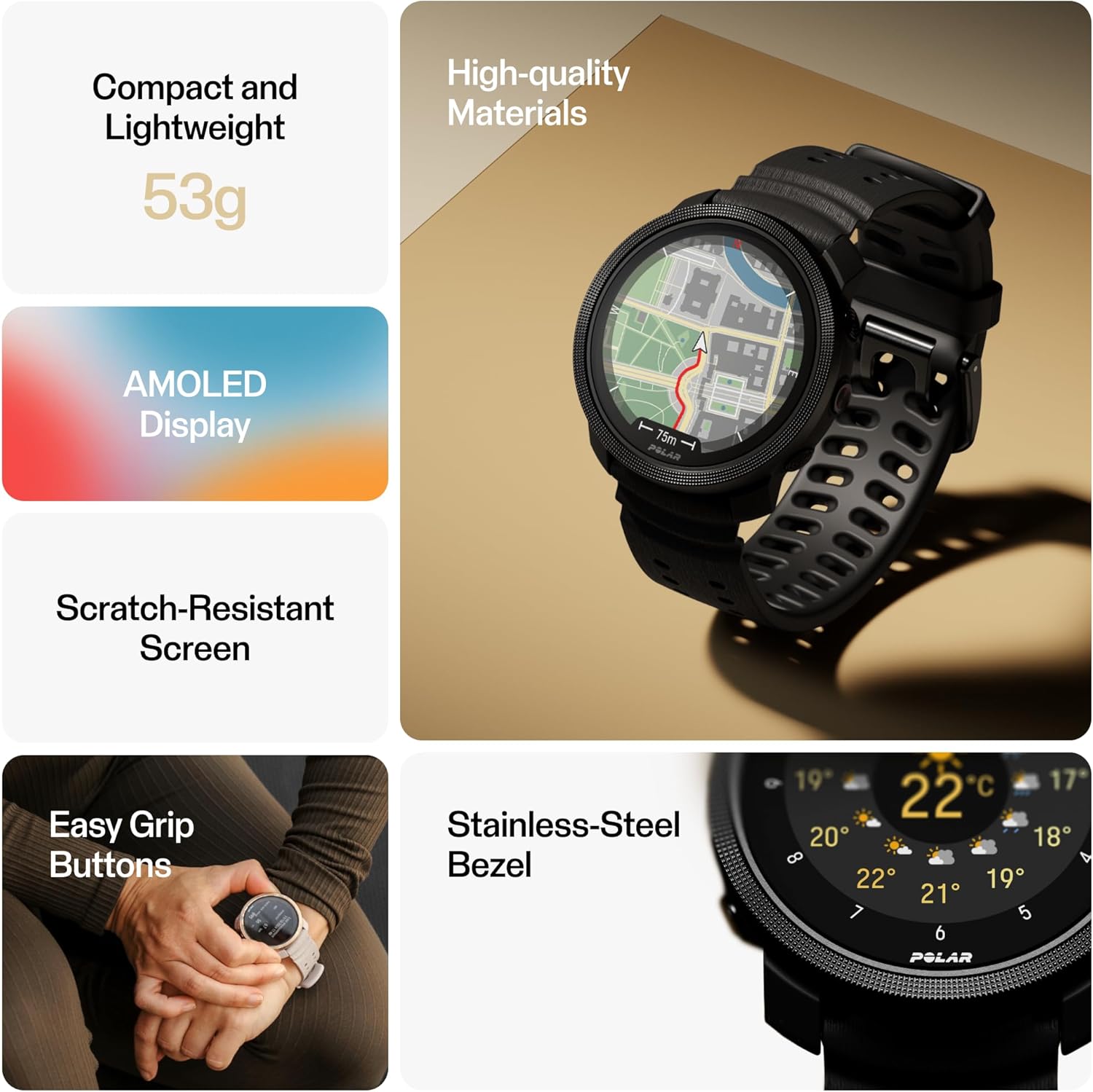
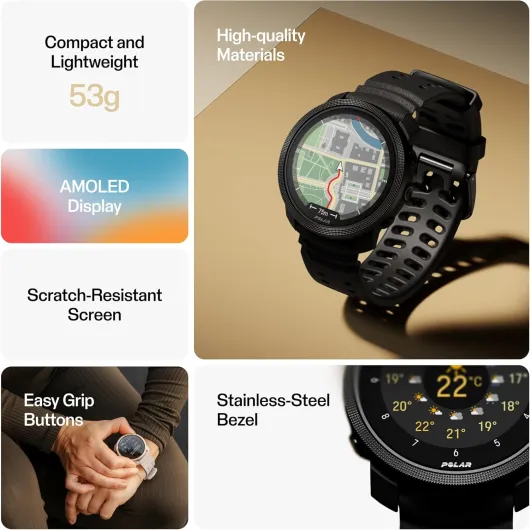
The 1.28" AMOLED screen is the main design upgrade compared to older M‑series models. Indoors, it’s crisp and readable, and the colors help make data fields clearer. Outside, in bright sunlight, the 1000‑nit brightness is decent. I didn’t struggle to see my pace or heart rate mid‑run, which is what matters. The bezels around the screen are still visible though; it’s not edge‑to‑edge like a phone. So don’t expect a super modern look; it’s more functional than stylish.
The watch uses a mix of touchscreen and buttons. There are physical buttons on the side for starting/stopping activities and navigating menus, which is crucial when your hands are sweaty or it’s raining. The touch works fine for scrolling and selecting options, but it’s not as smooth as a smartphone. There’s a small delay sometimes when swiping between widgets, which can feel a bit dated compared to an Apple Watch or Galaxy Watch.
On the wrist, the 45 mm case looks sporty and fits the “active person” vibe. If you have very small wrists, it may feel a bit big but the included smaller strap helps. Overall, the design is practical and low‑key. It does the job, doesn’t look cheap, but it’s not going to impress anyone who cares a lot about style. For training, that’s fine; for someone wanting a dressy watch, this isn’t it.
Battery life: honest, but not a monster
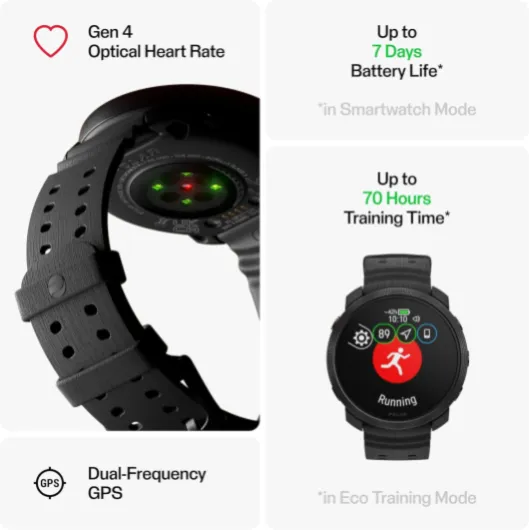
Battery is always a big topic with sports watches. Polar advertises up to 7 days in smartwatch mode and around 30 hours in training mode with GPS. In real life, with my usage (about 4–5 hours of GPS workouts per week, notifications on, sleep tracking on, screen brightness on auto), I was getting roughly 5–6 days per charge. So not quite the full 7, but close enough that I wasn’t panicking about the battery all the time.
When I pushed it harder with more GPS usage and a long run with navigation, the battery dropped faster, which is expected. A 1‑hour GPS run usually burned around 5–6% for me, sometimes a bit more with dual‑frequency and navigation. If you’re someone who runs every single day with GPS, you’ll probably be charging every 3–4 days. For casual runners who train 3–4 times a week, once a week charging is realistic.
Charging itself is pretty quick. Going from around 20% to full took just under an hour in my case using a normal USB‑C charger. The magnetic charging cable connects easily enough, though like all proprietary chargers, you’ll be annoyed if you forget it on a trip. I’d have preferred something more standard like USB‑C directly in the watch, but that’s not common in this category yet.
Compared to some Garmin models that can last 10+ days with light use, the Vantage M3 isn’t a battery champion. But compared to full‑fat smartwatches like the Apple Watch, it’s clearly better. I’d rate the battery as good but not exceptional: it gets the job done, you don’t need to babysit it daily, but if you’re an ultra‑runner or multi‑day hiker who hates charging, you might find it a bit limited.
Comfort: light and wearable all day (and night)
One thing Polar got right here is comfort. At 53 g, the Vantage M3 is light enough that you forget about it most of the day. I wore it 24/7 for several days straight, including sleep, and it never felt like a brick on my wrist. Compared to chunkier multisport watches, this is a clear plus, especially for smaller wrists or people who hate heavy gear. The rounded case back also helps; it doesn’t dig into the skin.
The silicone strap is soft out of the box, not stiff like some cheaper sports watches. It has enough adjustment holes to get a snug fit for heart rate tracking without cutting off circulation. I wore it slightly tighter during runs and a bit looser during the day, and it stayed comfortable either way. The fact that you get both S and L sizes in the box is very practical; my partner with a much smaller wrist could try it without the strap being way too long.
During workouts, especially running and indoor cycling, the watch stayed in place well. No bouncing around, no need to constantly re‑adjust. That also helps with heart rate accuracy, since loose straps are a common reason for bad readings. Even when sweating a lot, the strap didn’t become slippery or itchy. After a long summer run, I just rinsed it under water and it was fine.
For sleep tracking, I was worried the 45 mm case would feel bulky, but honestly it was okay. You notice it the first night, then it becomes normal. If you’re used to wearing any kind of watch at night, you’ll adapt quickly. Overall, on comfort, I’d say the Vantage M3 is very solid: light, non‑irritating, and easy to wear 24/7. Not much to complain about here unless you absolutely hate wearing anything on your wrist.
Durability and build: tough enough for regular training
In terms of build, the Vantage M3 feels solid but not tank‑like. The case is stainless steel with Gorilla Glass 3 on the screen, and it’s rated water‑resistant to 50 m (IPX8). I used it in the shower, in the rain, and for a couple of pool sessions, and it didn’t complain. No fogging under the glass, no weird condensation. So for normal sports use, water resistance seems fine.
The Gorilla Glass 3 screen held up well in my testing. I brushed it against door frames and gym equipment a few times (the usual daily abuse) and didn’t get any visible scratches. If you’re someone who regularly bangs your watch against rocks while climbing, I’d still consider a screen protector or a more rugged watch, but for running, gym, and general life, it feels robust enough.
The strap feels durable too. After weeks of daily use and sweat, there’s no cracking or discoloration. The buckle is basic but works, and the strap loop holds the excess firmly so it doesn’t flap around. If it ever fails, it’s a standard style of strap, so replacements are easy to find. I didn’t see any quick‑release pins mentioned, but swapping straps doesn’t look complicated if you’re a bit handy.
On the flip side, I did notice some user reviews mentioning reliability issues, like one person whose watch died after 53 days and couldn’t be reset. I didn’t experience anything that bad, but it’s worth keeping in mind. Any electronics can fail, but if you’re unlucky, dealing with support is never fun. Overall, from my own use, I’d say durability is pretty solid for the price bracket, but it doesn’t feel like an indestructible outdoor watch either.
Performance and tracking: strong on GPS and training metrics
Let’s talk about the core job of this watch: tracking your activities. In my runs, the dual‑frequency GPS was clearly better than using my phone alone. On routes with tall buildings and some tree cover, the track on Polar Flow was cleaner and less “zig‑zag” than what I used to get. Distance and pace felt accurate compared to known route distances. GPS lock usually took under 10 seconds outdoors, sometimes a bit longer if I started right next to buildings, but nothing dramatic.
Heart rate from the wrist was good but not perfect, like most optical sensors. On steady runs it matched pretty well with a chest strap I used on a couple of tests (usually within a few bpm). During intervals or sudden sprints, it lagged a bit behind, which is normal for wrist sensors. If you’re really picky about HR accuracy for structured workouts, I’d still recommend pairing a chest strap, but for most people the built‑in sensor is fine.
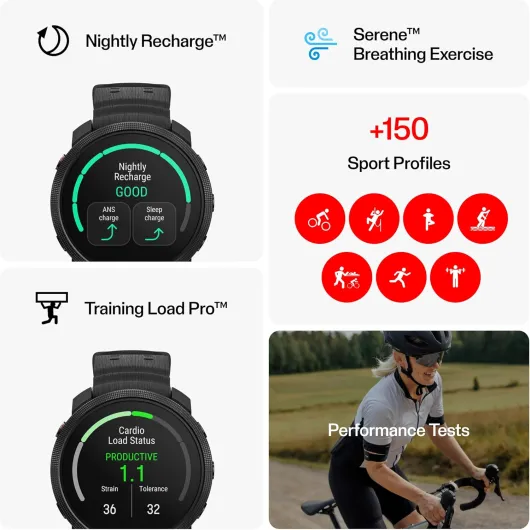
The training features are where Polar leans in hard. You get Training Load Pro, Running Index, and recovery tools like Nightly Recharge. After a week of regular training, the watch started giving me realistic feedback on whether I was overdoing it or slacking. It doesn’t always nail how I “feel”, but it was close enough to make me think twice before stacking hard workouts. The amount of data in Polar Flow (both app and web) is serious: pace zones, heart rate zones, cadence, and more. It’s a bit nerdy, but if you like numbers, you’ll enjoy it.
Navigation with Komoot turn‑by‑turn worked fine once set up, but the process is not super intuitive the first time. You need to plan the route in Komoot, sync it, then start it from the watch. On the road or trail, the directions were clear enough, and the breadcrumb trail is handy to see if you’re off‑course. Just don’t expect super detailed mapping like on high‑end Garmins; it’s more functional than pretty. Overall, performance is strong for training, slightly behind the high‑end competition in polish, but good enough that I never felt limited.
What the Polar Vantage M3 actually offers
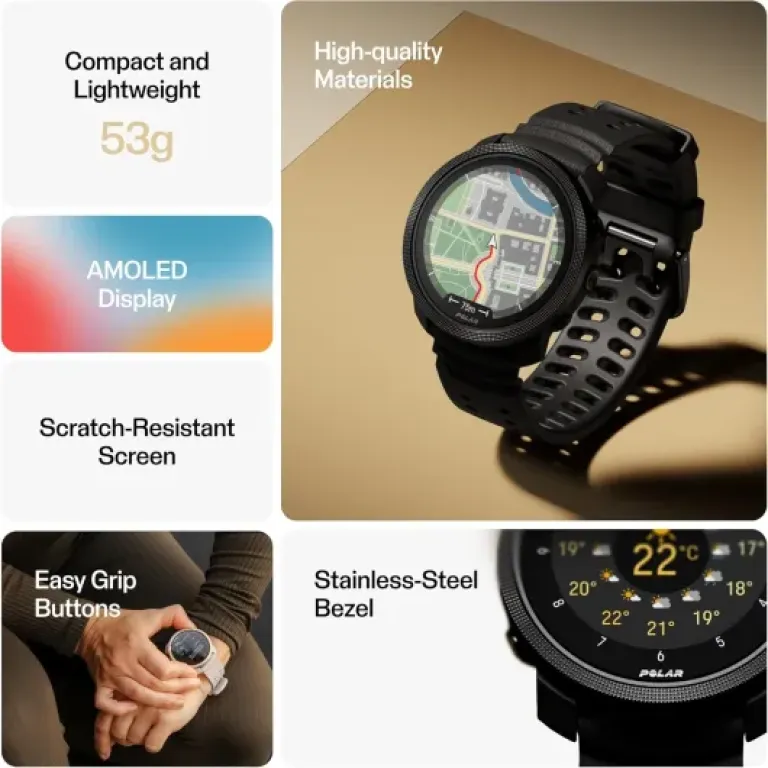
On paper, the Vantage M3 is a mid‑range multisport watch: 1.28" AMOLED display, dual‑frequency GPS, offline maps, and up to 7 days of battery in smartwatch mode or around 30 hours in full GPS training mode. It weighs 53 g, which is light enough that you forget it’s there after a while. The case is 45 mm, so it’s not tiny, but on my average wrist it didn’t look ridiculous. In the box you get two strap sizes (S‑L), which is a nice touch because you don’t have to guess your size when ordering.
Feature‑wise, Polar throws in a lot: over 150 sport profiles, Training Load Pro, Running Index, Nightly Recharge, SleepWise, heart rate tracking from the wrist, and navigation through Komoot with turn‑by‑turn directions. It’s clearly built for people who like structure in their training: intervals, pace targets, heart rate zones, and post‑workout analysis. You don’t get an app store or a bunch of third‑party widgets like on Garmin or Apple, so don’t expect Spotify or contactless payments. It’s more about tracking and less about lifestyle extras.
In practice, the core package is: accurate GPS, detailed training stats, solid sleep tracking, and basic smartwatch features (notifications, alarms, watch faces, etc.). The GPS and navigation are the big selling points here, especially the dual‑frequency GPS which helps in cities or wooded areas. The 7‑day battery spec is realistic if you don’t live in training mode, but if you hammer GPS every day, expect to charge roughly twice a week.
If I had to sum it up, I’d say: it’s a training‑oriented watch that happens to do a few smartwatch things on the side. If your priority is tracking runs, rides, and sleep, the feature list is solid. If you want a mini phone on your wrist, you’ll probably feel it’s missing a lot of “fun” stuff.
Pros
- Accurate dual‑frequency GPS with decent lock times and clean tracks
- Lightweight and comfortable enough for 24/7 wear, with two strap sizes included
- Strong training and recovery features (Training Load Pro, Nightly Recharge, Running Index)
Cons
- Smartwatch features are very basic (no music, payments, or big app ecosystem)
- Interface and app can feel a bit clunky and confusing at first
- Battery is good but not outstanding for heavy GPS users; some reports of reliability issues
Conclusion
Editor's rating
The Polar Vantage M3 is a training‑focused watch that does its main job well: accurate GPS, detailed metrics, and useful recovery tools in a light, comfortable package. The AMOLED screen is easy to read, the dual‑frequency GPS holds up nicely in tricky environments, and the battery is good enough for most runners and fitness‑minded people. If you like digging into pace, heart rate, and training load, there’s plenty of data to chew on, and Polar Flow (once you get used to it) is a strong platform.
It’s not perfect though. The smartwatch features are basic, the interface feels a bit dated in places, and some users have reported reliability issues, even if I didn’t hit any major bugs myself. If you want music, payments, and a rich app store, this isn’t the right product. But if you’re mainly after a sports tool that tracks your runs, rides, swims, and sleep in a serious way without going into ultra‑premium prices, the Vantage M3 is a pretty solid option. Runners, triathletes, and data‑driven gym goers will likely be happy. People who want a stylish everyday smartwatch with lots of extras should probably look elsewhere.