
Summary
Editor's rating
Value for money: who this makes sense for (and who should skip it)
Design: looks like a normal watch, for better and worse
Battery life: finally a watch you don’t have to babysit
Comfort: easy to forget you’re wearing it (most of the time)
Durability and build: solid case, some limits on water and tracking accuracy
Health tracking and daily performance: mostly solid, with some quirks
What you actually get with the ScanWatch 2
Pros
- Very long battery life (around 3–4 weeks in real use) so you barely think about charging
- Discrete analog design that looks like a normal watch and works in office or casual settings
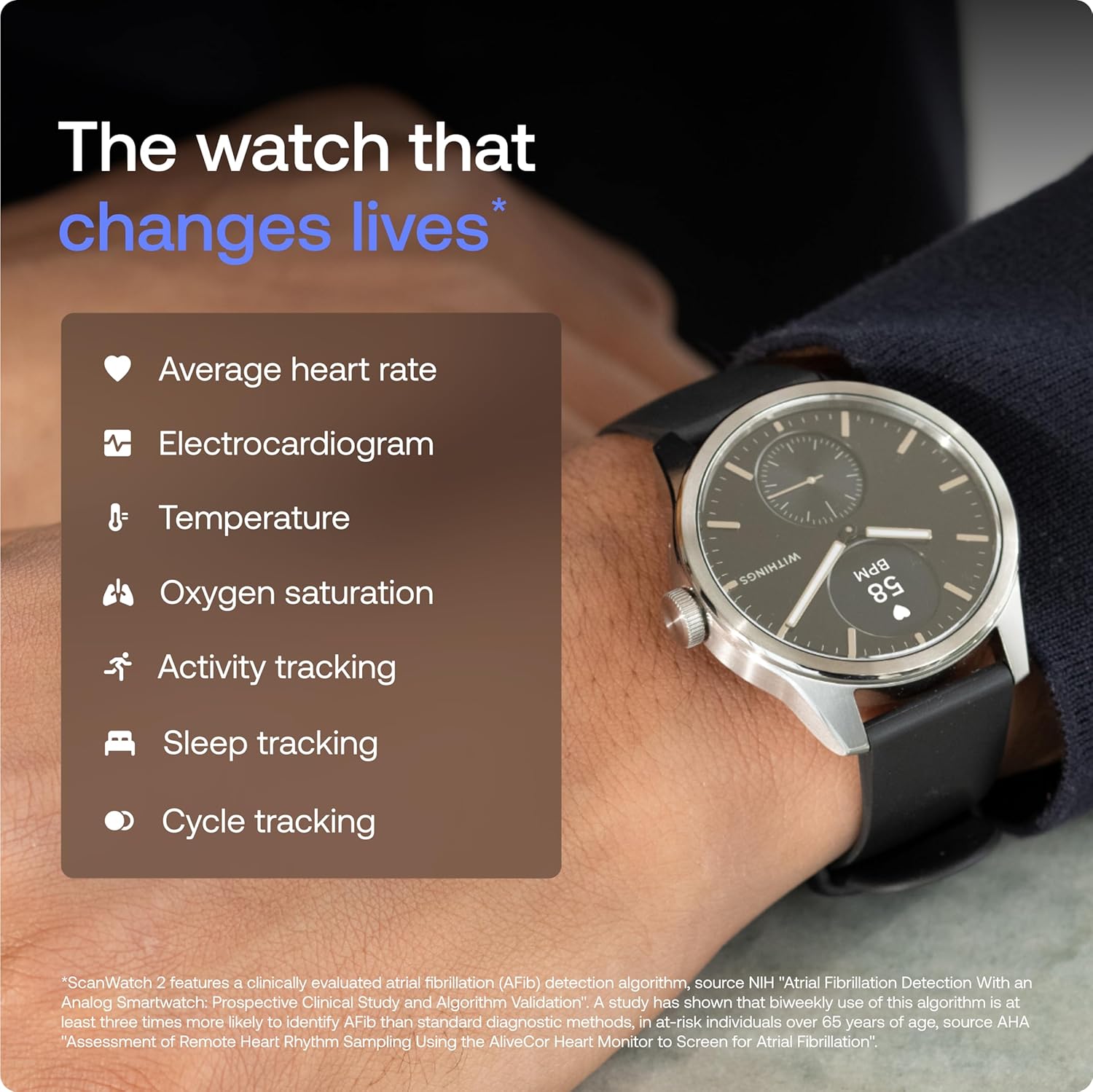
- Strong health focus with ECG, AFib detection, continuous heart rate, and useful sleep tracking
Cons
- Activity metrics (steps, calories, sometimes distance) can be inconsistent compared to other trackers
- Small screen and basic OS feel limited if you’re used to full-featured smartwatches
- Customer support and troubleshooting experience can be frustrating based on user reports

Specifications
View full product page →| Brand | Withings |
A smartwatch that doesn’t scream smartwatch
I’ve been wearing the Withings ScanWatch 2 38mm Rose Gold on my wrist pretty much nonstop for a couple of weeks, day and night, including showers and sleep. I came from more classic smartwatches (Garmin and Apple Watch) and I mainly wanted something that tracked health properly without lighting up like a mini smartphone on my arm every five minutes. In short: I wanted something that still looked like a watch and not a tiny TV.
From day one, the big difference is how low-key this thing is. The analog hands and small screen mean you’re not constantly distracted by notifications. I still get calls and basic alerts, but it’s less in my face than a full touchscreen watch. If you’re used to Apple Watch-style interactivity, it will feel limited. If you’re tired of that constant buzzing, it’s actually a relief.
I mostly tested the ScanWatch 2 for three things: daily activity tracking (steps, distance, calories), sleep tracking, and heart-related features (continuous heart rate and ECG). I also checked how annoying (or not) it was to charge, if the strap was comfortable all day, and how the watch held up to minor knocks and water. I didn’t baby it; it went through workdays, workouts, and a couple of nights where I rolled around a lot.
Overall, it’s not perfect. There are some quirks with step counts and the app can be a bit rigid, and if you’re expecting Apple-level smoothness, you’ll be a bit let down. But if your priority is health tracking, classic look, and battery life, it hits a pretty solid middle ground. I’ll break down what worked for me and what annoyed me so you can see if it fits your style or not.
Value for money: who this makes sense for (and who should skip it)
In terms of price, the ScanWatch 2 sits in that mid-to-high segment of smartwatches. It’s not cheap, especially in the rose gold version, but it’s also not at the very top like some premium Apple and Garmin models. For what you pay, you’re getting a watch that focuses heavily on health features (ECG, AFib detection, sleep and breathing tracking) and long battery life, wrapped in a classic analog design. If that combination lines up with what you care about, the value is actually pretty decent.
Where the value feels a bit weaker is if you compare it to a full-featured smartwatch at a similar price. For roughly the same money, you can sometimes find an older Apple Watch or a Samsung watch that gives you a bright screen, more apps, better integration with notifications, and often more polished software. The trade-off is battery life and a more "techy" look. So it really comes down to priorities: if you want a mini smartphone on your wrist, this Withings will feel limited for the price. If you want something you can wear for a month without charging that quietly tracks your health, it’s more attractive.
You also have to factor in the Withings ecosystem. The app is decent, syncs with Apple/Google Health, and gives you clear graphs. It’s not perfect, and support (based on reviews) isn’t always very responsive – people mentioned AI chat and some frustration when things went wrong. I didn’t have major issues during my test, but it’s something to keep in mind. The watch also comes with 1 month of Withings+ for more advanced insights. It’s a nice extra, but I wouldn’t buy the watch just for that subscription layer.
Overall, I’d call the value "good if you know what you’re buying". It’s not a bargain, but you’re paying for a specific mix: classic look, strong battery, and health-first tracking. If that’s exactly what you’re after, you’ll probably feel you got your money’s worth. If you’re on the fence and mainly want smart features and apps, I’d say look at Apple, Samsung, or Garmin before you commit.
Design: looks like a normal watch, for better and worse
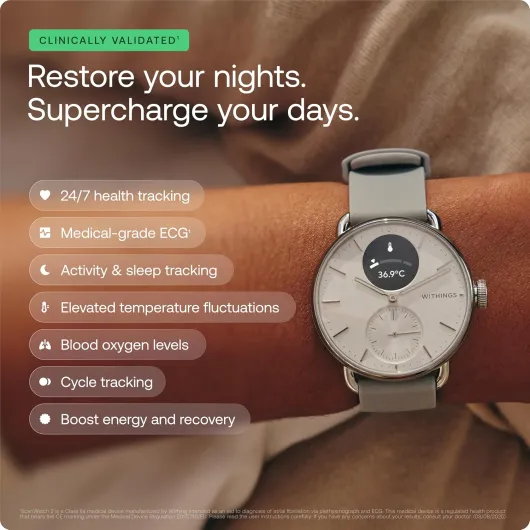
The first thing I noticed when I pulled it out of the box is that it actually looks like a regular analog watch. The rose gold case looks decent in real life, not super flashy, and the 38mm size is pretty compact. On a smaller wrist it sits nicely; on a bigger wrist it might look a bit small, but that’s a personal taste thing. The dial is grey, not black, and that matters more than I expected. A black dial would have blended better with the small screen, but the grey creates a clear contrast, which some people will find less clean visually.
The analog hands glow in the dark, which is more useful than I thought. At night, I can quickly glance and see the time without waking the screen or twisting my wrist around. The small digital display is integrated at the top. It’s readable indoors and outside as long as you’re not in direct harsh sunlight. Under strong sun, you sometimes have to tilt the watch a bit to catch the right angle, but it’s still usable. It’s not as bright or smooth as an Apple Watch screen, but again, that’s not what this watch is trying to be.
There’s a single crown/button on the side that you press and rotate to navigate. The interface is basic: tap to wake, rotate to scroll through functions (heart rate, workouts, ECG, temperature, etc.), press to select. It’s simple and after two days I could use it without thinking. The downside is you can’t really customize the layout that much, and it feels a bit limited if you’re used to swiping around on a touchscreen with lots of options.
In terms of style, it’s clearly aimed at people who want something that can pass in an office or a dinner without screaming "sports gadget". With a metal or leather strap, it easily looks like a dress watch. With the supplied FKM band, it looks more casual but still neat. Personally, I liked that it doesn’t draw attention. But if you like bold sporty designs with huge digital screens, this will feel a bit too tame and maybe even a little plain.
Battery life: finally a watch you don’t have to babysit
This is where the ScanWatch 2 really stands out compared to most smartwatches I’ve used. With daily wear, notifications on, sleep tracking, and a few ECGs and workouts per week, I was easily on track for around 20–25 days before needing a charge. Withings advertises up to 30–35 days, and I think that’s doable if you don’t hammer it with workouts and constant measurements. Either way, it’s in a completely different league from something like an Apple Watch that needs a daily or every-other-day charge.
In practice, this means you just stop thinking about battery most of the time. During my test, I never had that "oh no, I forgot to charge it" panic before going out. Even after several nights of sleep tracking and some GPS-assisted walks, the battery percentage was dropping slowly. I checked it roughly every few days out of curiosity and it barely moved. That’s one of the main reasons I kept it on my wrist instead of leaving it on a charger like my other watches.
Charging itself is straightforward. You snap it onto the magnetic puck and plug into any USB port. It’s not the fastest charging in the world, but when your watch only needs juice once or twice a month, it doesn’t matter much. I usually topped it up while sitting at my desk and it was done before I even thought about it again. The cable is proprietary, so don’t lose it, but that’s standard for most watches anyway.
If you’re the type of person who forgets chargers on trips or just hates managing one more device every night, this battery life is a real advantage. On the flip side, if you’re used to daily charging but want a bright, full-color screen and app ecosystem, you’ll be trading that away for this battery life. For me, the long battery plus 24/7 tracking was a big positive and one of the main reasons I’d pick this over a more "advanced" smartwatch.
Comfort: easy to forget you’re wearing it (most of the time)
Comfort-wise, the ScanWatch 2 is one of the easiest watches I’ve worn for long stretches. It’s light (around 55g / 0.12 lb), fairly thin, and the 38mm size doesn’t dig into the wrist or catch on sleeves. I wore it for over 12 hours a day, including sleep, and never got that heavy, sweaty feeling I sometimes get with chunkier smartwatches. One of the user reviews said it was the first watch that didn’t make their skin itchy after 12 hours, and I had a similar experience – no irritation, no weird redness.
The default FKM band is basically a soft rubber-like material. It’s not fancy, but it’s practical: it handles sweat, showers, and sleep without getting gross. It also dries quickly after you wash your hands or shower. The buckle is standard and holds well; I never felt like it was going to come loose. That said, the band does look more "fitness" than "dressy". If you’ve already bought nicer straps (like that rose gold mesh someone mentioned in the reviews), the watch head works well with them and you can make it look more polished without losing comfort.
For sleep, the watch is pretty decent. It doesn’t have that big square-edge feeling of some smartwatches that press into the back of your hand. I could sleep on my side and mostly forget about it. The only small annoyance is the occasional light from the sensor if you move a lot and the watch shifts, but that’s pretty standard for any optical heart rate watch. The glow-in-the-dark hands are actually useful at night so you don’t have to twist your wrist to wake the screen.
Overall, if your priority is something you can wear 24/7 without thinking about it, this does the job. It’s not the softest strap on the planet, but it’s good enough, doesn’t itch, and the watch itself is light and compact. For all-day comfort, I’d give it a solid score. If you want something super plush or very premium-feeling on the wrist, you’ll probably want to swap the strap pretty quickly.
Durability and build: solid case, some limits on water and tracking accuracy
On the build side, the ScanWatch 2 feels pretty solid. The stainless steel case and sapphire glass give a bit more confidence than the usual plastic-and-mineral-glass combo you see on cheaper trackers. Over a couple of weeks, I bumped it into door frames and desks a few times (as usual) and didn’t get any scratches on the glass. The rose gold coating didn’t chip or fade in that short time, though obviously long-term wear is another story. Compared to some older Withings models where glass cracks were mentioned, this one feels more robust.
Water resistance is rated IPX8 / 1 meter. That’s fine for showers, washing hands, and light swimming, but I wouldn’t take it for deep dives or constant pool sessions. I wore it in the shower multiple times and had zero issues – no fogging under the glass, no condensation. If you’re a serious swimmer and want dedicated swim tracking plus stronger water resistance, I’d look at something else. For normal daily life, this level is okay but nothing crazy.
Long-term durability of the strap will depend on how you treat it. The FKM band feels tougher than cheap silicone; it didn’t stretch or deform during my test. It’s also easy to clean, which is handy if you sweat a lot or wear it during workouts. If you swap to a mesh or leather strap, obviously you’ll trade some of that toughness for looks, so it’s a balance.
Where durability is less impressive is more on the "data reliability" side than the physical hardware. Like one of the negative reviews mentioned, the step counter and calories can be off compared to Apple or other trackers. I didn’t have the huge 3,000-step discrepancy they reported, but I did see that the watch sometimes overestimates steps on days with a lot of arm movement. That’s not a physical durability problem, but it does affect long-term trust in the metrics. If you want something clinically precise for every metric, you might end up frustrated. If you’re okay with "directionally correct" data, it’s fine.
Health tracking and daily performance: mostly solid, with some quirks
Let’s talk about how it actually tracks stuff, because that’s the main reason to buy this. For daily activity (steps, distance, calories), I’d say it’s pretty decent but not perfect. On normal walking days, it was in the same ballpark as my phone and another watch I tested alongside. But I did notice what one Amazon reviewer mentioned: sometimes the step count on the watch and the app didn’t match exactly. I saw differences of a few hundred steps, not 3,000 like in their case, but enough to notice. It’s not deal-breaking for me, but if you want super-precise step counts, it might annoy you.
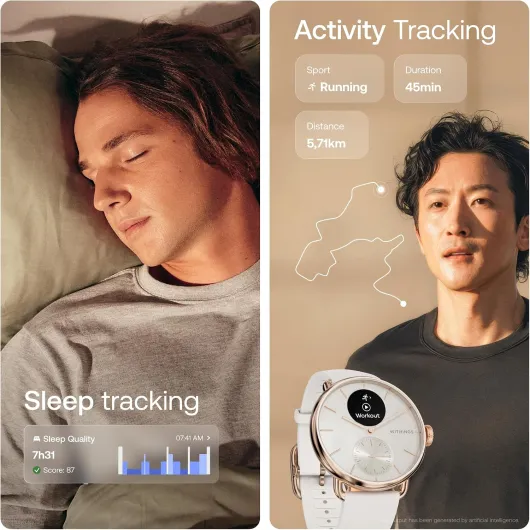
For workouts, there are 40+ sports modes, but realistically I used walking, running, and a bit of indoor exercise. The watch uses your phone’s GPS, so if you leave your phone at home, distance will be more of an estimate based on movement. With the phone, distance and pace were reasonably accurate compared to other apps I use. Heart rate during workouts tracked fine most of the time. It lagged a bit at the start of intervals (typical for wrist sensors), but once locked in, it followed the intensity changes well enough for casual to moderate training.
Sleep tracking is one of the better parts. You get sleep stages (light, deep, REM), duration, and a breathing component. Over several nights, it matched quite closely how I felt in the morning. Nights where I woke up often were clearly flagged, and the app gives you a simple score so you can see at a glance if it was a good or bad night. It’s not magic, but it’s useful. The downside is that the app sometimes takes a bit to fully sync and show all the details, especially if you haven’t opened it in a while.
On the heart health side, the 30-second ECG is easy to launch from the watch. You press, hold your hand still, and after half a minute you get a basic reading (sinus rhythm or possible AFib). One Amazon user said an older Withings watch helped catch bradycardia, and I can believe it – you can see if your heart rate is way off normal and act on it. Obviously, it’s not a doctor, but as an early warning tool it’s useful. Continuous heart rate is fine for general trends: resting heart rate, daily average, and so on. Notifications for high or low heart rate are there, but they’re not as polished or configurable as Apple’s.
What you actually get with the ScanWatch 2
On paper, the Withings ScanWatch 2 is a hybrid smartwatch with ECG, continuous heart rate, sleep tracking, VO₂ max estimates, and up to 30–35 days of battery life. It connects to your phone via Bluetooth and syncs with the Withings app, which then pushes data into Apple Health or Google Health if you want. The 38mm version I tested is the Rose Gold case with a rose gold-style band, so it leans a bit more on the dressy side than sporty.
The watch itself has analog hands plus a tiny round digital screen at the top. That screen is small (0.63 inch), so don’t expect to read long messages or detailed stats on your wrist. It’s mainly for: current heart rate, steps, simple workout info, and basic notifications. All the deeper stuff (sleep graphs, ECG history, VO₂ max trends) lives in the app. The watch has sensors for heart rate, movement (accelerometer), temperature, and uses your phone’s GPS for distance during workouts. No standalone GPS, so you still need your phone if you want good route tracking.
In the box, you get the watch, an FKM band (kind of rubbery and sweat-friendly), a small charging puck with USB cable, and the usual leaflets. Setup is done through the Withings app. It took me around 10–15 minutes from opening the box to having the watch updated and paired. Not super fast, but nothing painful either. The app walks you through calibration of the hands and some basic personalization (wrist, notifications, etc.).
Function-wise, it’s clearly a health-first watch. You get: ECG on demand (30 seconds), AFib detection via the Withings ECG app, continuous heart rate, sleep stages, breathing tracking, and over 40 workout profiles. But don’t expect third-party apps or installing Spotify or whatever. This runs on Withings’ own system, so you’re living inside their ecosystem. If you’re fine with that and mainly want tracking, it makes sense. If you want a tiny smartphone on your wrist, this isn’t it.
Pros
- Very long battery life (around 3–4 weeks in real use) so you barely think about charging
- Discrete analog design that looks like a normal watch and works in office or casual settings
- Strong health focus with ECG, AFib detection, continuous heart rate, and useful sleep tracking
Cons
- Activity metrics (steps, calories, sometimes distance) can be inconsistent compared to other trackers
- Small screen and basic OS feel limited if you’re used to full-featured smartwatches
- Customer support and troubleshooting experience can be frustrating based on user reports
Conclusion
Editor's rating
After wearing the Withings ScanWatch 2 38mm Rose Gold day and night, I’d sum it up like this: it’s a solid health-focused watch for people who want something that looks normal and doesn’t need constant charging. The ECG, continuous heart rate, sleep tracking, and long battery life are the clear strengths. The design is low-key, the watch is comfortable, and the sapphire glass plus steel case feel reassuring on the wrist. If you’ve tried full-on smartwatches and got tired of the constant screen time and nightly charging, this feels like a calmer, more practical option.
On the downside, it’s not the most accurate or feature-packed device out there. Step counts and calories can be off compared to Apple or other trackers, and the small screen plus basic interface mean you’re relying heavily on the app. Customer support, from what I’ve seen and read, isn’t top-tier either. So if you’re extremely picky about metric precision, or you want lots of apps and deep integration with your phone, you’ll probably be happier with something else.
I’d recommend the ScanWatch 2 to people who care more about long-term health trends than about fancy smartwatch features: office workers who want a discreet watch, anyone focused on heart monitoring and sleep, and those who hate charging their watch every day. I’d skip it if you’re a heavy smartwatch user, a serious athlete who needs top-level GPS and training tools, or someone who expects perfect step and calorie accuracy. For the right person, it’s a pretty solid everyday health companion; for the wrong one, it will feel a bit limited for the price.