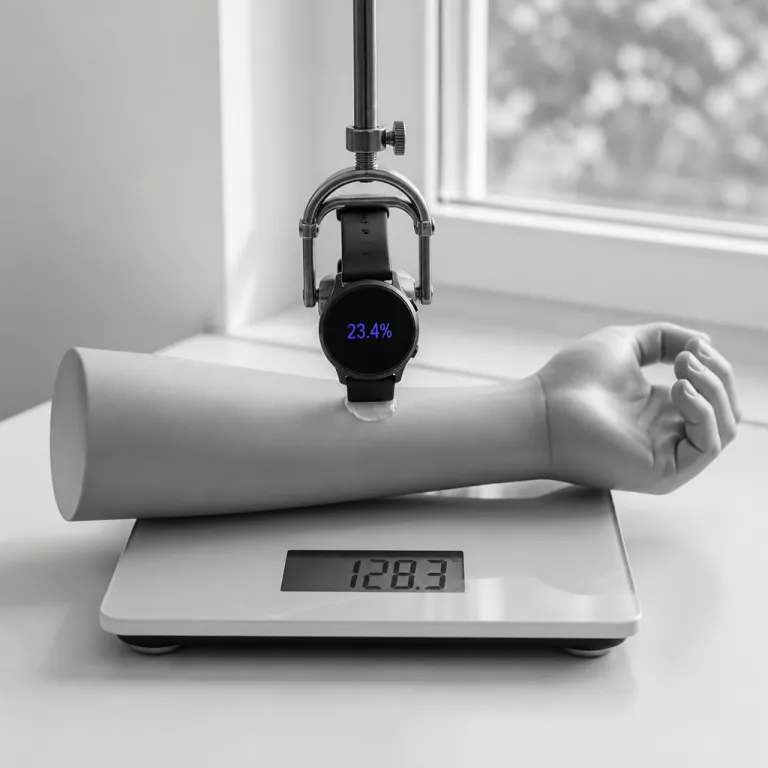
What smartwatch body composition BIA accuracy really means
Smartwatch body composition BIA accuracy sounds precise, but it is not magic. When a Galaxy Watch runs a body scan, it sends a tiny electrical current through your upper body and measures how easily that current moves through different tissues. The watch then uses built in equations to turn that electrical data into estimates of body fat, skeletal muscle, total body water and overall body composition.
This method is called bioelectrical impedance analysis, or BIA, and it has been used for decades in clinical BIA devices and gym analyzers. In the Galaxy Watch and other wearable BIA implementations, the current travels from the back of the watch through your arm, then returns via your fingers touching the side buttons, so the circuit mainly covers your arms and upper torso rather than your whole body. That limited current path is the first reason smartwatch body composition BIA accuracy will never perfectly match a bathroom scale that sends current foot to foot or a DXA scan that images your entire body mass directly.
Researchers judge BIA validity by comparing it with reference methods such as DXA, which measures fat mass and lean mass using low dose X rays. In peer reviewed article comparisons indexed on PubMed and Google Scholar, wrist based BIA devices show reasonable agreement for group averages but larger individual error margins, especially for people with very high or very low muscle mass. That means a Galaxy Watch can be a useful wearable for tracking trends in body fat and muscle mass, yet it should not be treated as a clinical BIA device for making medical decisions in the United States or elsewhere.
How Galaxy Watch BIA works compared with bathroom scales and DXA
On a Galaxy Watch, a body composition scan takes about 15 seconds. You strap the watch snugly on your non dominant wrist, then lightly place two fingers from the opposite hand on the side buttons to close the BIA circuit through your upper body. During that short window, the wearable BIA system measures resistance and reactance in your body tissues, then applies proprietary equations to estimate body fat, skeletal muscle and total body water.
A bathroom scale that uses BIA works differently because the current travels from one foot to the other, so it mainly measures your legs and lower trunk. That foot to foot path often leads to different body composition estimates than a wrist to finger path, even when both devices use BIA and both claim clinical BIA style precision. DXA, sometimes called DXA wearable imaging when used in research on portable setups, does not rely on electrical properties at all, so it serves as a reference standard for checking smartwatch body composition BIA accuracy and for calculating metrics such as mean absolute percentage error, or MAPE, and concordance correlation coefficient, or CCC.
When scholars perform conceptualization writing for a validation study, they usually pre register how they will test agreement and equivalence between a BIA device and DXA. They might use Bland Altman plots to show bias and limits of agreement, report MAPE values for body fat percentage, and calculate CCC to summarize overall concordance between methods. Those same tools can be applied to Galaxy Watch BIA data, bathroom scale BIA readings and DXA results to quantify where each method shines and where each one shows systematic error in estimating fat mass and muscle mass.
Consistency versus accuracy: what the numbers on your wrist can and cannot tell you
For everyday buyers, the key question is not whether smartwatch body composition BIA accuracy matches DXA to the decimal. The more practical question is whether your Galaxy Watch gives consistent readings from day to day so you can track trends in body fat and skeletal muscle over weeks. If the error is stable, the watch can still be a powerful wearable for behavior change, even if its absolute numbers differ from a clinical BIA device or a research grade DXA scan.
Hydration status, recent meals and exercise timing all influence BIA measurements because water conducts electricity better than fat tissue. If you step off a long run drenched in sweat, your body water distribution has shifted, and both a bathroom scale and a Galaxy Watch BIA reading will likely underestimate body fat and overestimate muscle mass. That is why scholars who publish on PubMed and Google Scholar standardize testing conditions in their original article protocols, often asking participants to avoid heavy meals, alcohol and intense exercise for several hours before any BIA clinical assessment.
You can borrow that same rigor at home without turning your bathroom into a lab. Measure at the same time each day, ideally in the morning after using the bathroom and before breakfast, and keep your arm position and finger contact identical for every Galaxy Watch scan to reduce random error. Over time, you will see whether your body composition is trending leaner or heavier, and that trend is usually more meaningful than whether your smartwatch agrees perfectly with a gym scale or a DXA wearable research setup on any single day.
What the research says about Galaxy Watch BIA validity
When you read a validation article about smartwatch body composition BIA accuracy, you will often see a familiar toolkit of statistics. Researchers compare Galaxy Watch BIA estimates of body fat and muscle mass with DXA values, then calculate MAPE to express average percentage error and CCC to show how closely the two methods line up across the full range of body sizes. Bland Altman plots visualize whether the watch tends to overestimate fat at low values or underestimate it at high values, revealing systematic bias rather than just random noise.
Across multiple wearable BIA and clinical BIA studies, the pattern is consistent. Group averages for body fat percentage often show good agreement and acceptable equivalence between BIA devices and DXA, but individual errors can reach several percentage points, especially in athletes with high skeletal muscle or in people with obesity. That means a Galaxy Watch can rank you roughly in the right body composition category, yet its single reading should not be treated as a definitive clinical BIA diagnosis, whether you live in the United States or elsewhere.
Scholars who handle conceptualization writing, original draft preparation, writing original methods sections and later review editing or writing review tasks often emphasize this nuance in their discussion sections. They note that smartwatch body composition BIA accuracy is sufficient for population monitoring and personal trend tracking, but not for replacing DXA in medical decision making or for certifying exact fat mass in elite sport. For a health conscious consumer, the practical takeaway is clear ; use your Galaxy Watch BIA as a directional tool, and rely on DXA or a high quality bia device in a clinic if you need precise numbers for a medical or training program.
How to use Galaxy Watch BIA and a bathroom scale together
If you already own a bathroom scale with BIA, you do not need to choose between it and your Galaxy Watch. Each device measures a slightly different slice of your body, and together they can give a richer picture of body composition changes over time. The scale focuses more on your legs and lower trunk, while the watch emphasizes your arms and upper torso, so comparing both can highlight whether fat loss or muscle gain is happening evenly across your body.
To get the best smartwatch body composition BIA accuracy in real life, build a simple routine. Weigh yourself on the same BIA scale at the same time of day, then immediately run a Galaxy Watch BIA scan with the same arm position and finger placement, ideally before coffee or breakfast. Log both sets of numbers, and after several weeks you will see whether the two BIA devices show similar trends in body fat and muscle mass, even if their absolute values differ by a few percentage points.
If the bathroom scale and the Galaxy Watch move in the same direction over months, that agreement is more important than perfect equivalence on any single morning. When they disagree wildly, think about hydration, recent travel, or even firmware updates that might have changed the watch algorithms, and consider a checkup with DXA or a professional bia clinical assessment if the discrepancy persists. Used this way, your watch, your scale and occasional clinical BIA or DXA testing become complementary tools rather than competing gadgets, each adding a layer of insight into how your body is changing beneath the surface.
FAQ
How accurate is Galaxy Watch BIA compared with DXA scans ?
Galaxy Watch BIA is reasonably accurate for tracking trends but less precise than DXA for absolute values. Studies that compare smartwatch body composition BIA accuracy with DXA often find average body fat errors of several percentage points, with larger deviations in very lean or very heavy individuals. For medical decisions, DXA or a clinical BIA device remains the reference standard.
Why do my Galaxy Watch body fat readings change so much day to day ?
Short term swings usually reflect changes in hydration, food intake and exercise timing rather than real shifts in body fat. Because BIA depends on how electrical current moves through water in your body, drinking more, sweating heavily or eating a salty meal can all alter readings. Measuring at the same time each day under similar conditions will reduce this apparent noise.
Should I trust my bathroom scale or my Galaxy Watch more ?
Neither device is universally better ; they simply measure different current paths through your body. A bathroom scale mainly assesses your legs and lower trunk, while the Galaxy Watch focuses on your arms and upper torso, so each can over or underestimate body fat in different ways. If both show similar long term trends, you can be more confident that your body composition is truly changing.
Can Galaxy Watch BIA replace a professional body composition test ?
For most people, Galaxy Watch BIA is best viewed as a convenient self monitoring tool rather than a replacement for professional testing. It can highlight meaningful trends in body fat and muscle mass, but it lacks the precision and clinical validation of DXA or high quality multi frequency BIA analyzers. If you need exact numbers for medical treatment or elite training, schedule a formal assessment.
Is it safe to use BIA on a smartwatch every day ?
The electrical current used for BIA in smartwatches and bathroom scales is extremely low and considered safe for healthy adults. People with implanted medical devices such as pacemakers should follow manufacturer guidance and consult their clinician before using any BIA feature. For everyone else, daily scans are more likely to cause data fatigue than physical harm.