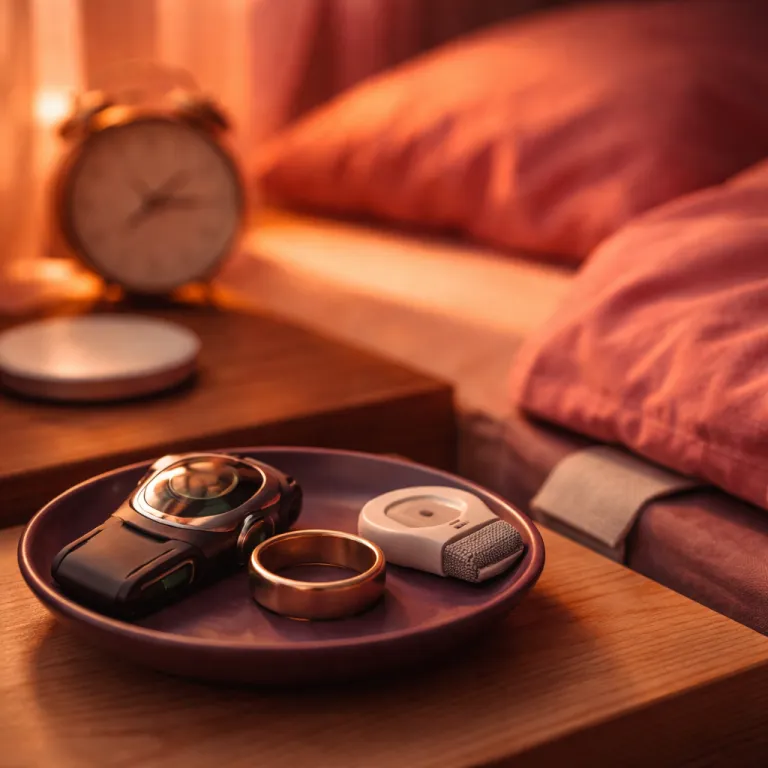

How smartwatches really measure sleep, and where they go wrong
Your smartwatch does not see brain activity, it infers sleep. It combines movement from accelerometers with heart rate and sometimes blood oxygen to guess when you are asleep or awake. That means every consumer sleep tracker is always interpreting signals, not directly measuring sleep stages.
Clinical sleep tracking in a lab uses polysomnography, often abbreviated as PSG, which records brain activity, eye movements, muscle tone and breathing. By contrast, a wearable on your wrist or a ring on your finger only captures motion and cardiovascular data, then runs stage classification algorithms on top. This gap between full polysomnography and simplified wearable data explains much of the frustration you feel when your watch says you slept well but you wake up exhausted.
Most sleep trackers are quite good at detecting total sleep time and broad sleep timing, such as when you fell asleep and when you woke up. They are much worse at wake after sleep onset, the brief periods you are awake in the night that often get labelled as light sleep instead. This is why smartwatch sleep tracking accuracy often overestimates total sleep and underestimates how restless your night actually felt.
When you read a review of a sleep tracker, always check whether it has been validated against proper PSG rather than just compared with another consumer device. Peer reviewed validation studies on Apple Watch, Fitbit and Samsung Galaxy Watch models consistently show that these devices cluster in similar accuracy ranges for sleep stage classification. For example, de Zambotti et al. (2018, Sleep) reported that Fitbit Alta HR overestimated total sleep time and underestimated wake after sleep onset versus PSG, while Chinoy et al. (2021, Sleep) found that Apple Watch Series 3 and 5 showed comparable patterns. None of them match polysomnography for precise sleep stage or sleep latency measurement, but they can still be useful trend tools for everyday health.
The same limitations apply to ring based devices such as the Oura Ring, even though the marketing often leans heavily on deep sleep and REM sleep graphs. The Oura Ring and similar wearables still rely on heart rate and movement rather than direct brain activity, so their deep REM and light deep breakdowns are estimates. Validation work such as de Zambotti et al. (2017, Behavioral Sleep Medicine) shows strong agreement with PSG for total sleep and REM timing but only moderate accuracy for individual stages. Treat those colourful sleep stages as helpful illustrations, not as medical grade data.
Why your watch misjudges wake time, light sleep and deep sleep
The biggest blind spot in smartwatch sleep tracking accuracy is wake after sleep onset, often shortened to WASO in research papers. When you lie still in bed, your watch or ring assumes you are in light sleep even if you are quietly awake and worrying about work. Because movement is low and heart rate is modest, the device has no clear signal that you are awake.
Polysomnography solves this by reading brain activity directly, so even a brief awakening shows up clearly in the EEG lines. Consumer sleep trackers cannot see that, so their algorithms tend to smooth over short awakenings and fold them into light sleep or sometimes even deep sleep. This is why your total sleep number often looks generous while your lived experience of the night feels much shorter and more fragmented.
Apple Watch, Fitbit and other mainstream devices all share this pattern, even if their apps present the graphs differently. Independent validation against PSG has repeatedly shown that most wrist wearables significantly underestimate WASO and overestimate total sleep duration. For instance, de Zambotti et al. (2018, Sleep) found that Fitbit Alta HR underestimated WASO by roughly 30 to 40 minutes, while Chinoy et al. (2021, Sleep) reported similar underestimation for Apple Watch models. In practice, that means your watch is better at telling you when you were in bed than how much of that time you were truly asleep.
Light sleep and deep sleep labels are especially shaky on a wrist based sleep tracker, because the stage classification relies on subtle shifts in heart rate and movement. Deep REM and light deep splits look precise in the app, but they are built on probabilities rather than direct observation of sleep stages. For a health conscious user, the safest approach is to treat changes in these graphs over weeks as signals, not to obsess over any single night.
If you use an Apple Watch as your main sleep tracker, focus less on the exact minutes of REM sleep and more on consistent bedtimes and resting heart rate trends. A detailed Apple Watch sleep tracker guide can help you interpret these metrics without overreacting to nightly noise. The same philosophy applies whether you wear a Fitbit, a Garmin watch or an Oura Ring, because all these devices share the same core limitations.
Sleep stages on your wrist : useful story or misleading fiction ?
Those multicoloured charts of light sleep, deep sleep and REM sleep are the most eye catching part of any sleep tracking app. They are also the least reliable part of smartwatch sleep tracking accuracy, because they try to reconstruct complex sleep stages from just movement and heart rate. In a lab, technicians use polysomnography to label each sleep stage based on brain activity, eye movements and muscle tone.
On your wrist, the device has to guess whether a period of very still, slow heart rate sleep is deep sleep or just relaxed light sleep. Algorithms use patterns in heart rate variability and motion to perform stage classification, but they cannot see the brain waves that truly define each sleep stage. This is why two different sleep trackers worn on the same night can disagree wildly on how much deep sleep or REM sleep you supposedly had.
Consumer sleep devices such as Apple Watch, Fitbit and Oura Ring are generally better at separating sleep from wake than at distinguishing between individual sleep stages. When researchers compare their stage classification to PSG, they often find reasonable accuracy for total sleep and REM sleep timing but poor precision for light deep boundaries. For example, de Zambotti et al. (2018, Sleep) and Chinoy et al. (2021, Sleep) both reported overall sleep versus wake accuracy around 85 to 90 percent, while epoch by epoch agreement for specific stages such as N2 and N3 hovered closer to 60 percent. In other words, your watch can usually tell when you were in some form of sleep, but it struggles to label that sleep correctly.
For most people, obsessing over exact minutes of deep sleep or REM sleep is a distraction from more actionable health metrics. A more practical use of sleep tracking is to watch how your sleep time, sleep latency and resting heart rate change when you adjust caffeine, alcohol or exercise. Guides that explain how smartwatches track your sleep patterns can help you focus on trends that genuinely reflect your health rather than on nightly fluctuations in stage graphs.
If you wear multiple devices, such as an Apple Watch by day and an Oura Ring at night, expect their sleep stages to disagree. Each tracker uses its own proprietary model, trained on different datasets and tuned for different priorities. The important question is not which device nails every sleep stage, but which one gives you consistent, understandable feedback that helps you sleep better over months.
What your sleep data is actually good for in everyday health
Even with their flaws, modern sleep trackers can be powerful tools when used wisely. The key is to shift your attention from single night scores to multi week patterns that reveal how your behaviour shapes your sleep. Think of your watch or ring as a long term diary of your nights rather than a nightly exam you either pass or fail.
Smartwatch sleep tracking accuracy is strongest for simple metrics such as bedtime, wake time and total sleep time in a broad sense. If your device shows that your sleep time drifts later on weekends and never fully recovers, that pattern is almost certainly real. Likewise, if your resting heart rate during sleep climbs steadily over several weeks, that is a genuine health signal worth discussing with a clinician.
Heart rate trends at night can reveal how your body responds to stress, illness or alcohol, even when stage classification is noisy. A spike in overnight heart rate combined with shorter total sleep and longer sleep latency often signals that your system is under strain. In that context, the exact split between light sleep and deep sleep matters less than the overall picture of recovery.
For a health conscious user, the most practical way to use a sleep tracker is to run small experiments. Go to bed 30 minutes earlier for a week, reduce late evening screen time or cut back on alcohol, then watch how your sleep tracking data responds. If your sleep stages graphs look calmer and your resting heart rate drops, you have concrete feedback that your new habit is helping.
Some advanced users also track heart rate variability and SDNN metrics to gauge stress and recovery across nights. A detailed explanation of SDNN in smartwatch heart health tracking can clarify how these numbers relate to your nervous system balance. Used together with simple sleep metrics, these cardiovascular signals can turn a basic wearable into a meaningful health companion rather than just a gadget.
When a ring, a different device or a sleep lab makes sense
Not every sleep problem can be solved with a smartwatch, no matter how polished the app looks. If your partner notices loud snoring, pauses in breathing or restless movements, smartwatch sleep tracking accuracy will not be enough to rule out conditions such as sleep apnoea. In those cases, a conversation with a doctor and possibly a formal polysomnography study in a sleep lab is the right next step.
For milder concerns, a ring based tracker such as the Oura Ring can be a comfortable alternative to a bulky watch. The Oura Ring and similar devices place sensors on the finger, which often gives cleaner heart rate and temperature data during sleep. That can improve the stability of nightly trends, even though the underlying stage classification still relies on indirect signals rather than direct brain activity.
People who dislike wearing a watch in bed often find that a ring style sleep tracker disappears on the hand, making long term use more realistic. Consistency matters more than the exact brand, because sleep tracking only becomes truly useful when you collect weeks or months of data. Whether you choose an Oura Ring, an Apple Watch or another wearable, the goal is to build a reliable baseline for your own nights.
There are also chest strap and headband devices that sit somewhere between consumer sleep trackers and full PSG. These devices can capture richer signals such as more detailed heart rate variability or limited brain activity, but they are usually less comfortable for nightly use. For most health conscious adults, they make sense only during short diagnostic periods rather than as everyday sleep companions.
If you already own an Apple Watch or a Fitbit, upgrading to a newer model rarely transforms sleep tracking accuracy overnight. The bigger gains usually come from wearing the device consistently, tightening the strap enough for clean heart rate readings and keeping the software updated. When those basics are in place, a ring or a different device is a preference choice rather than a mandatory upgrade.
How to read your sleep tracker like an expert, not a victim of the score
That single sleep score on your watch face is tempting, but it hides a messy mix of metrics. To use smartwatch sleep tracking accuracy wisely, you need to look under the hood at sleep time, sleep latency, wake periods and heart rate. The goal is not to chase a perfect number but to understand how your daily choices shape your nights.
Start by checking whether your total sleep time is broadly aligned with how you feel during the day. If your watch regularly reports eight hours of sleep but you feel drained, assume that wake after sleep onset is being underestimated and that some of that time was light, restless dozing. In that situation, focus on improving sleep hygiene rather than arguing with the device about exact minutes.
Next, pay attention to how long it takes you to fall asleep, because prolonged sleep latency often signals stress, caffeine or irregular schedules. Most trackers estimate this by looking at the gap between when you stop moving and when your heart rate settles into a sleep pattern. While not as precise as PSG, this estimate is usually good enough to show whether your wind down routine is working.
Finally, watch how your sleep stages and heart rate respond to specific triggers such as late dinners, alcohol or intense evening workouts. If a heavy meal pushes your resting heart rate up and your deep sleep down, that pattern is more trustworthy than any single night’s deep REM percentage. Over time, you will learn which habits reliably improve your sleep trackers graphs and, more importantly, how you feel the next morning.
In the end, the value of any sleep tracker, whether a watch, a ring or another wearable device, lies in the patterns it reveals rather than the precision of each data point. Consumer sleep devices are not mini sleep labs, but they are honest enough trend mirrors when you understand their limits. Trust the direction of change, question the exact numbers and remember that the real test of a good night’s sleep is how you move through your day.
Key figures on smartwatch sleep tracking accuracy
- Studies comparing consumer sleep trackers with polysomnography consistently find that wrist wearables underestimate wake after sleep onset by around 20 to 50 minutes per night, meaning your watch often misses several brief awakenings that you clearly remember (for example, de Zambotti et al., 2018, Sleep, on Fitbit Alta HR; Chinoy et al., 2021, Sleep, on Apple Watch Series 3 and 5; and validation work in Journal of Clinical Sleep Medicine on various commercial devices).
- Validation research on Apple Watch, Fitbit and Samsung Galaxy Watch models shows that their overall sleep versus wake detection accuracy typically falls between 85 and 90 percent when compared with PSG, which is acceptable for trends but not for clinical diagnosis, according to multiple independent comparison studies in Sleep and JCSM.
- Stage classification accuracy for light sleep, deep sleep and REM sleep in consumer devices often drops to around 60 percent agreement with polysomnography, so roughly four out of ten epochs may be mislabelled at the individual sleep stage level, as reported in device specific validation papers such as de Zambotti et al. (2018, Sleep) and de Zambotti et al. (2017, Behavioral Sleep Medicine).
- Independent tests of ring based trackers such as the Oura Ring have shown strong agreement with chest strap references for overnight heart rate, with average errors often under 2 beats per minute, which makes these devices reliable for tracking cardiovascular trends during sleep in non clinical settings (for example, Kinnunen et al., 2020, Journal of Sports Sciences).
- Large scale consumer sleep datasets from major wearable platforms suggest that many adults average less than 7 hours of total sleep time on weeknights, highlighting a widespread sleep debt that no amount of perfect tracking can fix without behavioural change.
Table 1 summarises these headline figures so you can quickly see where smartwatch sleep tracking is strong and where it falls short compared with a full sleep study.
| Metric | Typical smartwatch / ring performance | Reference method |
|---|---|---|
| Total sleep vs wake | ~85–90% agreement with PSG | Polysomnography (EEG, EOG, EMG, breathing) |
| Wake after sleep onset (WASO) | Underestimates by ~20–50 minutes per night | PSG scoring of awakenings |
| Individual sleep stages (light, deep, REM) | ~60% epoch by epoch agreement | PSG stage scoring by a sleep technologist |
| Overnight heart rate | Error often < 2 bpm vs chest strap | ECG or validated chest strap monitor |
FAQ about smartwatch sleep tracking accuracy
How accurate are smartwatches at tracking total sleep time ?
Most modern smartwatches are reasonably accurate at estimating total sleep time, usually within about 30 minutes of polysomnography on average. They tend to overestimate sleep because they misclassify quiet wakefulness as light sleep. For everyday use, this is good enough to track trends but not precise enough for medical decisions.
Can my smartwatch really tell how much deep sleep and REM sleep I get ?
Smartwatches estimate deep sleep and REM sleep using movement and heart rate patterns, not direct brain activity. Validation studies show that stage classification for individual sleep stages is only moderately accurate, with many epochs mislabelled. You can use these graphs to spot broad changes over time, but you should not treat the exact minutes as definitive.
Why does my watch say I slept well when I feel exhausted ?
This mismatch usually happens because your watch underestimates wake after sleep onset and overestimates light sleep. If you lie still while awake, the device often assumes you are sleeping, which inflates your total sleep number. In such cases, trust your daytime functioning more than a single night’s score and look for patterns across several nights.
Is a ring like the Oura Ring better than a smartwatch for sleep tracking ?
Ring based trackers such as the Oura Ring can capture very clean heart rate data during sleep, which improves trend reliability. However, they still rely on indirect signals for sleep stages, so their deep sleep and REM sleep estimates share the same limitations as wrist devices. The main advantages are comfort and consistency rather than dramatically higher accuracy.
When should I get a formal sleep study instead of relying on a wearable ?
If you have symptoms such as loud snoring, gasping, pauses in breathing, severe daytime sleepiness or unexplained high blood pressure, a wearable is not enough. In those situations, you should speak with a healthcare professional about a formal polysomnography study. A sleep lab can measure brain activity and breathing directly, which no consumer device can match.