
Summary
Editor's rating
Value: strong hardware, slightly held back by software
Design: more tool than jewelry, which fits the target
Battery life: the main reason to buy this watch
Comfort: good for sports, acceptable for 24/7 wear
Materials and build: tough where it matters
Performance: GPS, maps and training tools where it counts
What this watch actually offers in real life
Pros
- Excellent battery life with up to 65 hours of All Systems GPS and very long standby use
- Robust build with titanium case and sapphire glass that handles bumps and scratches well
- Accurate dual‑frequency GPS and useful offline topo maps with turn‑by‑turn navigation
Cons
- Reports of unreliable Strava syncing and slow fixes from COROS
- MIP screen looks dated indoors compared to AMOLED competitors and needs backlight in low light
- Software and app feel less polished and intuitive than Garmin’s ecosystem

Specifications
View full product page →| Brand | COROS |
A watch built for long days out, not for showing off at the office
I’ve been using the COROS APEX 4 (46mm) mainly for trail running, hiking and a bit of indoor climbing. I came from a Garmin Forerunner, so I already had a decent idea of what a sports watch should do: track GPS reliably, survive long days outside, and not die halfway through a big run. On paper, the APEX 4 hits all those points: dual-frequency GPS, big battery, offline maps, turn‑by‑turn, and some extra stuff like voice notes and calls.
In practice, it feels like a watch made for people who actually spend hours in the mountains, not just jogging around the block. The battery is clearly one of the main selling points, and the GPS accuracy in rough terrain is honestly the thing that stood out the most to me. It locks on fast, and I didn’t see the usual “zig-zag” tracks in forests or near cliffs as much as with my old watch.
That said, it’s not perfect. The software side is a bit rough around the edges. First setup was more annoying than it should be, especially around Wi‑Fi and updates. Also, if you live in Strava, you really need to know there are people having sync issues. Mine has been okay so far, but seeing recent complaints doesn’t inspire full confidence.
Overall, this is a watch that focuses on endurance and performance more than fancy smart features. If you want a bright AMOLED screen and full smartwatch vibes, this isn’t it. If you want something you can beat up on long runs and mountain days, it’s pretty solid, as long as you accept a slightly clunky setup and a companion app that’s good but not perfect.
Value: strong hardware, slightly held back by software
In terms of value, the APEX 4 sits in that higher mid‑range segment: not cheap, but not at the extreme price of some flagship outdoor watches either. For the money, you’re getting titanium + sapphire, dual‑frequency GPS, offline topo maps with turn‑by‑turn, and genuinely strong battery life. If you compare that to something like a Garmin Forerunner or Fenix at similar price points, COROS usually gives you better materials and battery for the same or slightly less money.
Where the value drops a bit is on the software and ecosystem side. The watch itself is strong, but the app is less polished than Garmin’s and the Strava sync complaints are a real concern. One Amazon user flat-out said they might return the watch because of ongoing sync issues that COROS hasn’t fixed. If you don’t care about Strava and are happy to live in the COROS app, this might not bother you much. But if you’ve built years of training history in Strava and like instant sync, this is more than a minor annoyance.
For pure outdoors and endurance use, I’d say the watch is good value for money. You’re paying mainly for battery, GPS reliability, and robust materials, and those parts deliver. If you want slick smartwatch functions (apps, rich notifications, payments, etc.), you’ll feel the limits pretty quickly. The microphone/speaker and calls are nice extras but not at the level of a full smartwatch, so I wouldn’t buy it just for that.
So overall: if your priority is a durable, long‑lasting GPS watch for running, hiking, ski touring, and occasional climbing, the APEX 4 is a solid deal. If your priority is tight Strava integration, fancy smartwatch features, and a flashy screen, there are better choices, even if you lose some battery life and ruggedness.
Design: more tool than jewelry, which fits the target
Design-wise, the COROS APEX 4 (46mm) is clearly built as a sports tool, not a fashion accessory. The 46mm size is noticeable on the wrist but not ridiculous, especially if you’re used to outdoor watches. At 64 grams, it’s lighter than a lot of chunky GPS watches I’ve tried. You feel it’s there, but it doesn’t bounce around or feel like a brick during runs. For my medium wrist, it looks sporty but not overkill; under a shirt cuff it’s a bit bulky, but that’s normal for this type of watch.
The 1.3" MIP always‑on display is very practical outside. In bright sun, it’s easy to read without cranking the backlight, which is a big plus for battery life. In low light or indoors, it’s the opposite: you rely heavily on the backlight, and it’s not as punchy as an AMOLED screen. If you’re used to Apple Watch or newer Garmins with AMOLED, this will feel a bit dated visually, but it’s functional. The touchscreen works fine, and the combination of touch + physical controls is handy when you’re sweaty or wearing gloves.
The buttons and crown feel solid. I never had accidental presses during runs, which used to drive me nuts on other watches. The interface is pretty straightforward once you get used to COROS’ logic, but it’s not instantly intuitive if you’re coming from Garmin or Polar. There’s a slight learning curve to where things are in the menus, especially for map settings and custom activities.
Visually, the black 46mm version is discreet. No flashy accents, no chrome, just a simple sports watch look. If you want something more stylish for daily wear, this might feel a bit plain. For me, it’s fine: it looks like what it is, a watch meant to get dirty on trails. I would have liked slightly slimmer bezels and maybe clearer markings around the screen, but that’s nitpicking. Overall, the design is practical and low‑key, with a clear focus on usability in outdoor conditions.
Battery life: the main reason to buy this watch
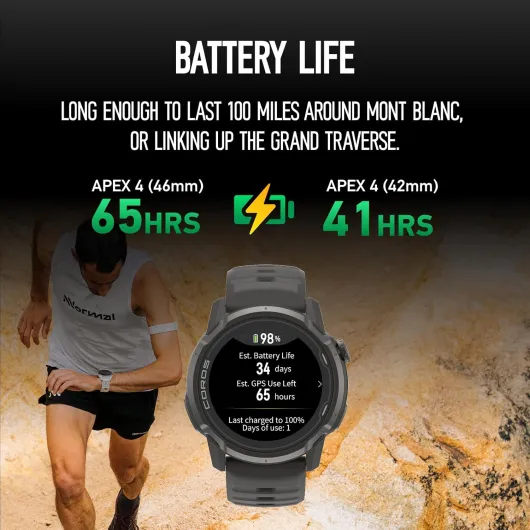
The battery is honestly the headline feature. COROS claims up to 65 hours of All Systems GPS and 41 days of regular use During a 3‑hour hike with full GPS and occasional map panning, the battery dropped around 6–7%, which lines up roughly with the claimed GPS endurance. I didn’t test a full 24‑hour ultra or anything, but based on the drain I saw, I’d be comfortable taking it on a full‑day mountain mission without a power bank. Compared to typical watches that offer 20–30 hours of GPS at best, this is a clear step up, especially if you’re doing multi‑day stuff and can’t charge constantly. In smartwatch mode (no GPS, just notifications, HR, sleep), the drain is very slow. You can easily go more than a week without thinking about the charger. The MIP screen helps here: it sips power instead of chugging it like an AMOLED panel. The trade‑off is less visual punch, but for battery nerds, it’s worth it. Charging is via a proprietary cable (of course), but it’s quick enough that you can top it up before a run without waiting forever. Realistically, if you train several times a week and wear it 24/7, you’re probably looking at charging every 10–14 days depending on how long your GPS sessions are. If you’re doing an ultra or big mountain route, you can trust it not to die halfway. For me, that’s the main reason to pick this watch over more “smart” options with pretty screens but much weaker battery life.
Comfort: good for sports, acceptable for 24/7 wear
Comfort-wise, the APEX 4 is pretty decent, especially considering it’s a 46mm outdoor watch. On runs and hikes, I honestly forgot about it most of the time. The weight is well balanced, and the watch doesn’t slide around if you tighten the strap properly. During a 3‑hour hike with some steep climbs, no hotspots or rubbing, and the back of the watch didn’t dig into my wrist, which has happened with bulkier sensors on other brands.
For sleep tracking, it’s okay but you do feel the size more. If you’re used to lighter or smaller watches, the 46mm case will be noticeable at night, especially if you sleep with your wrist under your head. I got used to it after a few nights, but it’s not as forgettable as a slim fitness band. The silicone strap is soft enough, and the holes are spaced well so you can fine‑tune the tightness for comfort vs. good HR reading.
During indoor climbing, I was a bit worried about banging it on holds, but the fit is snug enough that it doesn’t swing around. I logged a few sessions and didn’t feel like the watch was getting in the way. If you do a lot of crack climbing or anything where your wrist is scraping walls, I’d honestly consider taking it off or putting it over a sweatband, but that’s true for most watches.
Day to day, wearing it in the office and at home, it’s fine but not invisible. It looks and feels like a sports watch. If you want something that disappears under a shirt and feels ultra light, this isn’t that. But for a device that can track long mountain days with strong GPS and a big battery, the comfort is good. I never had skin irritation or issues with sweat under the strap, even after hot runs, which is important if you plan to wear it 24/7.
Materials and build: tough where it matters
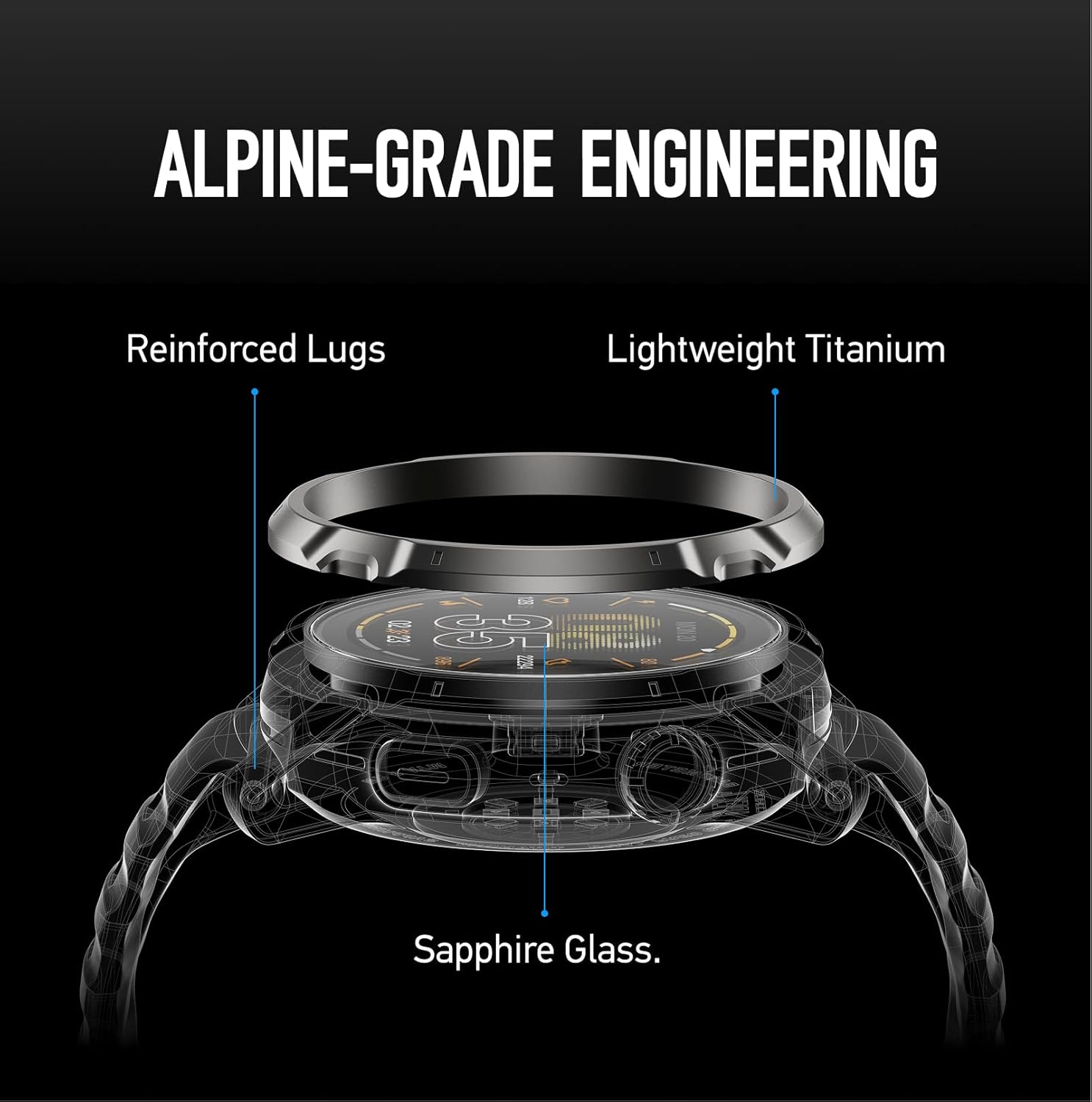
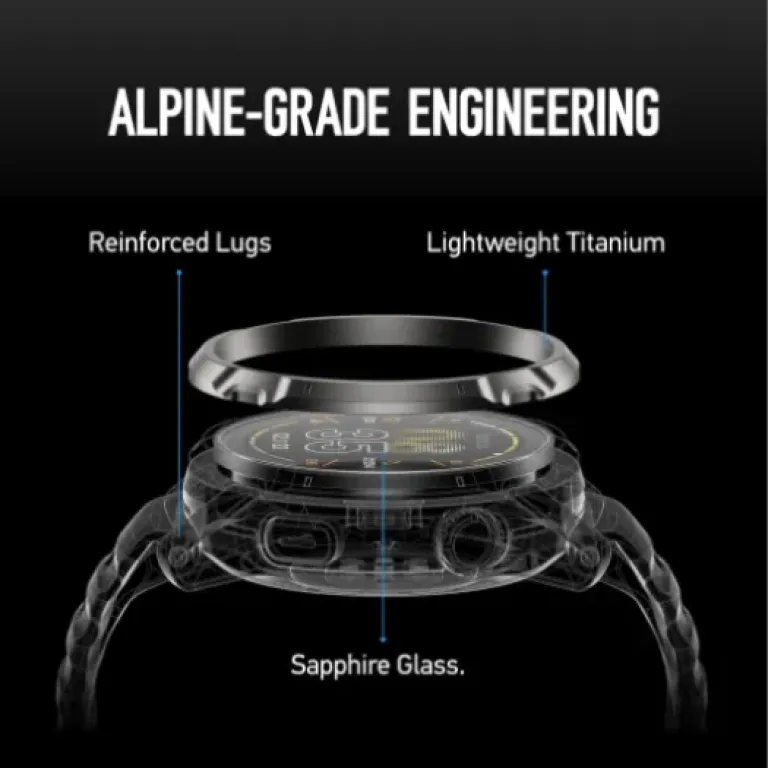
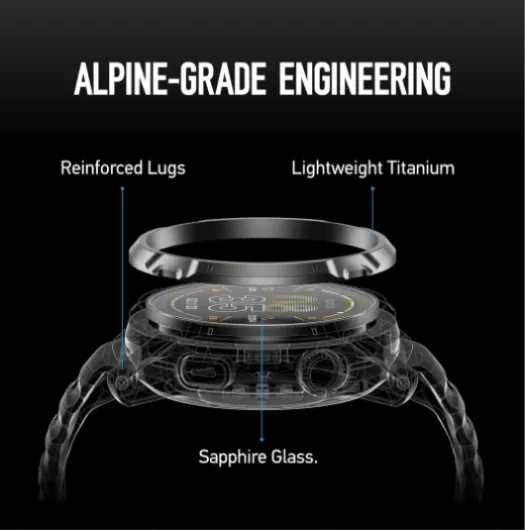
The materials on the APEX 4 are one of its strong points. You get a titanium body, sapphire glass on the screen, and reinforced lugs. In real life, that combo feels confidence‑inspiring. I’ve knocked it on rocks a couple of times while scrambling and brushed it against indoor climbing holds. After a few weeks, I don’t see any scratches on the glass, which is honestly the main thing I worry about with sports watches. The bezel has a couple of tiny marks if you look closely, but nothing shocking.
The strap is basic silicone, nothing fancy, but it’s comfortable and dries quickly. I wore it for runs, hikes, showers, and sleep. No skin irritation, no weird smell after sweating. It’s a standard quick‑release style, so if you don’t like it, you can swap it easily for another band. I’d probably switch to a softer or fabric strap for all‑day wear if I was using it as my only watch, but out of the box it’s totally fine for sports.
The buttons and crown feel sturdy, not wobbly. The tactile feedback is clear, even with gloves. That matters a lot in winter or on climbs where you don’t want to be guessing if you actually paused or started an activity. The watch is also light enough that the titanium and sapphire don’t turn it into a wrist weight, which is something I’ve felt with some heavy-duty Garmin models.
Overall, in terms of build quality, it feels like a watch that can handle rough use: trail dust, sweat, bumps, the usual abuse. It doesn’t feel premium in a luxury sense, but it feels solid and purposeful. For an outdoor‑focused watch at this price point, the materials are a big plus and one of the main reasons I’d pick this over cheaper plastic‑heavy models.
Performance: GPS, maps and training tools where it counts
This is where the APEX 4 is clearly focused. The dual‑frequency GPS and “all systems” mode are not just buzzwords. On routes where my old Forerunner used to cut corners or send my track into nearby buildings or cliffs, the COROS track was noticeably cleaner. In dense forest and in a narrow valley, the watch kept a much smoother line. Distance totals were closer to what I expected from mapping tools, with fewer weird spikes. For trail and mountain use, that’s a big plus.
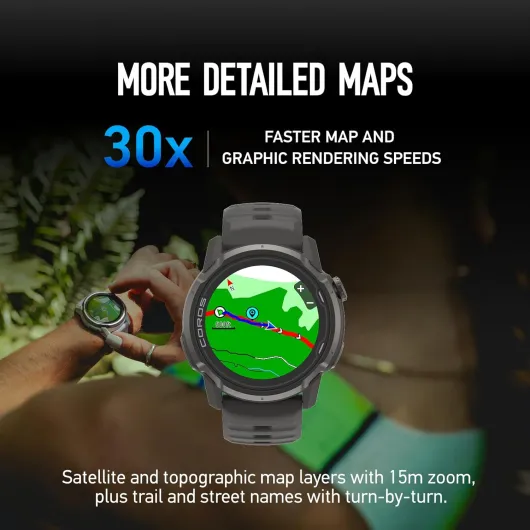
The maps and navigation are also solid. I loaded three GPX routes from different websites. Importing through the app was quick, and syncing to the watch didn’t give me any trouble. On the wrist, you can see the route, your position, and basic map details like trails and streets, plus turn‑by‑turn prompts. The 30x faster rendering claim is marketing talk, but in practice, map scrolling and zooming are smooth enough that it doesn’t feel laggy. It’s good enough to actually use mid‑run without wanting to throw the watch away.
Training features are pretty deep if you want them. You can build custom activities and workouts, set intervals, and even create things like breathing or meditation sessions, which one Amazon reviewer mentioned and I tested quickly. It’s flexible, though the app UI takes a bit of time to get used to. Sensor pairing worked fine: I used a Polar arm HR strap without issues, and the watch picked it up quickly every time.
On the downside, the whole ecosystem is not as polished as Garmin’s. The COROS app is decent but a bit rough in places, and there are user reports (including the Amazon 2‑star review) of sync problems with Strava. Mine synced to Strava so far, but knowing there’s a known issue that COROS seems slow to fix is not great. If your whole training log lives in Strava, that’s a real risk. So: performance for GPS and training is strong, but the software and integrations are the weak points.
What this watch actually offers in real life
On paper, the COROS APEX 4 (46mm) is stacked: dual‑frequency GPS, up to 65 hours in All Systems GPS, 41 days of regular use, topographic and landscape maps with turn‑by‑turn, 1.3" MIP touchscreen with sapphire glass, titanium case, 32 GB storage, microphone and speaker for voice notes and calls. It’s clearly aimed at trail runners, ski tourers, climbers, and anyone doing long endurance stuff outdoors.
In day‑to‑day use, the feature that matters most is honestly the battery. I charged it to 100%, used it for a week with 4 GPS activities (two 1‑hour runs, one 3‑hour hike, one 45‑minute indoor climbing session logged with HR), notifications on, and sleep tracking. I ended the week at around 55–60%. With my old Forerunner I’d be hunting for the charger by day 4 or 5 with similar use. So the advertised numbers are maybe optimistic but not totally unrealistic if you’re not running GPS 24/7.
The maps are a big difference compared to older mid‑range watches. Having topo maps with trail and street names, plus turn‑by‑turn, is genuinely useful when you’re somewhere new. I loaded a few GPX routes (easy via the app) and the watch handled them fine. Rendering is smooth enough; you’re not waiting ages for the map to redraw when you zoom or pan, which is what I’ve seen on some older devices.
The extra stuff like Voice Pins and hands‑free calls is nice to have but not life‑changing. I used Voice Pins a few times during a long run to note where a climb started or where a water source was, and it’s actually more practical than stopping to type on your phone. Calls work, but don’t expect smartwatch‑level comfort; it’s more of a backup feature. Overall, the watch is focused on endurance and navigation first, with smart features being secondary.
Pros
- Excellent battery life with up to 65 hours of All Systems GPS and very long standby use
- Robust build with titanium case and sapphire glass that handles bumps and scratches well
- Accurate dual‑frequency GPS and useful offline topo maps with turn‑by‑turn navigation
Cons
- Reports of unreliable Strava syncing and slow fixes from COROS
- MIP screen looks dated indoors compared to AMOLED competitors and needs backlight in low light
- Software and app feel less polished and intuitive than Garmin’s ecosystem
Conclusion
Editor's rating
The COROS APEX 4 (46mm) is clearly built for people who spend a lot of time outdoors and care more about battery and reliability than having the flashiest screen. The strong points are obvious: tough materials (titanium and sapphire), very good GPS accuracy even in tricky terrain, solid maps with turn‑by‑turn, and a battery that can handle long days and still have plenty left. For trail runners, hikers, ski tourers, and climbers who want a watch that just keeps going, it ticks most of the important boxes.
It’s not perfect, though. The MIP display is practical but looks dated next to AMOLED competitors, the first setup and Wi‑Fi/update process can be a bit annoying, and the COROS app is less polished than what Garmin offers. The big red flag for some people will be the Strava sync issues mentioned by users. If your whole training life is tied to Strava and you want instant, reliable uploads, you need to be aware this might cause frustration. The voice features and calls are nice bonuses, but they don’t fully compensate for ecosystem quirks.
In short: if you want a tough, long‑lasting sports watch for serious outdoor use and you’re okay with a slightly rougher software experience, the APEX 4 is a strong option. If you’re more into a smartwatch feel, with a bright screen, polished app, and flawless integrations, or you’re very Strava‑dependent, I’d look at alternatives even if it means charging more often.