
Summary
Editor's rating
Is it worth the money?
Looks like a real watch, not a mini phone
Battery life: the part that actually feels different
Comfort and daily wear: 24/7 is realistic
Build quality and how it holds up
Health and tracking: solid, with a few quirks
What this thing actually does (beyond telling the time)
Pros
- Looks like a normal analog watch while still tracking health data
- Battery easily lasts multiple weeks with 24/7 use
- Useful ECG and SpO2 features when worn and used correctly
Cons
- Step counting indoors and casual movement can be under-reported
- Charger is fiddly and easy to misalign
- Limited smart features and basic sports tracking compared to full smartwatches

Specifications
View full product page →| Brand | Withings |
A smartwatch for people who are sick of smartwatches
I’ve been using the Withings ScanWatch 42 mm for a few weeks, coming from more classic full-screen smartwatches (Fitbit and a Galaxy Watch before that). I bought it mainly because I was tired of charging my watch every night and I also wanted something that actually looks like a normal watch at work. On paper, the ScanWatch sounded like a decent compromise: real hands, long battery, ECG, SpO2 and sleep tracking, without turning my wrist into a tiny phone.
In practice, it really feels like a watch first and a tracker second. You glance at it and you see the time, no need to flick your wrist or wait for the screen to wake up. If you’ve used an Apple Watch or similar, that alone is pretty refreshing. The small digital screen at the top is there for health data and notifications, but it stays out of the way most of the time.
Day-to-day, I’ve mostly used it for steps, heart rate, sleep, a couple of ECGs and bike rides with GPS via the phone. I’ve also compared it a bit against a Fitbit and a chest strap. It’s not perfect, and some stuff feels a bit basic compared to the big players, especially around sports and step counting indoors, but overall it does what it says on the tin.
If you’re expecting a full smartwatch with a big bright screen, tons of apps and voice assistants, this isn’t it. If you want a watch that looks normal, tracks your health quietly in the background and doesn’t live on a charger, then it starts to make sense. I’ll break down the good and the annoying parts below.
Is it worth the money?
Price-wise, the ScanWatch sits in that mid-to-high range, especially if you compare it to basic fitness bands. You’re paying for the hybrid design, the ECG and SpO2 features, and the long battery. If you only care about counting steps and getting notifications, you can get cheaper devices that do that job just fine. So the question is really: do you care about the watch-like look and the more medical-focused features?
Compared to something like an Apple Watch or a high-end Garmin, the ScanWatch is usually cheaper, but it also does less in terms of smart features and sports analysis. No music control worth mentioning, no NFC payments, no third-party apps. On the other hand, those other watches usually have weak battery life and a much more obvious “tech gadget” look. So you trade features for discretion and endurance.
If you’re someone who has heart rhythm issues, worries about sleep apnea, or just wants a bit more insight into health without dealing with a full-blown smartwatch, the value is actually pretty good. The ECG and SpO2 alone, if you use them properly, are features you don’t find on the cheapest trackers. And the fact you don’t need to replace or charge it constantly adds to the long-term value.
If you’re more on the sporty side and want detailed training metrics, music on your wrist and all the smart toys, I’d say your money is better spent on a Garmin, Apple Watch, or similar. For casual users who want a normal-looking watch that quietly tracks health and lasts weeks on a charge, the ScanWatch hits a nice middle ground. Not cheap, but fair for what it offers.
Looks like a real watch, not a mini phone
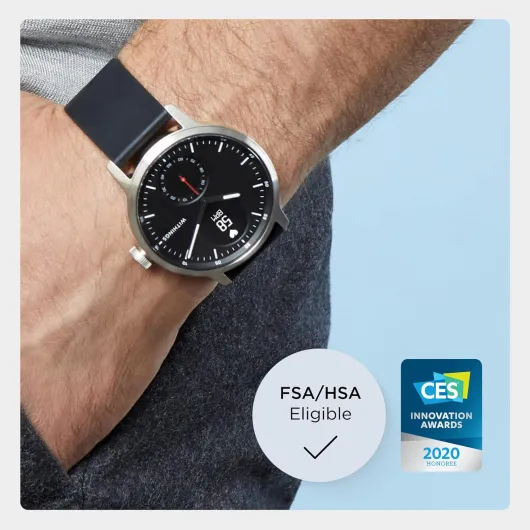
The main thing that stands out is the classic look. The 42 mm version I used is fairly big on the wrist, with a 50 mm lug-to-lug, so it’s more in line with a normal men’s watch than a tiny fitness band. If you have small wrists, I’d seriously consider the smaller size because this one has presence. But that presence is part of why it doesn’t scream “fitness tracker” like a rubber band from the gym.
The case is stainless steel with sapphire glass, and it feels pretty solid. It doesn’t have that cheap plasticky vibe some smartwatches have. The analog hands are easy to read, even in bright sunlight, and there’s a small bit of lume so you can sort of see them in the dark. If the hands are blocking the tiny OLED screen at the top, the watch moves them out of the way automatically when you wake the screen, which is a nice touch and actually useful.
The bottom sub-dial is a step progress gauge that goes from 0 to 100% of your daily goal. It’s surprisingly handy: you just glance and you know roughly how active you’ve been without having to dig into menus. The small PMOLED screen at 12 o’clock is simple and monochrome, but readable enough for short bits of info like heart rate, notifications, or timers. Don’t expect rich graphics or anything, it’s more like a tiny status display.
Overall, on the wrist it looks like a slightly dressy everyday watch. Swap the silicone strap for leather or a nicer nylon band and it easily passes in an office or more formal setting. So from a design point of view, it hits that niche: you get data and health functions, but you don’t look like you’re about to go for a run 24/7. Just be aware the 42 mm can feel large if you’re used to slimmer watches.
Battery life: the part that actually feels different
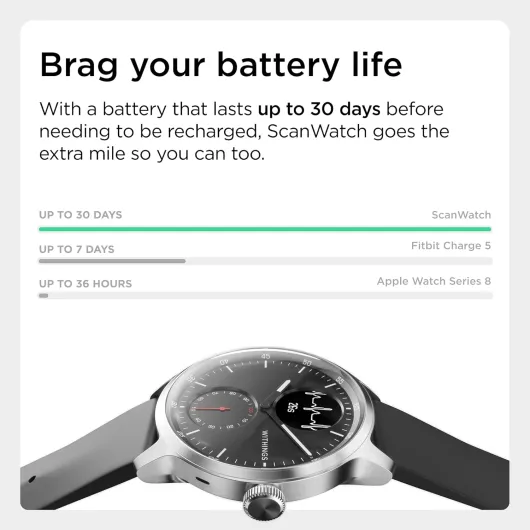
This is where the ScanWatch really stands out. With normal use (24/7 wear, continuous heart rate, sleep tracking, notifications on, a few ECG and SpO2 checks per week), I was easily getting over two weeks on a single charge. Some users report close to a month; I didn’t quite hit that, but I wasn’t trying to save battery either. Compared to an Apple Watch or most Wear OS watches that need daily or every-other-day charging, this is a big quality-of-life improvement.
The battery percentage drops slowly. I’d see around 3–4% drain per day with my usage. If you spam ECGs and SpO2 measurements, or do long GPS activities, it obviously drains faster, but still way better than full-screen smartwatches. After a while you just forget about charging, which is kind of the point. You can actually track your sleep every night without having to plan charging windows like you do with some other brands.
The downside is the charger design. It’s a small puck with two contacts that have to line up with contacts on the back of the watch. There’s no magnet strong enough to really lock it in place like Apple’s charger; if you bump it, it can move and stop charging. You have to be a bit careful when you set it down and maybe double-check that the charging icon appears on the screen. Not the end of the world, but it feels a bit cheap compared to the rest of the watch.
Charging speed is decent. From low battery to full took me under an hour in my tests, so it’s easy to top up while you shower and get ready. Because you charge so rarely, the imperfect charger is annoying but not a daily headache. Overall, if long battery life is high on your list, the ScanWatch delivers on that promise in a very noticeable way.
Comfort and daily wear: 24/7 is realistic
On paper the watch weighs around 80 g with the strap, and you do feel it a bit more than a tiny Fitbit, but after a couple of days I stopped noticing it. The included silicone strap is standard and does the job: it’s nothing fancy, but it’s soft enough, doesn’t irritate my skin, and handles sweat and showers without trouble. Because it uses standard spring bars, swapping to any 20 mm strap is easy. I tried a nylon strap and a leather one, and both made it feel more like a normal watch and less like a gadget.
For health measurements, the fit matters. To get good ECG and SpO2 results, the watch needs to sit at least 1 cm above the wrist bone and be reasonably snug. At first I wore it too loose (like a normal watch), and some SpO2 readings were either low or “inconclusive”. Tightened it one hole, moved it up the wrist, and readings became much more consistent. So there’s a bit of trial and error to find the sweet spot between comfort and sensor accuracy.
Sleeping with it is fine. It’s not ultra thin, but the rounded case and smooth back mean it doesn’t dig into the wrist. I’m a side sleeper and it didn’t bother me much, just the usual feeling of having a watch on. If you hate sleeping with any watch, this won’t magically fix that, but compared to bulkier smartwatches it’s pretty manageable. The vibration motor is strong enough for alarms and notifications; I never missed a wake-up alarm.
In daily use (work, biking, some light workouts), the watch stayed put and didn’t slide around. No skin irritation, no weird marks. The only annoyance is during some exercises like push-ups or planks, where the crown can press slightly into the back of your hand if the strap is tight. Not a deal-breaker, but you notice it. Overall, for 24/7 wear, including sleep, I’d say comfort is solid once you dial in the strap and position.
Build quality and how it holds up
The watch feels solid in the hand. The stainless steel case and sapphire glass give it a more serious feel than plastic fitness trackers. After several weeks of daily wear, including bumping it on door frames and desks like an idiot, I haven’t picked up any obvious scratches on the glass. The case might pick up tiny marks over time like any steel watch, but nothing out of the ordinary so far.
It’s rated for 50 m water resistance, which is fine for showers, swimming, and general everyday use. I’ve showered with it and got caught in the rain a few times, and there were no issues. I didn’t do deep diving or anything extreme, but for normal life it seems completely fine. The silicone strap obviously handles water and sweat without problems; if you switch to leather, you’ll want to be more careful around water, like with any leather strap.
The button/crown feels firm and doesn’t wobble, and the haptic vibration is still strong and clear. The back sensors still read correctly; I haven’t noticed any degradation or weird behavior. Software-wise, Withings has been pushing updates occasionally, which is good. The app itself is stable on my phone, no random crashes or constant disconnects, as long as I don’t let the phone’s battery saver kill it in the background.
Long term, I’d expect the weak points to be the strap (which is easy and cheap to replace) and maybe the charger cable if you’re rough with it. The watch head itself feels like it will last a while, especially with sapphire glass. It doesn’t feel fragile or toy-like. Obviously I haven’t had it for years yet, but based on build and materials, durability seems pretty solid for everyday use.
Health and tracking: solid, with a few quirks
Let’s talk performance in real life. For heart rate, the watch does continuous tracking but in a sampled way (not every second like some sports watches). When I compared resting and light activity heart rate against a chest strap and a Fitbit Sense, the ScanWatch was usually within a few beats per minute. During steady cycling it kept up fine. Where it’s a bit weaker is during very intense or fast-changing efforts; it can lag or smooth out peaks, but that’s common with wrist sensors.
The ECG is one of the main selling points. Doing one takes about 30 seconds: you start it from the watch, rest your opposite hand on the bezel, stay still, and it records. I showed a few traces to a doctor friend; his feedback was that it’s a bit noisy compared to a medical device, but usable for spotting irregular rhythms like AFib. If you have a known condition, it can be handy to capture an event at home and show it to your doctor. Just don’t treat it as a hospital-grade monitor.
SpO2 was picky at first. When I wore the watch too close to the wrist bone or too loose, I got low readings or inconclusive results. After adjusting the position and strap tightness (and resting my arm on a table), the readings lined up well with a finger pulse oximeter. So the sensor is fine, but you do need to follow the instructions. For sleep, the watch tracks light, deep, REM and gives you a sleep score, plus a breathing disturbance index based on oxygen drops and breathing patterns. It’s decent, but not as detailed or polished as Fitbit’s sleep analysis. Also, if you lie in bed awake but calm, it can still think you’re sleeping.
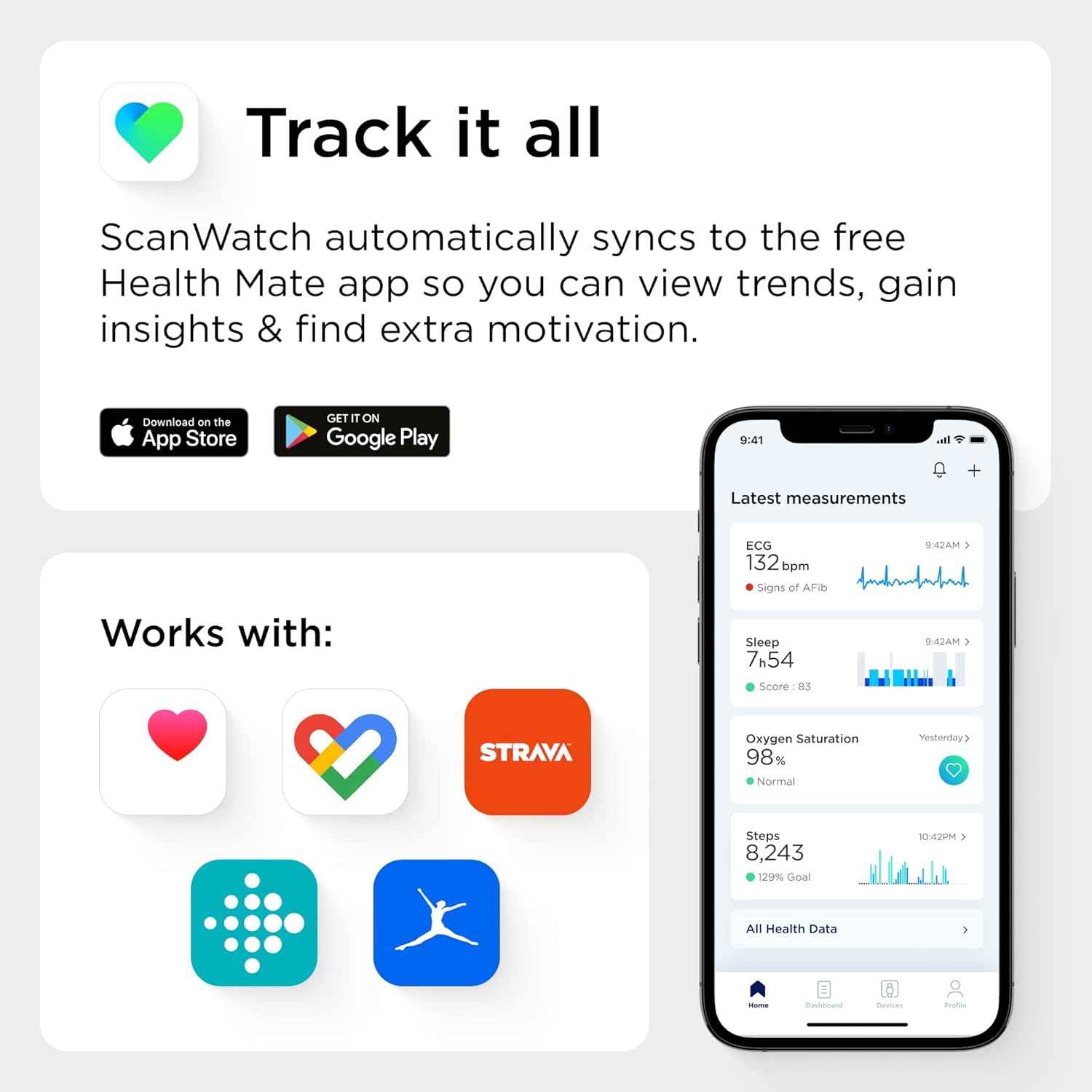
Steps are where I’m a bit less impressed. Outdoor walking and proper walks are tracked reasonably, but casual steps around the house sometimes don’t get counted as generously as other trackers. Compared to a Fitbit, I often ended the day with a lower step count even though my routine was the same. For some people that’s a non-issue, but if you live for step challenges with friends, this might annoy you. Sports tracking with GPS via phone worked fine for me on bike rides: distance and pace matched Strava pretty closely, as long as I had my phone on me and the app allowed in the background.
What this thing actually does (beyond telling the time)
The ScanWatch is a hybrid smartwatch, which basically means: analog hands plus a small OLED window for data. No touch screen, everything is controlled with the crown/button on the side. It tracks steps, distance, floors climbed, heart rate, ECG, SpO2, sleep (including some apnea indicators), and can log sports using your phone’s GPS. It also pushes basic notifications from your phone (calls, messages, app alerts) to the tiny screen.
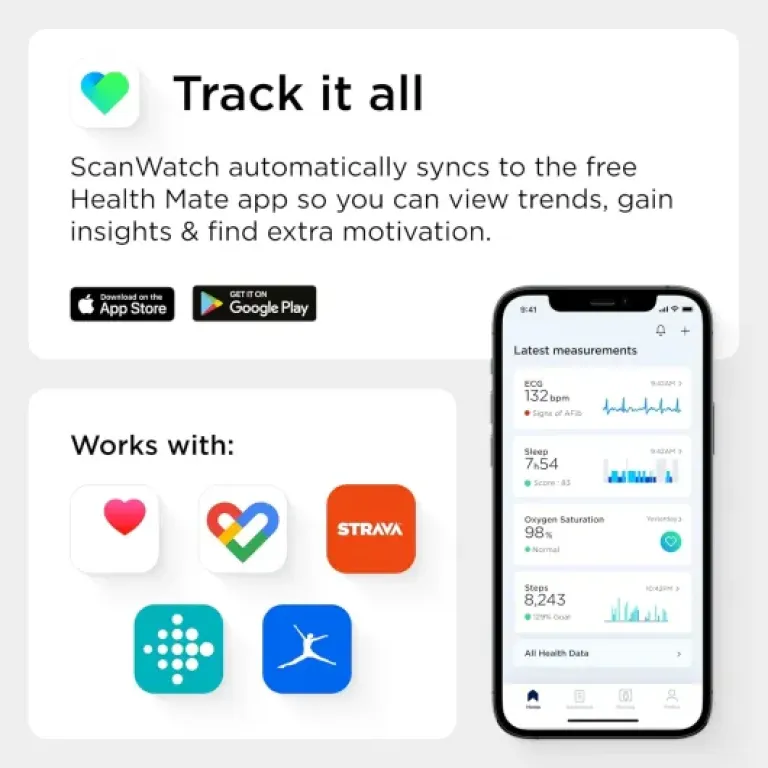
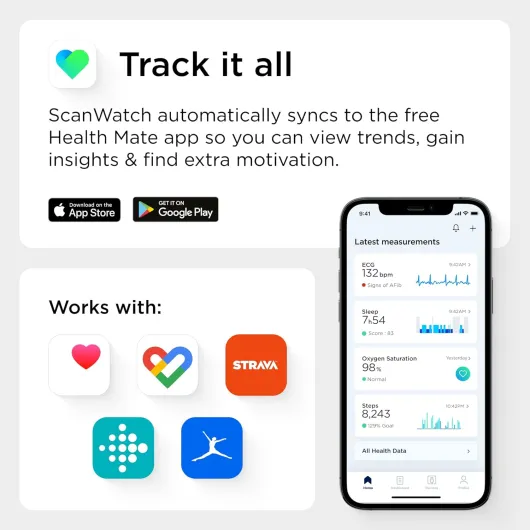
Setup is done through the Withings Health Mate app. On Android for me, it was pretty painless: install app, create/log in to an account, add device, let it update firmware, done. Some people complain about setup, but honestly it was no worse than any Fitbit or Garmin I’ve used. Syncing is automatic in the background, as long as Bluetooth is on and the app isn’t killed by your phone’s battery saver.
The health side is fairly complete: you get on-demand ECG (30 seconds, hand on the bezel), on-demand SpO2, continuous heart rate (but sampled, not every second like a sports watch), and sleep reports with sleep stages and a breathing quality index. For sports, you long-press the button to start an activity, scroll to your sport icon (running, cycling, etc.), press again, and it will use your phone GPS to log the route and pace if you have the phone with you.
Where it clearly lags behind full smartwatches is in smart features and sports depth. No app store, no music control worth talking about, no contactless payments, no voice assistant. Sports metrics are pretty basic compared to something like a Garmin or a serious running watch. So if you’re training for a marathon and obsessing over advanced stats, this will probably feel limited. But if you mainly want a health tracker that behaves like a normal watch, it covers the basics quite well.
Pros
- Looks like a normal analog watch while still tracking health data
- Battery easily lasts multiple weeks with 24/7 use
- Useful ECG and SpO2 features when worn and used correctly
Cons
- Step counting indoors and casual movement can be under-reported
- Charger is fiddly and easy to misalign
- Limited smart features and basic sports tracking compared to full smartwatches
Conclusion
Editor's rating
After living with the Withings ScanWatch for a while, my take is pretty simple: it’s a good fit for people who want a real watch first and a health tracker second. The design looks like a normal analog watch, the battery life is genuinely long, and the health features (ECG, SpO2, heart rate, sleep) are solid enough to be useful, especially if you have a reason to keep an eye on your heart or breathing at night. It does all that without spamming you with screens and apps all day.
On the flip side, it’s not a powerhouse smartwatch. Sports tracking is fine but basic, the step counter is a bit stingy indoors, and the smart features are limited compared to Apple, Samsung or Garmin. The charger design is also a bit fiddly. So if you want rich notifications, deep training metrics, music, and payments on your wrist, you’ll probably feel constrained.
I’d recommend the ScanWatch to anyone who’s tired of babysitting battery life on a full smartwatch, wants something that looks decent in everyday life, and cares more about health tracking than fancy apps. I’d say skip it if you’re a serious athlete, heavily into smart features, or obsessed with step competitions where every step counts. For everyone else, it’s a pretty solid, low-drama watch that quietly does its job.