
Summary
Editor's rating
Value: solid deal if you care about running more than smart features
Design: light, plastic, and very obviously a sports watch
Battery life: one of the main reasons to buy it
Comfort: you forget it’s there (in a good way)
Durability: tough enough, but not bulletproof
Performance: GPS and training tools are the strong points
What the Forerunner 55 actually offers (and what it doesn’t)
Pros
- Very good battery life (about a week+ with regular runs, up to 20 hours GPS)
- Accurate and quick GPS for everyday road running
- Lightweight and comfortable with simple button-based controls
Cons
- No music storage or contactless payments
- Sleep tracking and body battery are not very accurate
- Limited strength training and non-running activity features

Specifications
View full product page →| Brand | Garmin |
A simple running watch that actually focuses on running
I’ve been using the Garmin Forerunner 55 in white for a few weeks now, mainly for road running and some light gym stuff. I’m not an elite athlete, I just run 3–5 times a week and wanted something that tracks distance, pace, and heart rate without turning my wrist into a smartphone. This one is clearly built for that type of person: someone who wants the basics done well, plus a few training tools, but doesn’t care about music on the wrist or paying with the watch.
Right out of the box, the setup is fairly straightforward. You plug it in once, pair it with the Garmin Connect app, and it pulls in your profile and syncs quickly. No touch screen, only buttons, which I actually appreciated more than I expected. During runs, I don’t have to fight with a sweaty screen or random taps; the buttons just work, even in the rain or with gloves.
The big thing I noticed in the first week was the GPS reliability and battery life. I did three 10 km runs plus daily wear and didn’t have to charge until the end of the week. For a watch this light, that’s pretty solid. GPS locked on in under 10–20 seconds most of the time, even in a neighborhood with some trees and a few taller buildings. Distances matched pretty closely with known routes on Strava, usually within a few hundredths of a mile.
Overall first impression: it’s not flashy, but it feels like a runner’s tool more than a smartwatch toy. If you want Spotify, fancy maps, or contactless payments, this is not it. If you mainly want a reliable GPS watch that helps structure your training without drowning you in metrics, the Forerunner 55 hits that niche pretty well.
Value: solid deal if you care about running more than smart features
In terms of value for money, the Forerunner 55 sits in a nice spot. It’s not dirt cheap, but compared to more expensive Garmins and Apple Watches, it’s reasonably priced for what you get: accurate GPS, good battery life, and useful training tools. For someone who mainly wants a running-focused watch without paying for music, maps, and fancy screens they’ll barely use, it makes sense.
Where it shines in value is the core performance per dollar. GPS accuracy is on par with pricier watches, the daily suggested workouts and PacePro features actually help you structure training, and the battery life beats most general-purpose smartwatches easily. You’re basically paying for function, not fashion. If you compare that to buying a watch that looks nicer but needs charging every other day and gives you worse running data, the Forerunner 55 comes out looking pretty smart.
On the downside, there are some obvious corners cut: no music storage, no NFC payments, no altimeter, and fairly basic non-running modes. If you care a lot about those extras, you’ll quickly feel limited and might wish you had spent more on a Forerunner 255 or a Vivoactive/Venu model. Also, the sleep tracking and “body battery” stuff are not super accurate, which makes those features feel a bit like fluff rather than something you can really rely on.
So, value-wise, I’d sum it up like this: if your top priority is reliable running tracking and long battery life, this is a good deal. If you want a smartwatch that does “a bit of everything” and looks fancy, this will feel too basic, and you’re better off saving up for a higher-end model or going with something like an Apple Watch instead.
Design: light, plastic, and very obviously a sports watch
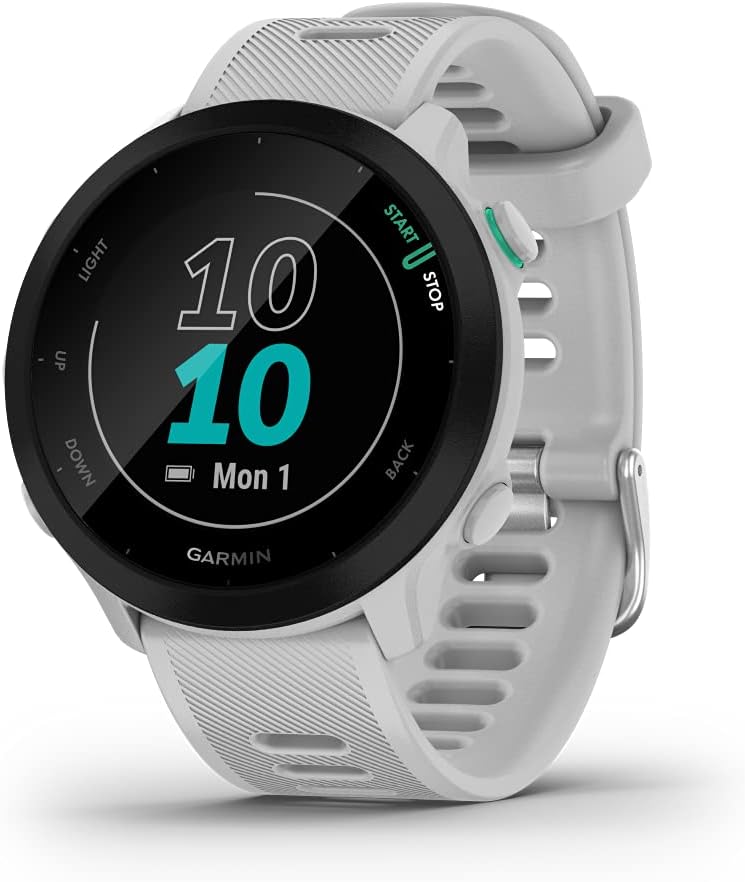
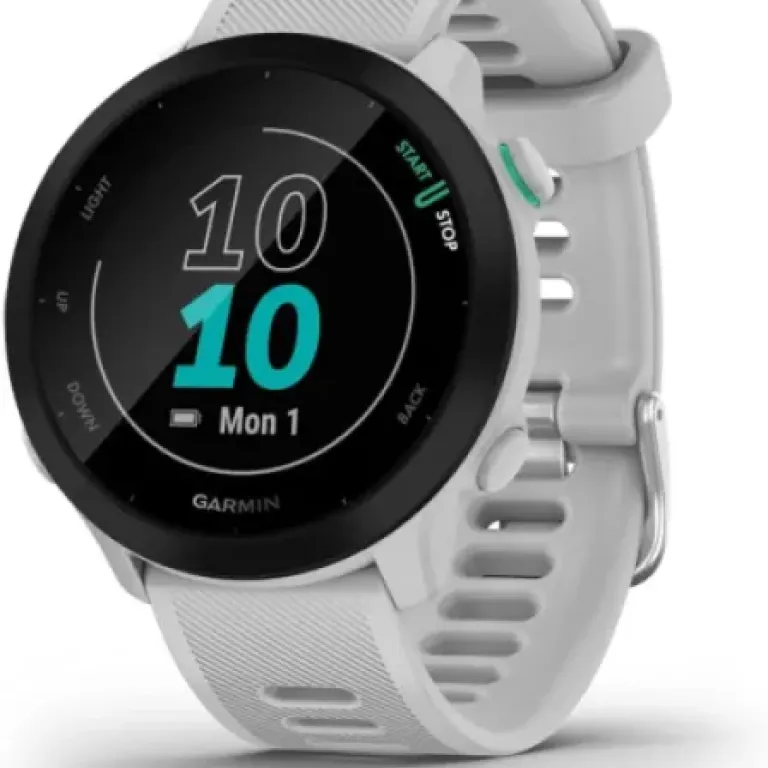
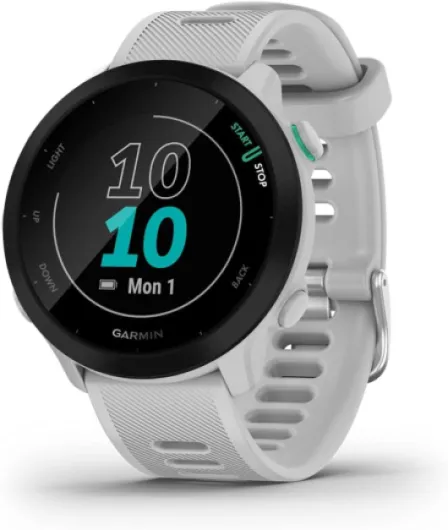
Design-wise, the Forerunner 55 is all business. It’s small, round, and very plastic. If you’re hoping for something that passes as a dress watch, this isn’t it. I tested the white version, and it looks clean but also clearly like a sports gadget, not a fashion accessory. Personally, I’m fine with that — I wanted something I could sweat in, not something to match with a suit.
The size is actually one of its biggest strengths. At around 1.31 ounces, it’s very light. On the wrist, it almost disappears once you start running. Compared to bulkier Garmins or something like a big Apple Watch, this feels way less intrusive. The bezel is simple, the screen is small but readable, and the five buttons are clearly labeled and easy to learn after a day or two. No rotating crowns, no touch gestures, just click up/down/start/back/light.
The screen is a basic transflective display with 208 x 208 resolution. It’s not sharp or colorful like an AMOLED, but it’s super readable in bright sunlight, which matters more to me mid-run than deep blacks or fancy graphics. Backlight at night is fine — not pretty, just functional. You can customize the watch face via the Connect IQ store, but don’t expect anything flashy; it’s mostly simple data-focused faces.
If I had to nitpick the design, I’d say it looks a little cheap off the wrist because it’s so plasticky. The bezel doesn’t feel premium, and the white version will probably show dirt over time if you don’t clean it. But for what it is — a budget running watch — the design is practical and low-profile, and I never felt like it got in the way of training. I’d call the design “plain but effective,” which fits the rest of the watch’s personality pretty well.
Battery life: one of the main reasons to buy it
Battery life is honestly one of the best parts of the Forerunner 55. Garmin claims up to 2 weeks in smartwatch mode and up to 20 hours in GPS mode. In real-world use, I was doing 4–5 GPS runs per week (30–60 minutes each), wearing it 24/7 with notifications on, and I was still getting around 8–10 days before I felt like I needed to charge. That’s with heart rate monitoring always on and occasional timer/stopwatch use.
On long-run days, the battery drain in GPS mode was pretty modest. Roughly, I saw about 4–5% battery drop per hour of running with GPS only. So even if you’re doing half marathons or a full marathon, you’re nowhere near the limit. Someone running 1–2 hours a day should comfortably get through a week on a single charge. That’s a big step up from smartwatches that barely make it through two days with light use.
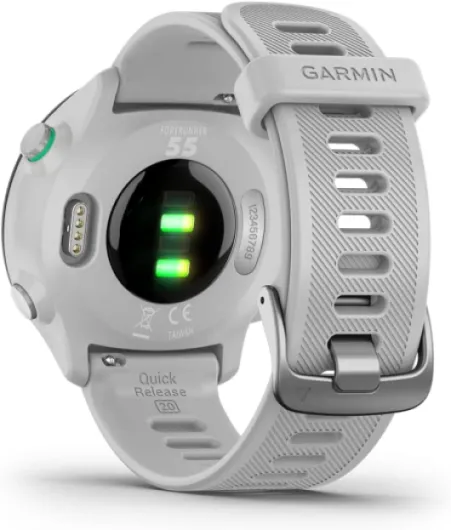
The downside is the proprietary charger. It uses Garmin’s own cable with a small clip-style connector. It works fine, but if you lose it, you’re stuck ordering a replacement; you can’t just grab any USB-C cable. Also, if the charging contacts on the watch get dusty or sweaty, the connection can be a bit finicky until you wipe them off. I ended up buying a second cable to keep in my travel bag, because forgetting the charger on a trip would be annoying.
Overall, though, the battery is a strong selling point. You don’t have to think about charging every night, and you don’t get that low-battery anxiety right before a planned long run. If you’re used to an Apple Watch or similar that needs constant charging, this feels very low maintenance in comparison.
Comfort: you forget it’s there (in a good way)
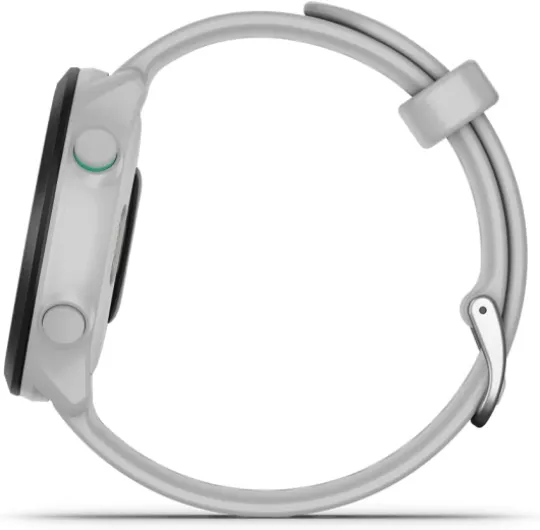
On comfort, Garmin did a pretty solid job. The watch is light, the silicone strap is flexible, and there are enough holes to get a good fit whether you have thin or thicker wrists. I wore it basically all day — runs, work, lounging on the couch — and only took it off to shower. It never rubbed or left marks, even on sweaty long runs.
For running specifically, the light weight makes a big difference. I’ve used chunkier watches before that feel like a small brick on your arm during intervals; this one doesn’t do that. After a couple of days, I mostly forgot I was wearing it unless I glanced down for pace or heart rate. The buttons are easy to press without having to twist your wrist into weird angles, which matters when you’re trying to start/stop a run at traffic lights or during intervals.
There is a bit of a balancing act with heart rate accuracy and comfort. If you wear it too loose, the HR readings can get flaky, especially during intervals or weight training. If you crank it too tight, it’s obviously less comfortable and can leave a bit of a line on your skin. I found a middle ground where it’s snug but not strangling my wrist, and that seemed to work fine for most steady-state runs. Still, if you’re picky about HR accuracy, a chest strap will always beat wrist sensors, regardless of watch.
For sleep, the comfort is good enough that I could leave it on overnight without it bothering me. The watch is thin enough that it doesn’t get caught on bedding much. Overall, I’d rate comfort as one of the better points of this watch. It’s not luxurious, but for actual sports use, it’s very easy to live with all day and night.
Durability: tough enough, but not bulletproof
Durability-wise, the Forerunner 55 feels sturdier than it looks. The case is plastic, but it doesn’t feel flimsy. I’ve knocked it into door frames, worn it while doing yard work, and generally not babied it, and so far it’s held up well. The screen has picked up a couple of tiny marks, but nothing major and nothing that affects readability. That lines up with other users saying the screen mostly resists scratches unless you really abuse it.
The strap is a basic silicone band with a standard buckle. It’s comfortable and hasn’t stretched out or cracked, even with sweat and daily wear. The good thing is that the strap is replaceable, so if it does eventually wear out or you just want a different color, you’re not stuck. There are tons of cheap third-party bands online that fit it.
One thing to mention: there’s no sapphire or super tough glass here; it’s a budget-level watch, so if you’re constantly bashing it on rocks during trail runs or doing construction work with it on, you may want a screen protector or a more rugged model. I tried a couple of screen protectors, and like other people, I found that a lot of them don’t fit perfectly around the curved edges and tend to peel. I eventually gave up and just went naked. So far, the minor scuffs haven’t bothered me.
In terms of water resistance, it’s rated for pool swimming, and I had no issues rinsing it or getting caught in the rain. I didn’t shower with it much just out of habit, but it handled sweat and occasional submersion fine. Overall, I’d say durability is good for normal use: daily runs, gym, general wear. If you want something bombproof for hardcore trails or extreme conditions, you’d probably look higher in the Garmin lineup, but for regular runners, this holds up just fine.
Performance: GPS and training tools are the strong points
In terms of performance, the Forerunner 55 does exactly what a runner watch should: it locks GPS quickly, tracks distance and pace reliably, and doesn’t crash or freeze. On my usual 5 km and 10 km loops, the distance was consistently within about 0.03–0.05 miles of what I get from other devices and mapped routes. That’s more than accurate enough for everyday training. It also handles intervals decently; pace reacts quickly enough when you speed up or slow down, so you’re not always a minute behind what your legs are doing.
The daily suggested workouts are a nice bonus if you’re the type who struggles to structure training. After a few runs, it started recommending easy runs, tempo sessions, and some intervals based on my previous efforts and recovery. They’re not magic, but they give you some direction instead of just mindlessly doing the same pace every day. The PacePro feature is also handy for specific distances — it gives you GPS-based pace guidance to hit a target time. Just keep in mind it’s not as full-featured as higher-end Garmins and doesn’t support on-device course navigation.
Heart rate performance is decent but not perfect. For steady runs, the numbers looked believable and matched fairly closely with a chest strap I tested for a couple of sessions. During sharp sprints or HIIT, it sometimes lagged or spiked oddly, which is pretty normal for wrist-based sensors. If you’re doing a lot of intensity work and care deeply about HR data, you’ll probably still want a chest strap paired to the watch.
Where performance dips a bit is in non-running activities. Using the generic “Other” or basic cardio profile for weightlifting doesn’t give much detail beyond time and HR. There’s no rep counting or exercise detection like some other brands offer. Also, no barometric altimeter means elevation data on hilly runs is just okay, not great. But if you judge it mainly as a road-running GPS watch, the performance is strong for the price, and it feels reliable enough to build a training plan around.
What the Forerunner 55 actually offers (and what it doesn’t)
The Forerunner 55 is basically Garmin’s entry-level running watch, but it still packs quite a few features. Core stuff first: built-in GPS, wrist-based heart rate, and up to 2 weeks of battery in smartwatch mode or about 20 hours in full GPS mode. For everyday running, that’s more than enough. I never even came close to killing the battery on a single run, and I’m doing 60–90 minute sessions most days.
On top of that, you get daily suggested workouts, race time predictions, finish time estimates, and basic recovery suggestions. It also tracks stuff like steps, intensity minutes, respiration, and sleep, plus has profiles for things like cycling, pool swimming, HIIT, Pilates, and general cardio. But it’s worth knowing that some of those extra modes are pretty barebones. For weight training, for example, there isn’t a proper strength training profile with rep counting; you just end up using “Other” or “Cardio,” which gives you heart rate and time, but not much else.
What it doesn’t do is just as important: there’s no music storage, no offline Spotify, no contactless payments, and no advanced running metrics like ground contact time or vertical oscillation. Also, there’s no built-in altimeter, so elevation is GPS-based and not super precise. For most casual runners, that’s not a big deal, but if you’re into trail running and care about accurate elevation gain, this model is not ideal.
So in practice, I’d describe it like this: it’s a good, focused running watch with some basic smartwatch stuff bolted on. Notifications, phone finder, period tracking, LiveTrack safety features — they’re there and they work, but they’re clearly not the main reason to buy it. If you go in expecting a mid-range Garmin with all the bells and whistles, you’ll be underwhelmed. If you just want rock-solid tracking and simple training guidance, you’ll probably be pretty happy.
Pros
- Very good battery life (about a week+ with regular runs, up to 20 hours GPS)
- Accurate and quick GPS for everyday road running
- Lightweight and comfortable with simple button-based controls
Cons
- No music storage or contactless payments
- Sleep tracking and body battery are not very accurate
- Limited strength training and non-running activity features
Conclusion
Editor's rating
The Garmin Forerunner 55 is a straightforward running watch that focuses on doing the basics well: solid GPS, decent heart rate tracking, very good battery life, and some helpful training tools like daily suggested workouts and PacePro. It’s light, comfortable, and easy to use with physical buttons, which makes it a good fit for beginner to intermediate runners who want something reliable on their wrist without turning it into a mini smartphone.
It’s not perfect. The design is plain and plasticky, sleep tracking and body battery aren’t very precise, and the non-running modes (especially for strength training) are pretty limited. There’s also no music, no contactless payment, and no barometric altimeter, so if you want a full-blown smartwatch or you’re deep into trail and mountain running, you’ll probably outgrow this quickly. But if your main goal is to track runs accurately, get pace and distance without fuss, and have a watch that lasts a week or more on a charge, it gets the job done very well for the price.
I’d recommend the Forerunner 55 to: new runners, casual half-marathoners, teens on school teams, and anyone coming from older Forerunners who just wants a lighter, longer-lasting version without extra clutter. People who should skip it: data-obsessed athletes who want advanced metrics, trail runners who care about accurate elevation, and folks who want music and payments on the wrist. For what it is — a simple, reliable GPS running watch — it’s a pretty solid choice.