
Summary
Editor's rating
Is the Forerunner 55 worth the money?
Simple plastic design that favors function over looks
Battery life: actually lives up to the promise
Light and forgettable on the wrist (in a good way)
Build quality and long-term wear: tougher than it looks
GPS, heart rate, and training features: solid, with a few quirks
What the Forerunner 55 actually offers (and what it doesn’t)
Pros
- Light, comfortable design that’s easy to wear all day and on long runs
- Very good battery life (around a week+ with regular GPS use)
- Accurate-enough GPS and simple, useful running features like daily suggested workouts
Cons
- No music storage or contactless payments
- Sleep and some wellness metrics are not very reliable
- Proprietary charger can be finicky and requires a specific cable

Specifications
View full product page →| Brand | Garmin |
A running watch that finally stays in its lane
I’ve been using the Garmin Forerunner 55 for a few weeks now, mainly for road running and a bit of casual daily wear. I’m not an elite athlete, just someone who runs 3–5 times a week and wants solid GPS, pace, and distance without getting buried in useless features. I picked this one because it’s one of Garmin’s cheaper models and is supposed to be beginner-friendly, with good battery life and simple buttons instead of a fussy touchscreen.
Right out of the box, it feels like a watch that’s built for people who actually go out and run, not for people who want a mini smartphone on their wrist. It’s light, the interface is basic, and there’s no music, no payments, none of that. If you’re coming from an Apple Watch or a fancier Garmin, it will feel stripped down. If you’re coming from no watch or an older Forerunner, it feels pretty straightforward and focused.
During my time with it, I used it for easy runs, intervals, a long run, some light cycling, and as a general step/heart-rate tracker during the day. I also played with the daily suggested workouts, the race prediction, and the basic smart notifications. I didn’t bother with every single sport profile, but enough to get a feel for how the watch behaves in normal use, not just in theory.
Overall, my impression is that the Forerunner 55 is a practical, no-frills running watch. It does the core stuff well enough: GPS, pace, heart rate, and battery. It’s not perfect, and there are a few annoyances (especially the charger and some of the health tracking), but for the price and target user, it mostly gets the job done without drama.
Is the Forerunner 55 worth the money?
In terms of value, I’d say the Forerunner 55 is good bang for the buck if your main goal is running. You’re paying for reliable GPS, decent battery life, and a set of training tools that actually help you structure your runs a bit better. For beginners or casual runners, it’s more than enough. You get distance, pace, heart-rate, basic race predictions, and daily suggested workouts without having to dive into complex menus or pay the premium for advanced features you’ll probably never touch.
Where the value question gets trickier is if you start comparing it to slightly more expensive Garmin models or discounted older ones that add things like music, more detailed metrics, or better navigation. If you know you’ll quickly get into serious training, or you want one watch that doubles as a more modern smartwatch, you might be better off spending a bit more upfront. The Forerunner 55 is a bit limited outside of running and simple cardio stuff. No elevation stats beyond GPS-based, no advanced strength tracking, and the sleep/body battery features are honestly not that reliable.
On the plus side, what it does, it generally does well: accurate-enough GPS, strong battery, and a light, comfortable build. You’re not overpaying for a bunch of features that sound cool in a spec sheet but don’t matter day to day. If you’re someone who just wants to press a button, run, and see time/distance/pace clearly, this is very decent value. If you expect a full health platform and smartwatch features, you’ll feel the limitations pretty quickly.
So for me, the value is solid for beginners to intermediate runners who want a dedicated running watch that gets the basics right. For heavy tech users or data nerds, it’s more of a stepping stone than a long-term solution.
Simple plastic design that favors function over looks
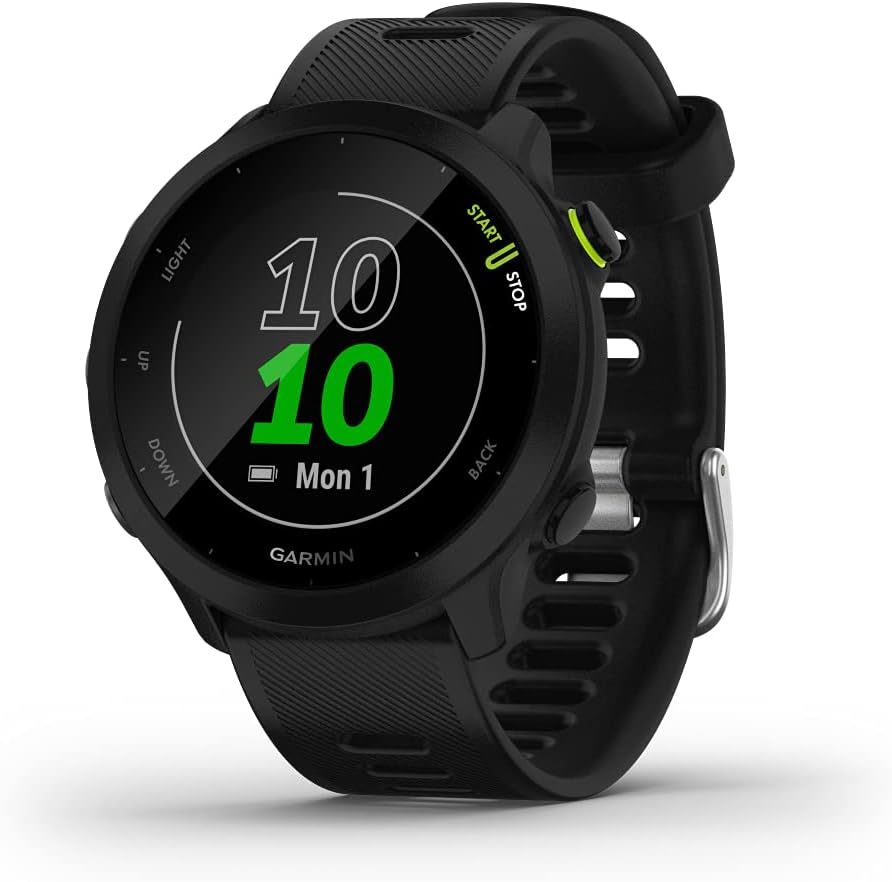
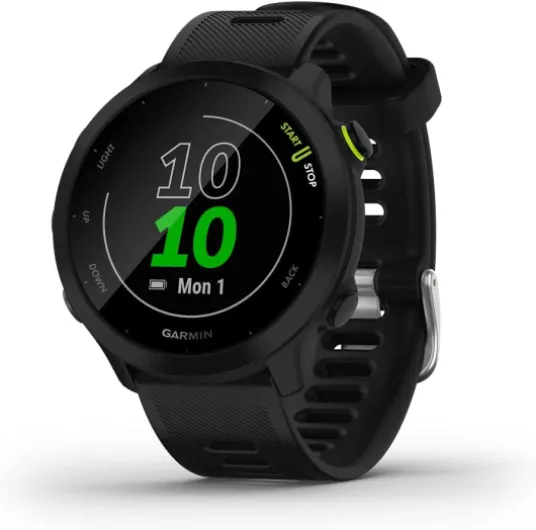
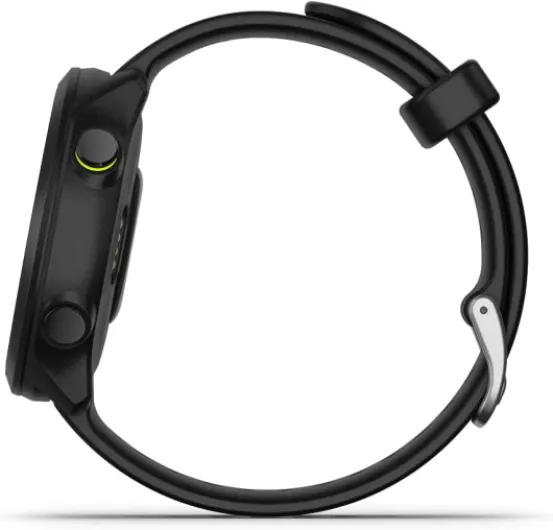
The design is pretty basic: small round case, plastic body, silicone strap, and a non-touch color screen with five physical buttons (three on the left, two on the right). If you’re used to glossy smartwatches with big bright screens, this will look a bit plain and maybe even cheap. Personally, I don’t really care what my running watch looks like as long as it’s light and easy to use while I’m sweaty and half-dead at the end of a tempo run, and on that front it works fine.
The screen is 1.04 inches with a 208 x 208 resolution. It’s not high-res and it doesn’t try to be. It’s a transflective display, so the more light you have outside, the easier it is to read. In full sun, it’s actually easier to see than an OLED smartwatch. Indoors or at night, you just tap a button to turn on the backlight. It’s not pretty, but you can clearly read pace, distance, and heart rate during a run, and that’s what matters. I never struggled to see my numbers mid-interval.
One thing I really liked is the button-based navigation. No accidental touches when you wipe sweat off your face or adjust your sleeve. Start/stop and lap buttons are clear and easy to press even while moving. It reminds me of older Forerunners: not sexy, but reliable. It’s also small and light enough (around 37 g) that it doesn’t feel like a brick on your wrist, which is a big plus for smaller wrists or people who hate bulky watches.
On the downside, the watch definitely looks more like a sports tool than something you’d wear with a dress shirt. If you want a watch that doubles as a stylish everyday accessory, this one is kind of “meh” visually. The bezels are chunky, and the overall impression is “plastic sport watch”. For me, that’s fine. For someone wanting a fashion piece, it’s not going to do it.
Battery life: actually lives up to the promise
Battery life is one of the things that impressed me the most. Garmin claims up to 2 weeks in smartwatch mode and up to 20 hours in GPS mode. Obviously that depends on how you use it, but in real life it’s definitely above average. With about 4–5 runs per week (30–60 minutes each using GPS), plus 24/7 heart-rate and notifications on, I was easily getting around 7–10 days before needing to charge. If you only use it for time and occasional runs, stretching close to the 2-week mark seems realistic.
On long runs, the battery drain is reasonable. A 1-hour GPS run took around 4–5% of the battery in my case, which lines up more or less with the 20-hour claim. You can definitely take it through a half-marathon or marathon without worrying about it dying mid-race, as long as you don’t start at 5%. For people training for distance events, that’s reassuring. You don’t feel forced to charge it every night like some smartwatches.
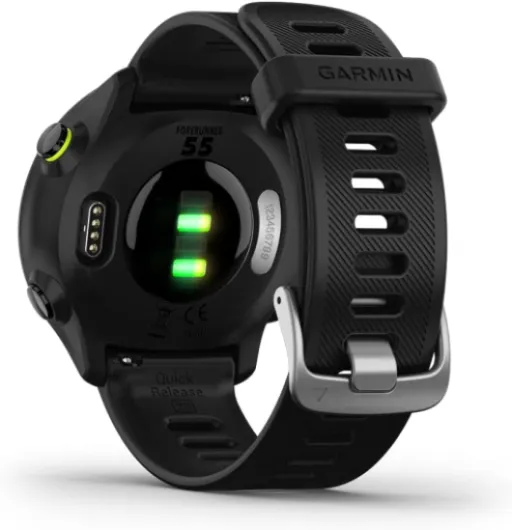
Now, the downside: the charging cable is proprietary and a bit finicky. It’s the usual Garmin clip-style connector, and if the pins or the port get dirty (sweat, dust, whatever), the connection can be touchy. I had one situation where I thought it was charging and it wasn’t making proper contact. You kind of have to double-check that the charging icon is on. Also, because it uses a specific cable, you can’t just borrow any random USB-C from a friend. I ended up buying a second cable just to keep one in my bag.
Overall, though, in terms of raw battery life, the Forerunner 55 is very practical. You charge it once a week or so, forget about it, and it just keeps working. If you’re coming from something like an Apple Watch that needs near-daily charging with GPS use, this is a nice change of pace.
Light and forgettable on the wrist (in a good way)
Comfort-wise, the Forerunner 55 is one of its strong points. It’s very light, and the silicone strap is soft enough that it doesn’t dig into the skin, even on longer runs. I wore it pretty much all day for several days in a row, including at night for sleep tracking, and it never felt heavy or annoying. If you’ve used chunkier watches like some Fenix models or older GPS watches, this feels like a relief by comparison.
During runs, the watch stays in place without needing to crank the strap super tight. That’s important for heart-rate accuracy but also just basic comfort. I tightened it one extra notch for workouts and it still didn’t feel restrictive. No rubbing, no hot spots, no weird edges. The underside is smooth, and the optical sensor bump is not too aggressive. I never got any skin irritation, even with sweat and sunscreen involved.
One thing to note: for heart-rate readings to work decently, you can’t wear it too loose. If it slides up and down your wrist, the readings get choppy or drop out. I did notice that if I wore it a bit too tight, sometimes the sensor would just stop picking up for a bit, leaving gaps in the HR graph. It’s not terrible, but don’t expect perfect chest-strap-level data from a cheap optical sensor. Still, for easy runs and general tracking, it’s comfortable enough that you forget it’s there, which is what I want.
For sleep, again, it’s light enough that it doesn’t bother you, but the sleep tracking itself isn’t very reliable. It tends to think I’m asleep when I’m just lying still reading in bed. So comfort is good, but don’t rely too much on the watch’s idea of how many hours you slept. Overall, if your priority is a watch you can wear all day and on long runs without feeling weighed down, this one does the job well.
Build quality and long-term wear: tougher than it looks
Even though the Forerunner 55 is all plastic and looks a bit basic, it actually holds up pretty well to everyday abuse. The case and strap feel light but not flimsy. I’ve banged it against door frames, used it in the rain, sweated all over it, and it just keeps going. No weird creaks, no looseness in the buttons, and the strap holes haven’t stretched out so far.
The screen is not sapphire or anything fancy, but it doesn’t scratch easily in normal use. After regular daily wear and several outdoor runs, I only picked up a couple of tiny marks that you can only see if you really look closely under certain light. One Amazon reviewer mentioned a small chip after long-term wear, which sounds right for this kind of watch: it’s not indestructible, but you have to hit it pretty hard against something sharp. I tried screen protectors, but like that user said, most of them don’t fit perfectly and tend to peel at the edges and collect dirt, so I eventually just went without.
Water resistance is enough for pool swimming and showers, though I usually took it off for showers out of habit. No issues with sweat or rain at all. The buttons still click fine after repeated use, and they haven’t gotten mushy or stuck. For a watch at this price level, it feels like something you can genuinely wear every day without babying it, which is kind of the point for a training tool.
The only part that feels a bit vulnerable long-term is again the charging port. If you’re not careful and keep connecting the cable at an angle or with dirt in the pins, I could see that becoming annoying over time. But as long as you rinse off sweat occasionally and don’t force the connector, it should be okay. In short: durability is good for a plastic sports watch, just don’t expect tank-level toughness like Garmin’s higher-end outdoor models.
GPS, heart rate, and training features: solid, with a few quirks
From a performance standpoint, the Forerunner 55 is pretty solid for basic running. GPS lock is quick most of the time; usually within a few seconds once it has seen the satellites in your area before. On my usual routes, the distance readings were very consistent from run to run, usually within about 0.02–0.05 miles of what I get from other devices and known distances. Corners and tree-covered sections are handled reasonably well – it doesn’t draw crazy zigzags like cheap GPS watches sometimes do.
Heart-rate performance is mixed, which is normal for a wrist sensor. For steady easy runs, the readings looked believable and lined up with how I felt. For intervals or sudden pace changes, the HR graph often lagged behind or spiked weirdly. Also, if the watch wasn’t sitting just right on the wrist, I’d get some flat spots where it clearly lost the signal. So it’s fine for general training zones and all-day tracking, but if you’re really picky about heart-rate data, you’ll want a chest strap paired with a higher-end watch.
The daily suggested workouts are actually more useful than I expected. Based on your recent runs and recovery, it suggests easy runs, intervals, or tempo sessions with clear targets for time and pace. It’s not some deep coaching system, but for a beginner or someone who doesn’t want to think too hard about structuring their week, it gives decent guidance. The race time predictions are, like most watches, optimistic. They’re fun to look at but I wouldn’t take them as gospel.
PacePro is there, but on this model it’s a bit limited (no full on-device course support). Still, you can set up simple pacing strategies, which helps if you tend to go out too hard. Overall, performance is in line with the price: good enough for most runners, with some compromises in heart-rate precision and advanced metrics. If you’re running marathons seriously or obsessed with VO2 max and training load, you’ll probably want something higher up the Garmin range.
What the Forerunner 55 actually offers (and what it doesn’t)
On paper, the Garmin Forerunner 55 is marketed as an entry-level GPS running watch. In practice, it sits somewhere between basic and mid-range. You get built-in GPS, wrist heart-rate tracking, daily suggested workouts, basic race predictions, PacePro pacing guidance, and profiles for running, cycling, pool swimming, HIIT, Pilates, breathwork, and a few others. There’s also standard smartwatch stuff: notifications, phone finder, step counting, sleep tracking, and Garmin’s “body battery” style stats through the app.
What you do not get is also important: no music storage, no contactless payments, no touchscreen, no fancy maps, and no crazy advanced running dynamics like some of the more expensive Garmin models. It’s very much focused on people who want to track distance, pace, and heart rate accurately, maybe follow some training suggestions, and that’s about it. So if you like running with music from your wrist or tapping your watch to pay for coffee after a run, this is not the watch for you.
Setup is fairly simple: you install Garmin Connect on your phone, pair the watch via Bluetooth, and from there you can sync your runs, change watch faces, and grab a few extra widgets or data fields via the Connect IQ store. It’s not as slick as Apple’s ecosystem, but it works. Syncing my runs to Strava through Garmin Connect was automatic and fast once everything was linked. No weird manual export/import nonsense.
So overall, the presentation is clear: this is a running-first, budget-friendly Garmin. It’s aimed at beginners and intermediate runners who want reliable tracking and some light coaching features, not a smartwatch that tries to replace your phone. As long as you go in with that expectation, the feature set makes sense and feels fairly coherent.
Pros
- Light, comfortable design that’s easy to wear all day and on long runs
- Very good battery life (around a week+ with regular GPS use)
- Accurate-enough GPS and simple, useful running features like daily suggested workouts
Cons
- No music storage or contactless payments
- Sleep and some wellness metrics are not very reliable
- Proprietary charger can be finicky and requires a specific cable
Conclusion
Editor's rating
The Garmin Forerunner 55 is a straightforward, running-focused watch that does what most runners actually need: track distance, pace, and heart rate with decent accuracy, last a long time on a charge, and stay out of the way while you’re training. It’s light, comfortable, and the button-only interface is practical, especially when you’re sweaty or wearing gloves. Daily suggested workouts and simple race tools add a bit of structure without turning it into a complicated coaching platform.
On the downside, it’s not a fancy smartwatch. No music, no payments, no high-end materials, and some of the wellness features (sleep tracking, body battery style metrics) are kind of hit-or-miss. Heart-rate tracking is fine for most people but not perfect, and the proprietary charger is a bit annoying. If you’re a data-obsessed runner or you want one watch that can do hardcore training plus full smartwatch duties, you’ll probably outgrow this and want a higher-end Garmin or a different ecosystem.
Overall, I’d recommend the Forerunner 55 to beginner and intermediate runners who want a reliable training partner without spending a fortune or dealing with feature overload. If you mainly care about running and battery life, it’s a good, honest choice. If you want advanced metrics, music, or a more stylish everyday watch, skip this one and look higher up the range.